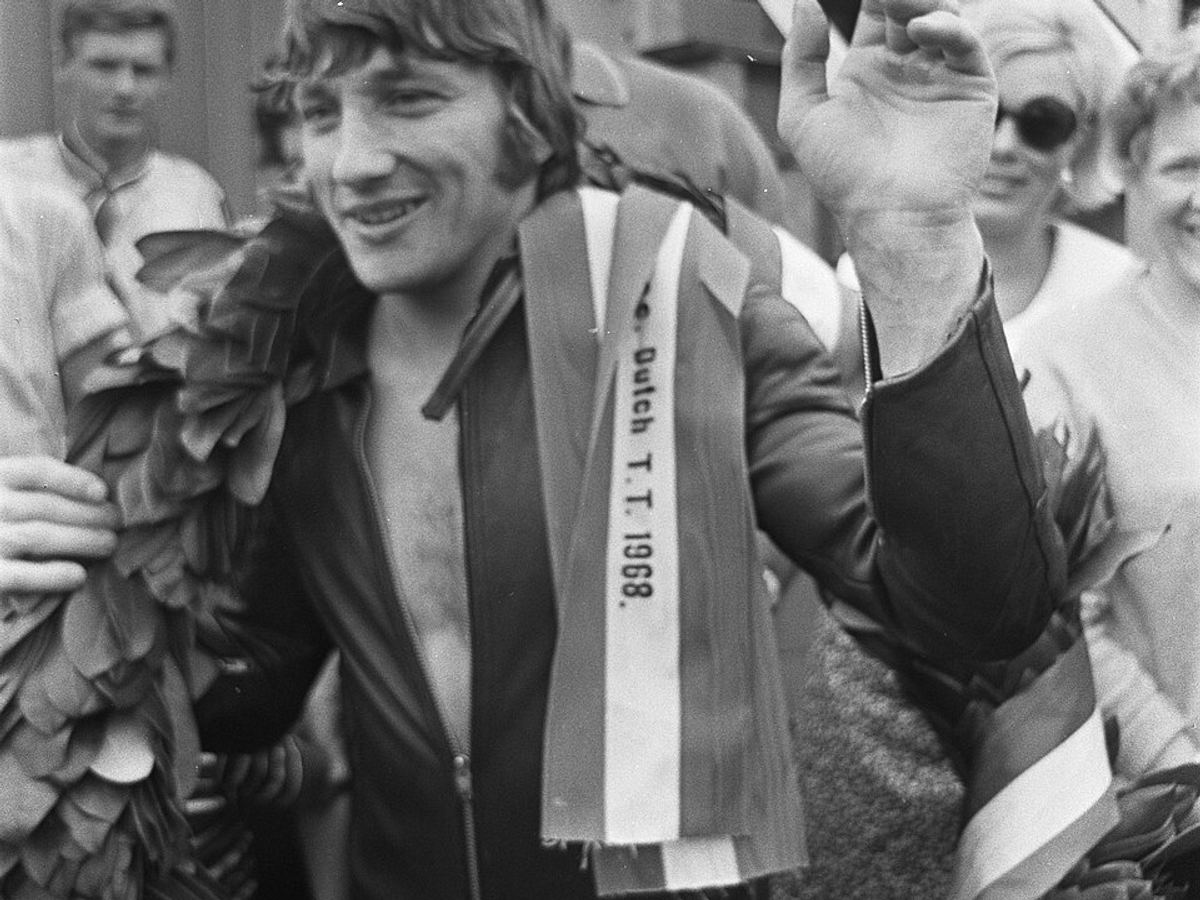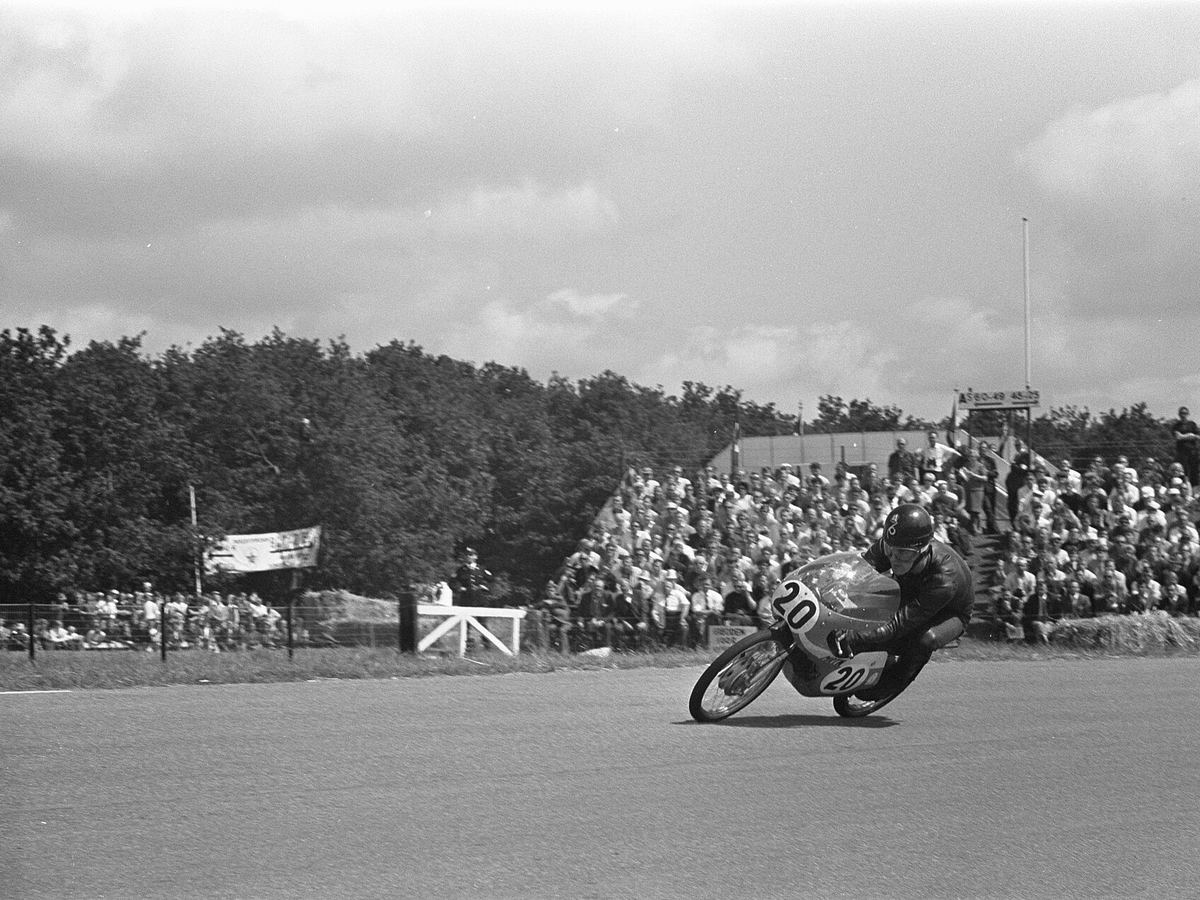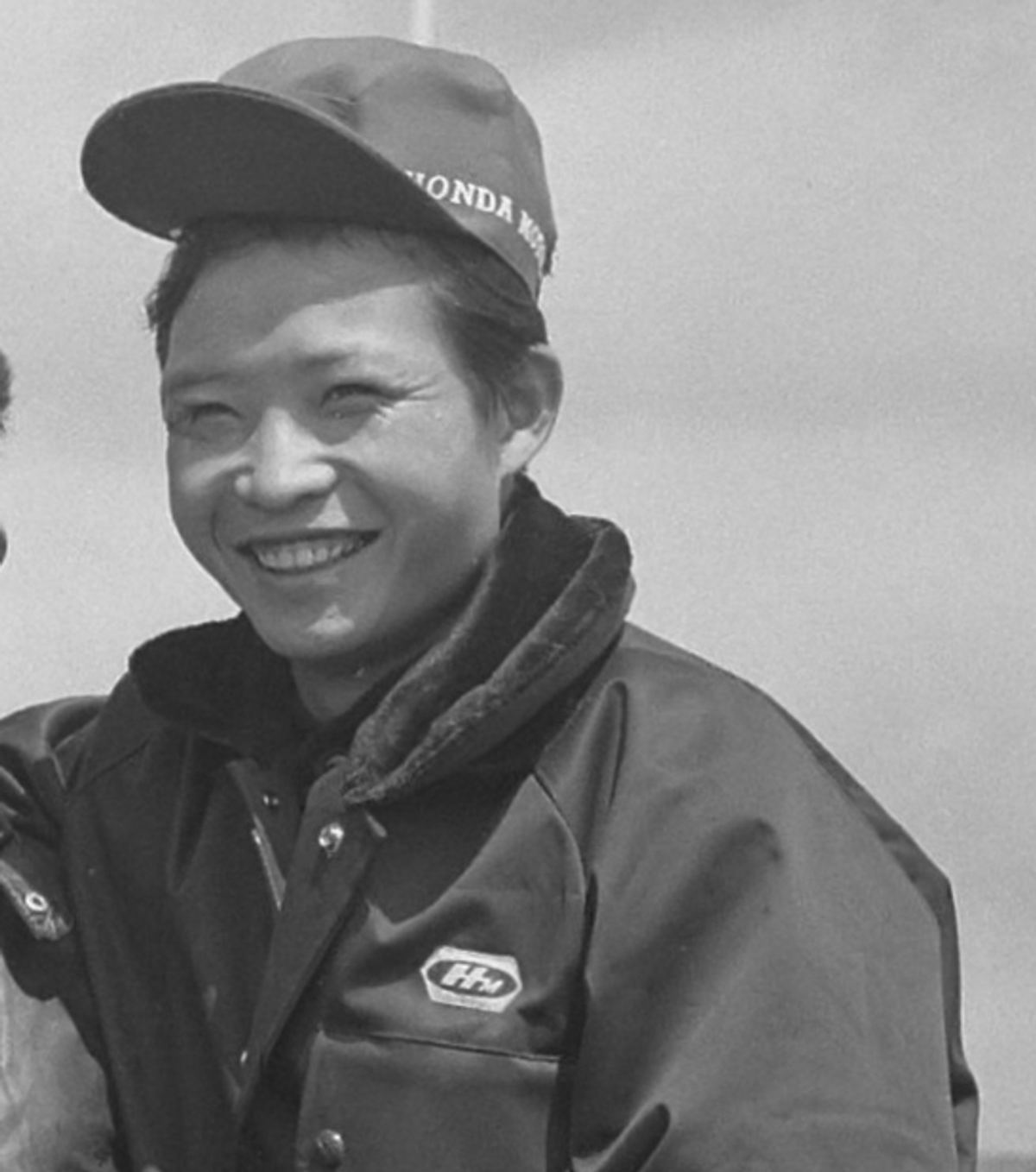
Kunimitsu Takahashi at Assen in 1963, two years after his Hockenheim win.. Photo: Anefo / Nationaal Archief, CC0
On the last lap of the 250cc West German Grand Prix at Hockenheim, on 14 May 1961, Kunimitsu Takahashi sat in Jim Redman's slipstream. Both were riding four-cylinder Hondas. At the final corner Takahashi moved to the inside, came past his team-mate and won by a small margin.
He was 21, riding number 100, in only his fourth Grand Prix. No Japanese rider had ever won a world championship race. The Japanese magazine Young Machine goes further: it was the first win by a Japanese competitor in any motorsport world championship, on two wheels or four. According to Honda's own history of the day, the team manager, Kiyoshi Kawashima, could not hold back his tears as he watched Takahashi on the podium and the Japanese flag go up over Hockenheim.
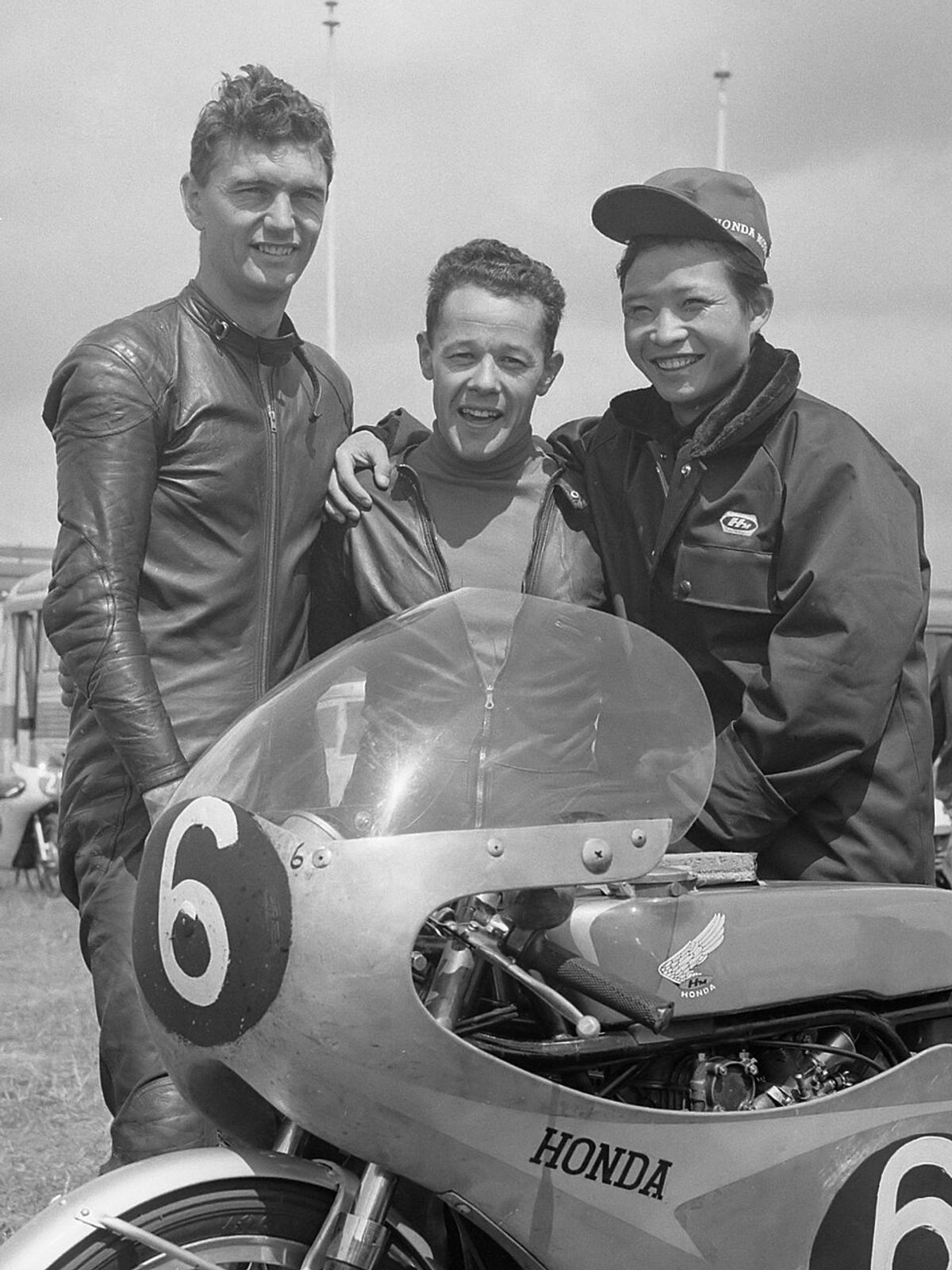
It was Honda's first win in the 250cc class, and only its second Grand Prix win of any kind. Takahashi had beaten his own team-mate, the man on pole, on the same model of machine.
How Kunimitsu Takahashi got to Hockenheim
Honda's road to that podium had started with a promise. In 1954 Soichiro Honda wrote that he had decided to compete in the Isle of Man TT, a goal he admitted was difficult but necessary "to prove the viability of Japanese industrial technology", according to a translation published by Honda.
The company kept it in June 1959, at its first world championship race, the Ultra-Lightweight TT. Its riders had learned the 37.75-mile Mountain Course from films and guides, only to find on arrival that their race would run on the shorter Clypse course. On machines first prepared for Japan's dirt roads, they still took the team prize. Naomi Taniguchi finished sixth, the best of Honda's four riders.
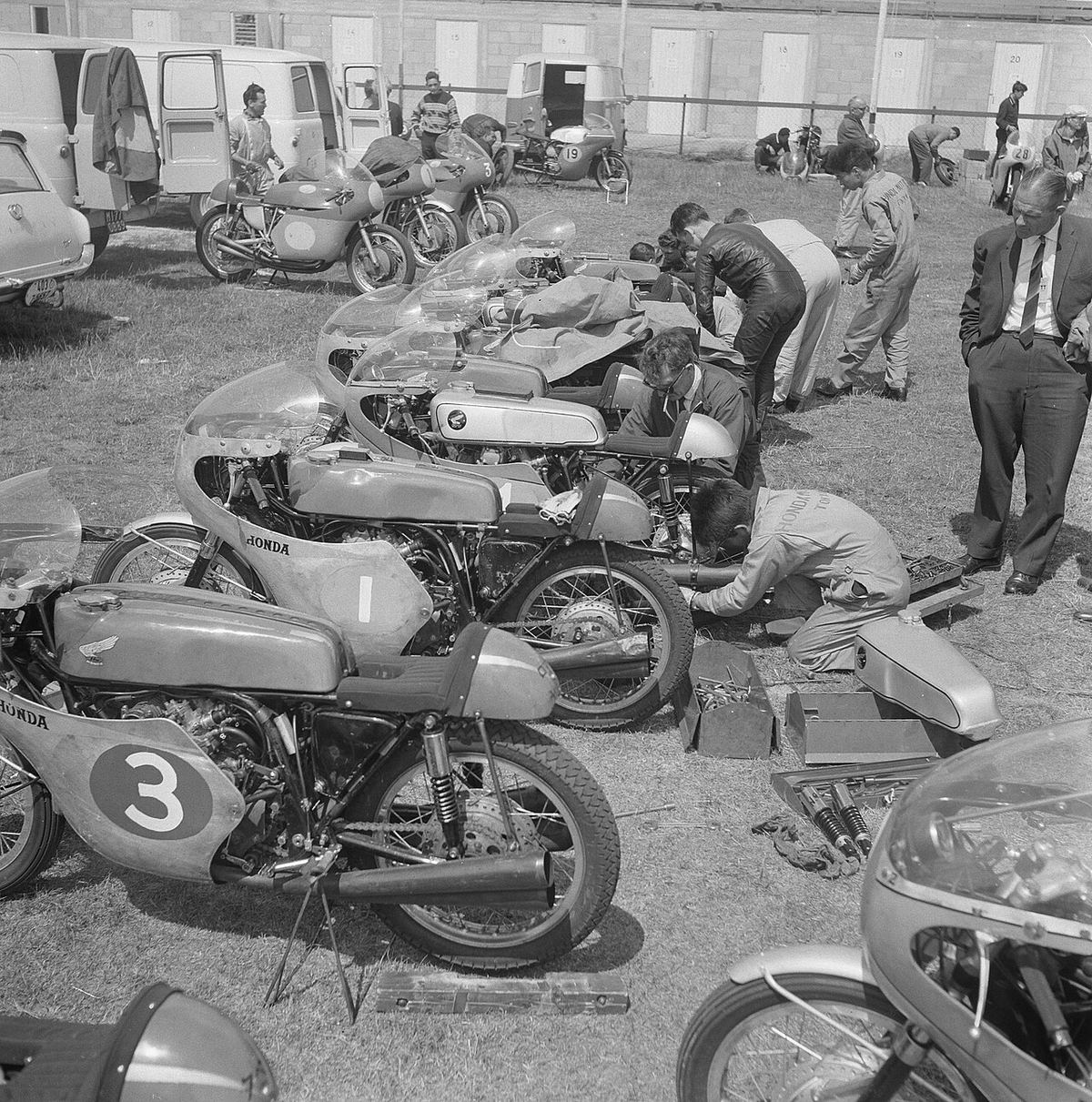
Kunimitsu Takahashi, born in Tokyo in 1940, joined Honda as a works rider in 1960 after impressing as a teenager in Japan's domestic racing. He made his Grand Prix debut that year, in a European paddock where, as he later told Motor Sport, the name Honda meant nothing.
By 1961 Honda had a machine to change that. The RC162 was an air-cooled four-stroke inline-four of 249cc, with twin overhead camshafts and four valves per cylinder. Honda's Collection Hall rates it at more than 45 PS at 14,000 rpm, with six gears and a top speed above 220 km/h (137 mph). Three weeks before Hockenheim, Tom Phillis had given Honda its first Grand Prix win, in the 125cc race in Spain.
The last lap at Hockenheim
Hockenheim in 1961 was not the circuit modern fans know. The original triangle had been reshaped into a long oval in 1938, and the German motorcycle Grand Prix first came there in 1957, according to the circuit's own history. The stadium section, the Motodrom, did not open until 1966. Honda describes the earlier track as a simple egg-shaped loop with no infield and very high top speeds, the kind of circuit where engine performance shows up directly in lap times. The 250cc race ran over 20 laps.
Redman took pole position and Takahashi started alongside him. Behind them, according to Honda's account, were three of the best riders in the class on three very different machines: Ernst Degner on the two-stroke MZ, Tarquinio Provini on the single-cylinder Morini and Gary Hocking on the MV Agusta, who would end the year as 350cc and 500cc world champion. Between them, the front of the grid covered almost every way of building a 250cc racer at the time.
The two Hondas led from the start. Around lap 10 Hocking charged to the front, but the MV's engine failed and he retired on lap 12. Provini slowly dropped back, and Degner could only watch the fight ahead of him.
That left Redman and Takahashi. Slipstreaming, tucking in close behind another rider to cut through less air, lets the following bike save effort and gain speed on the straights, and on a circuit made mostly of straights it was the decisive weapon. Takahashi used it on the final lap and took the inside line into the last corner. Honda gives no time gap, only that he passed Redman by a small margin.
Takahashi set a new 250cc race record. His race time was also quicker than the winner's in the 350cc race over the same 20 laps. Degner won the 125cc race that day.
After the flag
The welcome came later. Takahashi told Motor Sport that his return to Tokyo, and the crowd at Haneda airport, was "my most memorable moment."
He added a second win in the 125cc Ulster Grand Prix in August and finished fourth in the 250cc championship with 29 points. The RC162 won ten races that season, including the first five places in the 250cc Isle of Man TT. The title went to Mike Hailwood on another Honda, and the company won both the 125cc and 250cc world championships in only its third season of Grand Prix racing.
In 1962 Takahashi won the first two 125cc rounds, in Spain and France, then crashed at the Isle of Man TT and suffered life-threatening injuries. He raced motorcycles until 1964, but the crash turned him towards cars. Motor Sport points out that 14 riders died at Grand Prix meetings during his years in Europe, and counts him among the lucky ones.
From 1965 he became one of Japan's great racing drivers. He won four All-Japan Sports Prototype titles, started the 1977 Japanese Grand Prix in Formula One, won the GT2 class at Le Mans in 1995 in a Honda NSX and kept racing until 1999, when he was 59. His Team Kunimitsu won Super GT titles in 2018 and 2020. He died on 16 March 2022, aged 82.
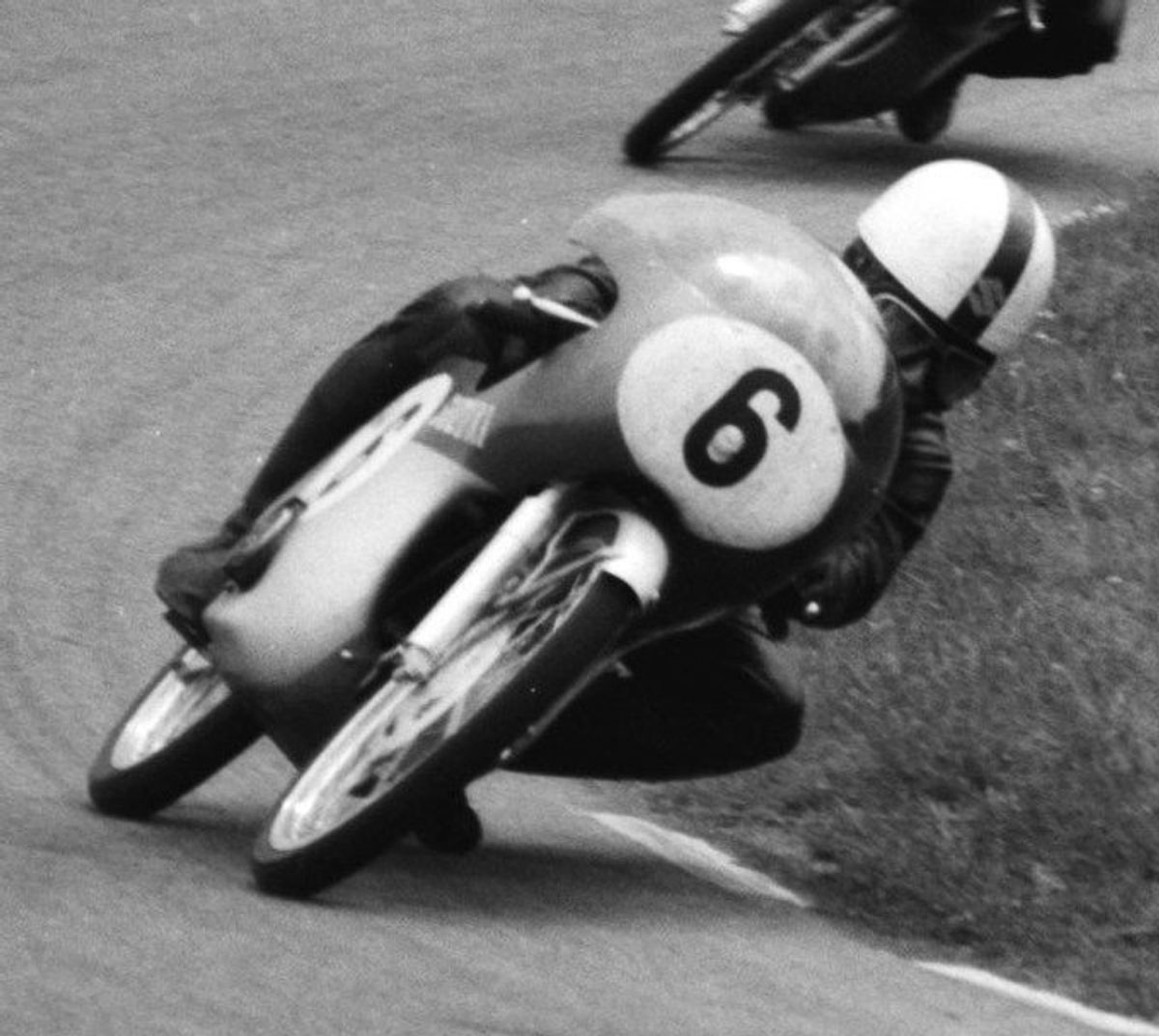
Other Japanese riders followed him through the door. In 1963 Mitsuo Itoh won the 50cc Isle of Man TT for Suzuki, and MCN describes him as still Japan's only TT winner. Itoh later trained young riders for Suzuki, among them Kevin Schwantz.
Why it still matters
Two decades later Takazumi Katayama won the 1982 Swedish Grand Prix on a Honda NS500, the first Japanese winner in the premier class [⚠ VERIFY: first Japanese 500cc winner, against MotoGP.com]. The line runs back to Hockenheim.
Takahashi's win marked the moment Japanese racing stopped being a curiosity in Europe. A factory nobody knew in 1959 had a home-grown rider on the top step two years later, beating its own pole-sitter with the oldest trick on a fast circuit. Within a decade the Japanese makers were the ones everybody else had to beat.
It also says something about Honda's early teams. The win went to a 21-year-old in his fourth Grand Prix, and the man in tears beside the podium was the team manager who would later lead the company.
Soichiro Honda swore in 1954 to prove Japanese engineering in Europe. Seven years later a Japanese rider proved it on a Japanese machine, from the inside of the last corner.
Quick answers
Who was the first Japanese rider to win a motorcycle Grand Prix?
Kunimitsu Takahashi was the first Japanese rider to win a motorcycle Grand Prix. He won the 250cc West German Grand Prix at Hockenheim on 14 May 1961, aged 21, on a four-cylinder Honda RC162, passing team-mate Jim Redman at the last corner of the final lap.
What motorcycle did Kunimitsu Takahashi win on in 1961?
Takahashi won the 1961 West German Grand Prix on a Honda RC162, a 249cc air-cooled four-stroke inline-four with twin overhead camshafts and four valves per cylinder. Honda rates it at more than 45 PS at 14,000 rpm, with six gears and a top speed above 220 km/h.
Why did Kunimitsu Takahashi stop racing motorcycles?
Kunimitsu Takahashi turned to cars after a life-threatening crash at the 1962 Isle of Man TT. He raced motorcycles until 1964, then from 1965 built a long car career that included four All-Japan Sports Prototype titles, a Formula One start in 1977 and a Le Mans class win in 1995.
Who is the only Japanese rider to win an Isle of Man TT?
Mitsuo Itoh is the only Japanese rider to win an Isle of Man TT. He won the 50cc race in 1963 for Suzuki, two years after Kunimitsu Takahashi became the first Japanese Grand Prix winner. Itoh later trained young Suzuki riders, among them Kevin Schwantz.