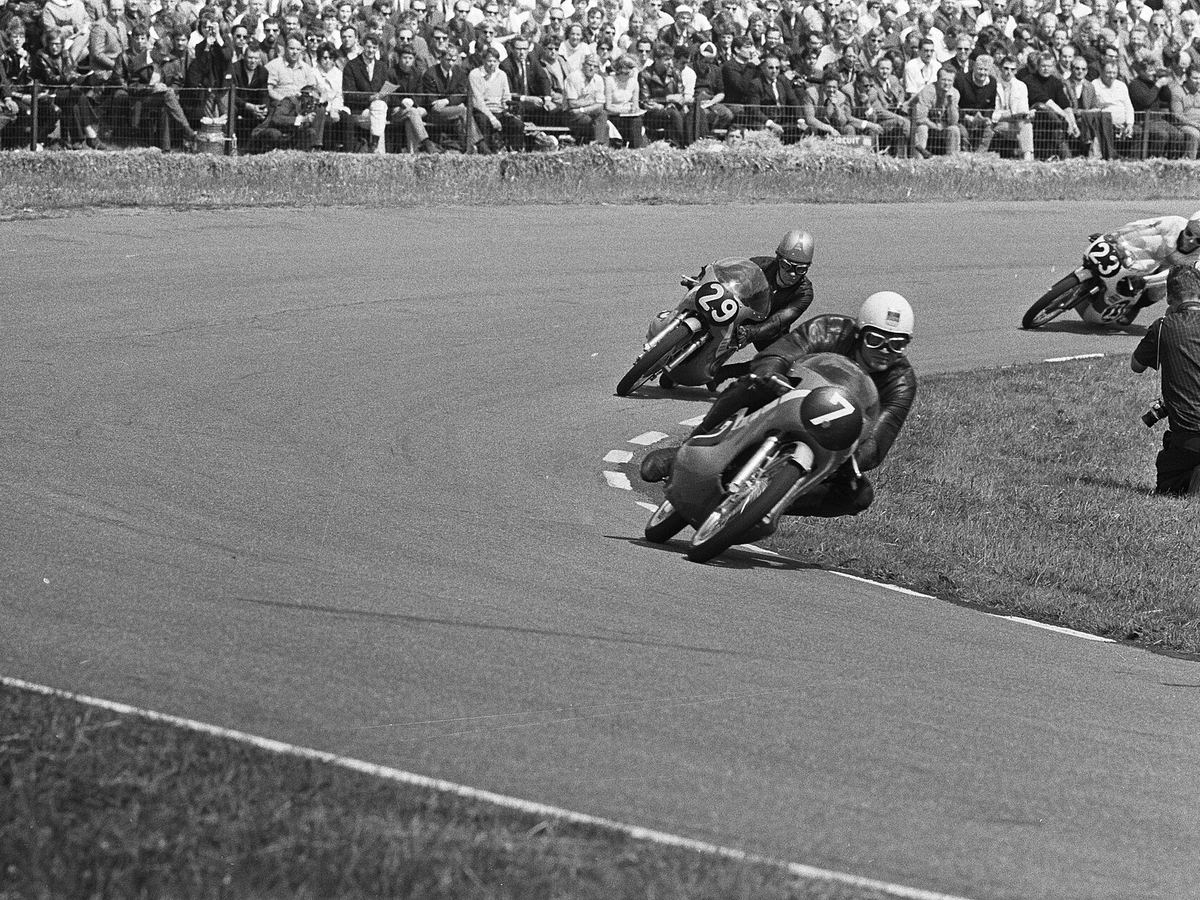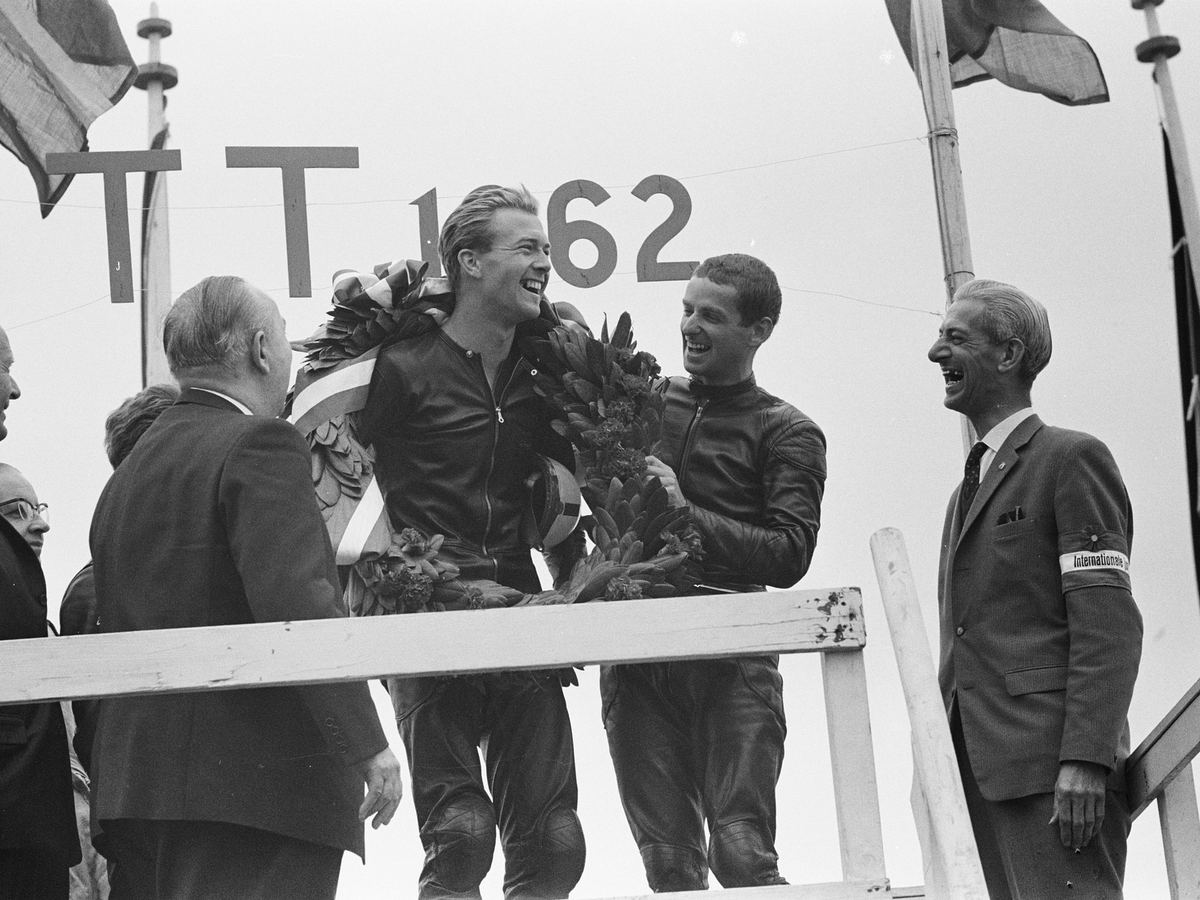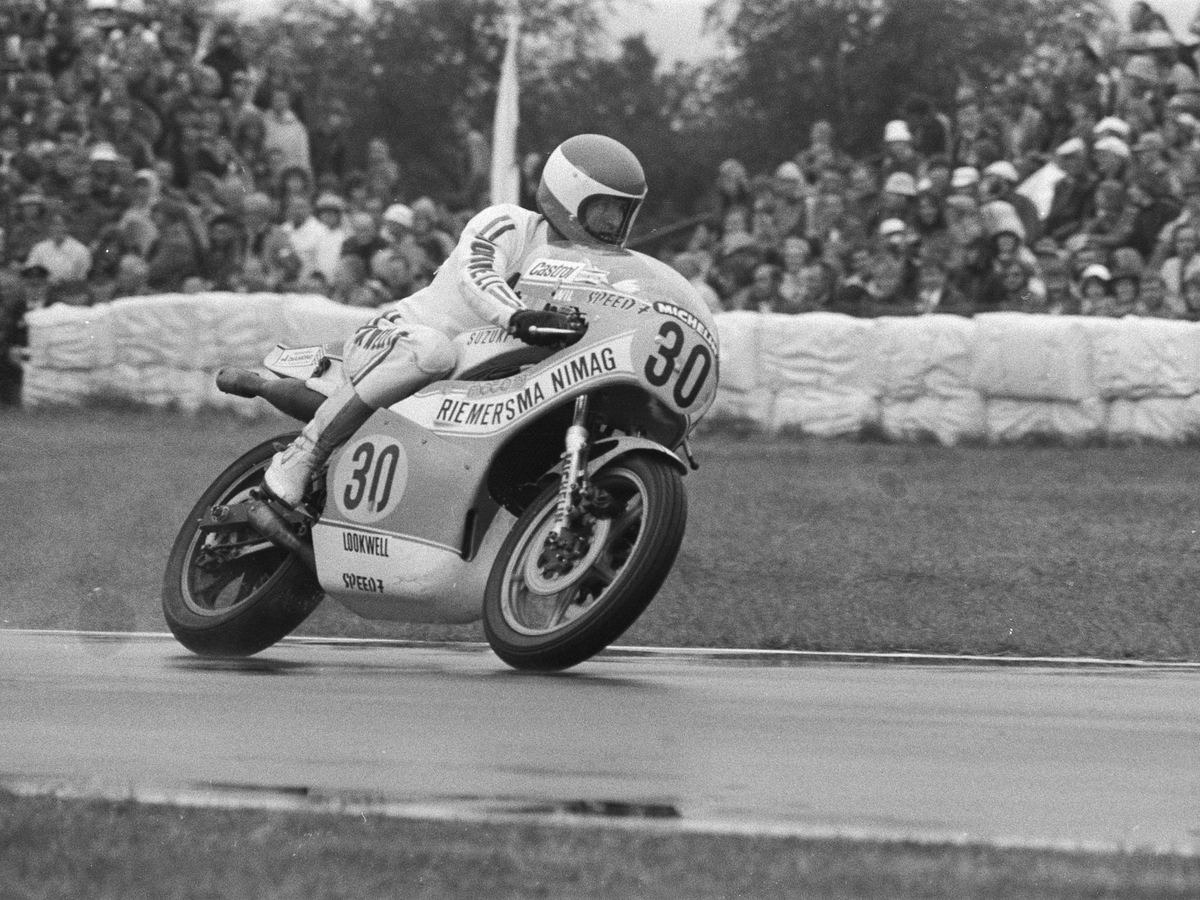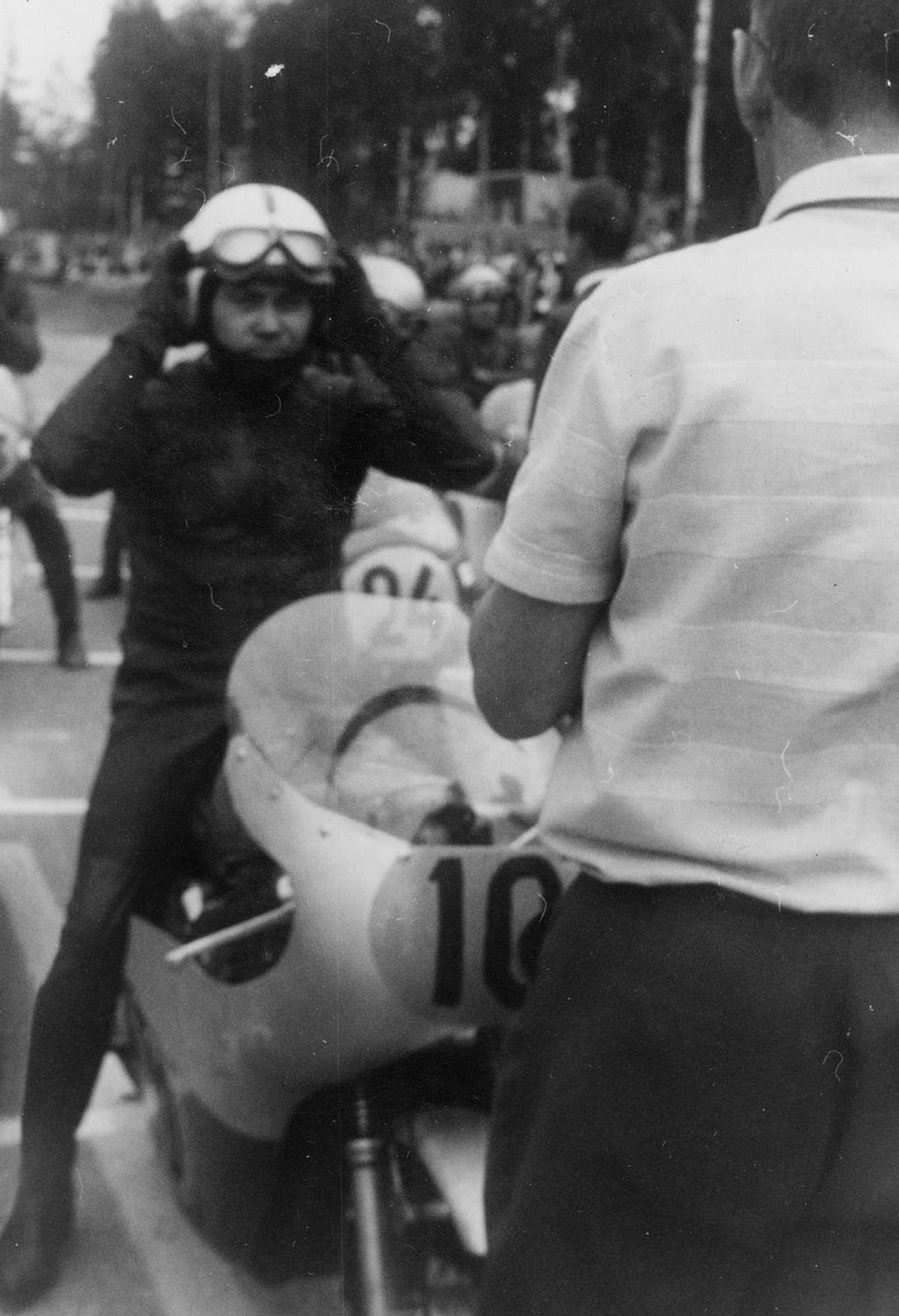
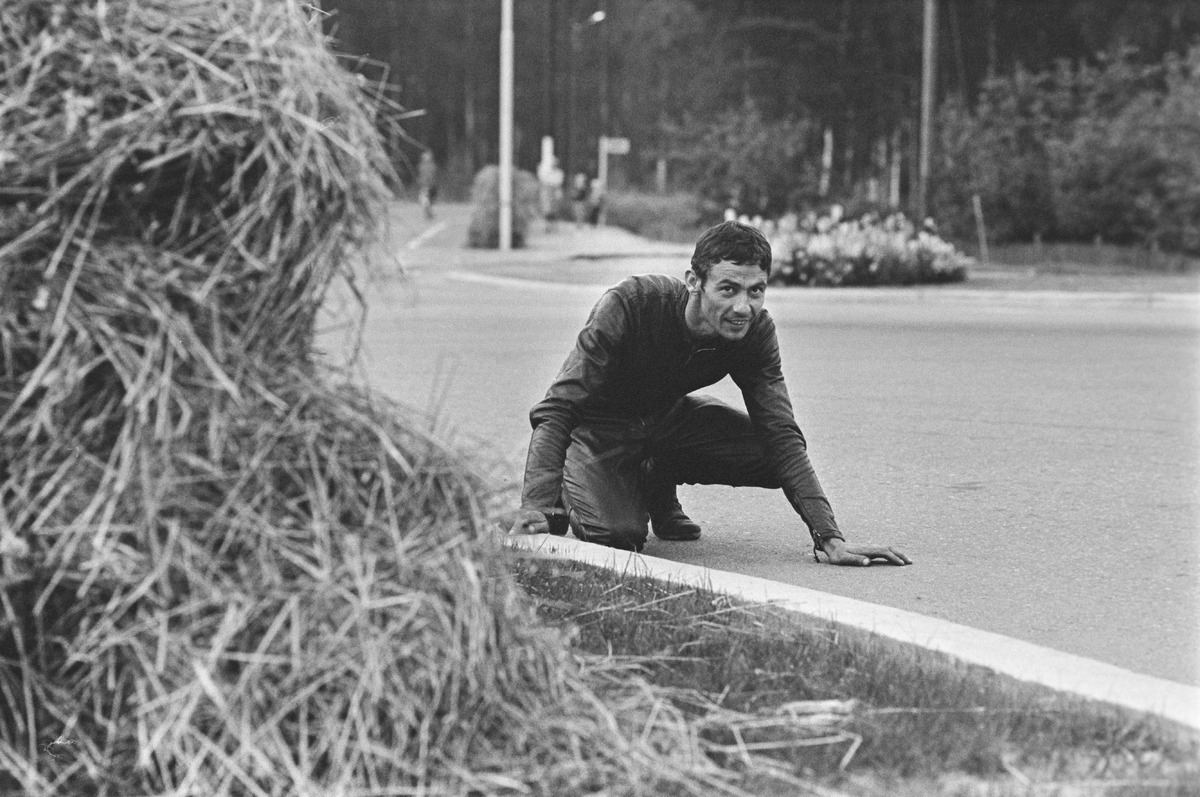
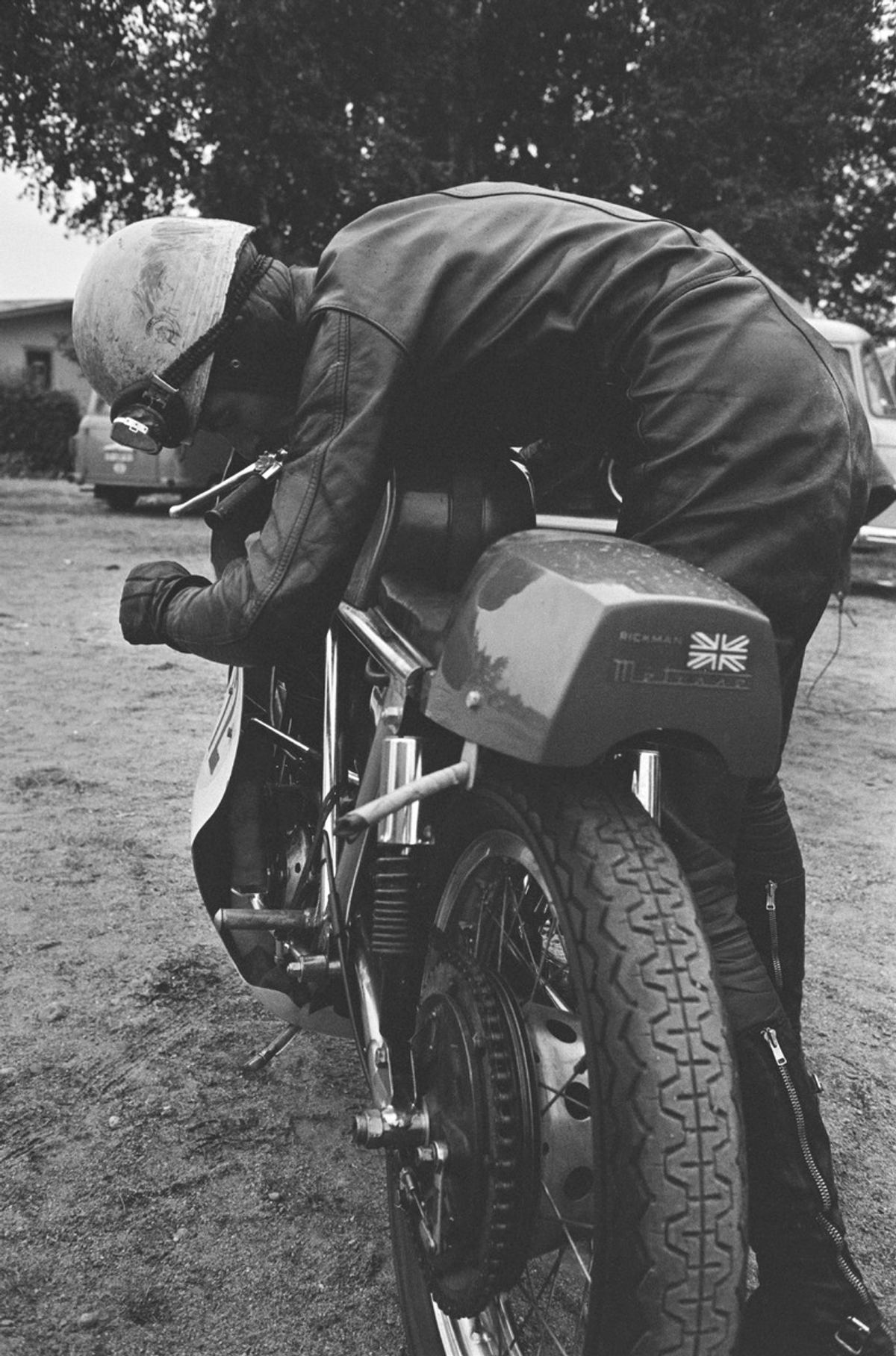
A rider heads out to race at the Imatranajo, Imatra, 1968.. Photo: Etelä-Karjalan museo, CC BY 4.0
Lewis Young had a corner to read. At the Imatranajo on 7 August 1966, the press photographer Helge Heinonen caught the British rider measuring the camber of a bend, the angle at which a road tilts across a corner, before he trusted a 500cc machine to it. On the Imatra circuit that was homework worth doing.
Imatra was not a racetrack in any ordinary sense. It was a loop of closed public roads on the east bank of the Vuoksi river in eastern Finland, a short drive from the Soviet border, lined with pine woods, lampposts and telephone poles. Somewhere on the lap the road crossed a freight railway, and riders took it at racing speed.
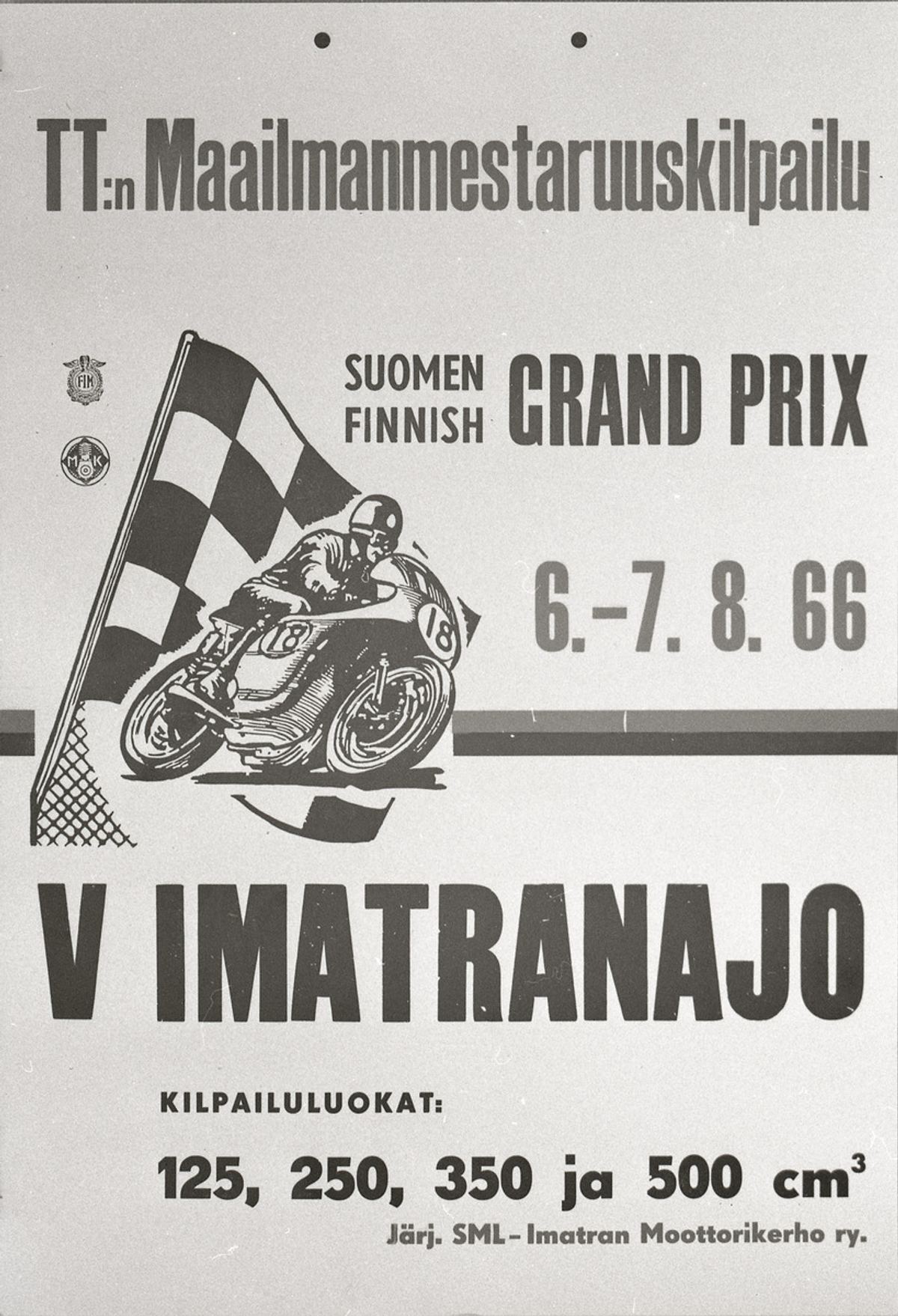
Young knew the place better than most visitors. In 1964 he had been the first foreign rider to enter the race. By 1966 Imatra was a round of the world championship, and that summer's poster called it the fifth Imatranajo.
What made the Imatra circuit different
The Imatra circuit hosted the Finnish motorcycle Grand Prix for 19 seasons, from 1964 to 1982, on roads people used every other week of the year. Finland's first world championship rounds had been held at Tampere in 1962 and 1963.
Crash.net notes that the course ran within sight of the Soviet border, which made Imatra the championship's frontier town in more than one sense. The town already had a racing habit: its first TT, for motorcycles and midget cars, ran past the Imatrankoski sports field in 1953, and the first international Imatranajo followed in 1962, once the course was paved. The Finnish name, Imatranajo, means simply the Imatra race, and it is still the name the organisers use.
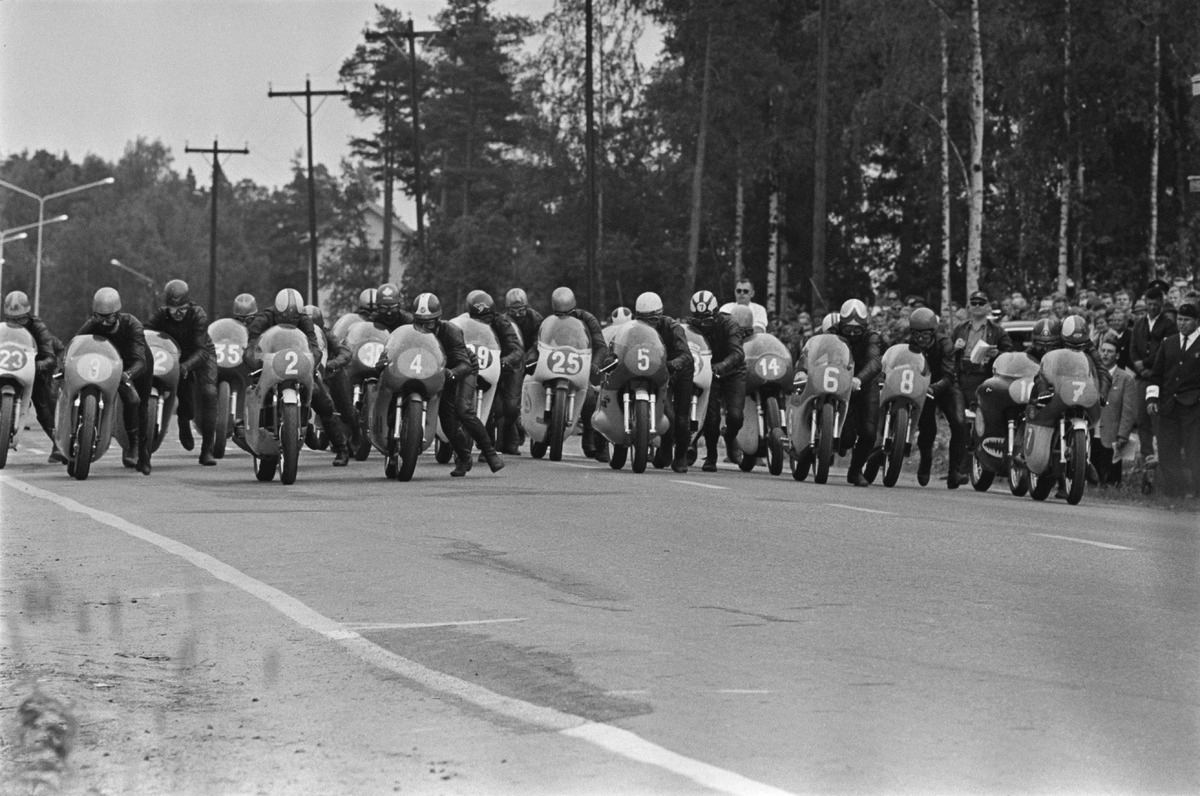
The original lap measured 6.030 km with seven corners, according to Crash.net, which puts top speeds at almost 300 km/h (186 mph). There was no run-off in the modern sense. Riders raced between trees, kerbs and unguarded telephone poles, about 600 metres from the town centre, according to the organisers.
The calendar turned it into a festival. The Finnish Grand Prix ran in late July or early August, when the nights in eastern Finland are very short. Teams worked out of tents in the paddock, and fans camped in the woods around the course.
Agostini and the railway crossing, 1964 to 1978
Giacomo Agostini owned the Imatra circuit more completely than any other rider. He began winning there in 1965, and by the organisers' count he took 16 class victories at Imatra, still the record. Crash.net splits them into 10 in the 500cc class and six in the 350cc; Yamaha's own history of the event gives 17, with seven in the 350cc. The sources disagree by one race. Nobody disputes who comes first. Most of those wins came on MV Agusta machines, before Agostini moved to Yamaha for 1974.
The railway was the part of the lap everybody remembered. Yamaha describes riders jumping their machines across the freight-train crossing at full speed, on a world championship course. Riders still cross those tracks just after turn one today, according to Visordown.
On 27 July 1975 Agostini won the 500cc Finnish Grand Prix on a Yamaha and set the fastest lap, 2:15.5 [⚠ VERIFY: date and fastest lap against the MotoGP.com results archive], on his way to his 15th and final world title.
On 1 August 1976 Pat Hennen won the 500cc race on a Suzuki, the first American to win a 500cc Grand Prix [⚠ VERIFY: date against MotoGP.com]. In 1977 Johnny Cecotto set the fastest lap the long circuit ever saw: 2:05.9, or 174.4 km/h (108.4 mph), in the organisers' records.
The shorter circuit and the last Grand Prix, 1979 to 1982
In 1979 the Imatra circuit moved to a shorter loop of 4.950 km, further from the houses, and chicanes were added. A chicane is a tight left-right kink placed on a straight to force riders to brake. Speeds kept climbing anyway: the Imatra motor club's own history puts average speeds at around 150 km/h (93 mph) after the change.
Marco Lucchinelli set the lap record for the new layout in 1981, 1:54.0 at 156.3 km/h (97.1 mph), the season he won the 500cc world title on a Suzuki [⚠ VERIFY: that Lucchinelli won the 9 August 1981 500cc race, against MotoGP.com]. It was the last full Grand Prix at Imatra.
For 1982 the 500cc class refused to return. Crash.net reports that the objection was safety: racing between woodland and unguarded telephone poles. The Finnish round went ahead with the 350cc, 250cc and 125cc classes and the sidecars.
The 1982 sidecar race brought the worst day of the Grand Prix era. Jock Taylor, the Scottish 1980 sidecar world champion who had won at Imatra the year before, crashed and was hit by a second outfit. He was killed. A memorial stone to Taylor stands in Imatra today, on Puomikuja.
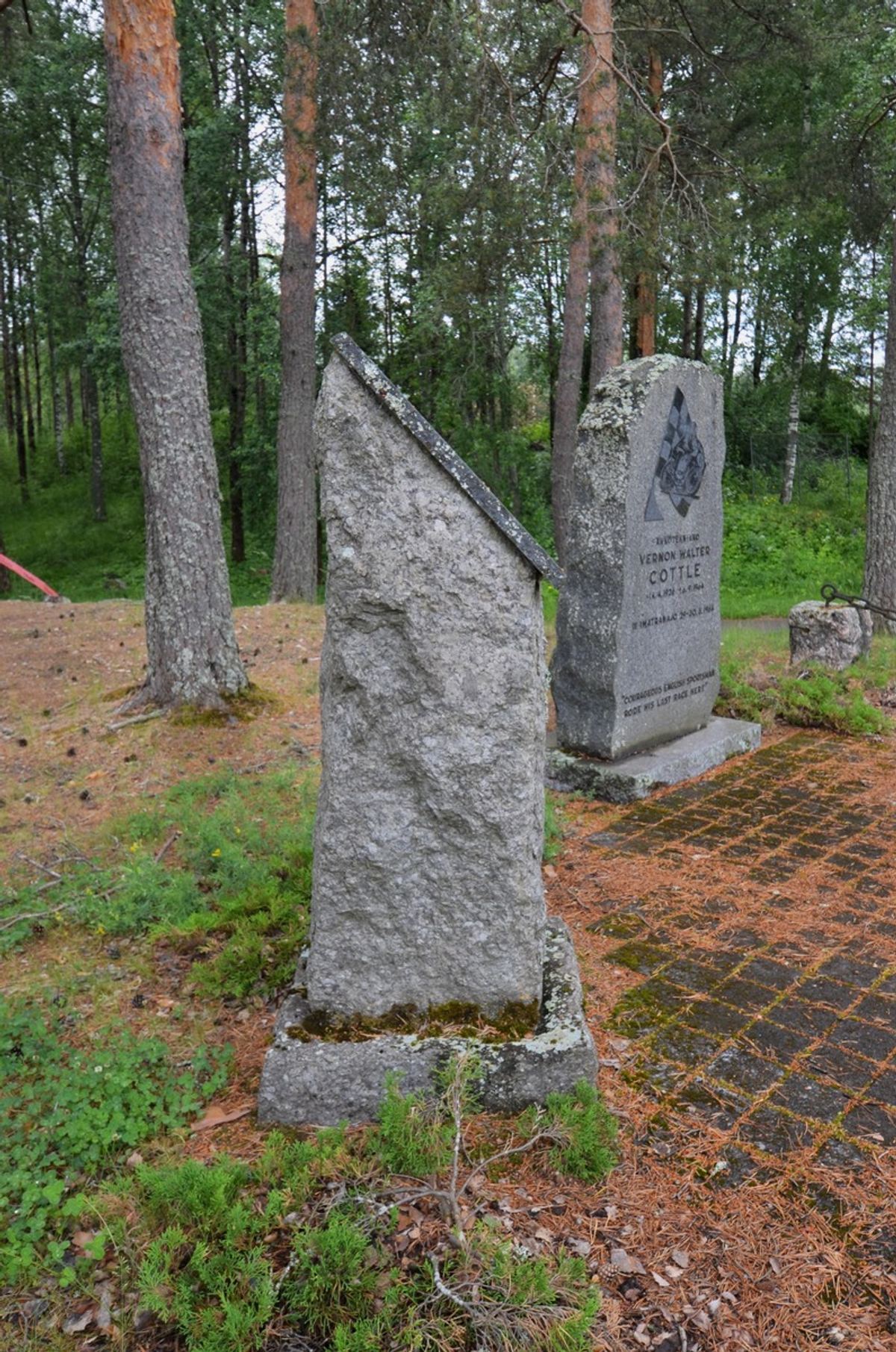
After the flag
The Imatra circuit lost its Grand Prix after 1982 but kept racing. European Championship rounds followed from 1983 to 1985, and the 1986 meeting, the 25th anniversary, carried both European Championship and Formula TT world championship status.
That 1986 meeting ended international racing in the town. During the 500cc race, the West German rider Detlef Vogt crashed at the intersection close to the railway tracks and his machine went into the crowd. A six-year-old boy was killed, and his elder brother and both parents were seriously injured.
The Imatranajo name survived in Finnish championship meetings from 1990 to 2015 and seven "Imatranajo of Memories" events between 1999 and 2014 [⚠ VERIFY: where the 1990–2015 national meetings were run]. Street racing returned in 2016 as a round of the International Road Racing Championship, and Visordown has since called Imatra the maddest race circuit still in use. The current lap record, 1:50.355, was set by Côme Geenen in 2024.
In 2022 the course was renamed the Jarno Saarinen Circuit Imatra, 50 years after Jarno Saarinen, the rider from Turku, won the 1972 250cc world title on a Yamaha. His widow, Soili Karmeen, was consulted on the name. Saarinen's Yamaha TD-3 is kept at the Sports Museum of Finland, according to Yamaha.
Why it still matters
The Imatra circuit is still running, which almost no world championship road course of its era can claim. The 60th Imatranajo was scheduled for 3–5 July 2026 [⚠ VERIFY: that the meeting went ahead as planned].
Imatra is also still the last place Finland hosted a motorcycle Grand Prix. A return at the purpose-built KymiRing, tested by MotoGP riders in 2019, has not reached the calendar [⚠ VERIFY: no Finnish GP held at KymiRing to date].
Its future is less settled. In 2025 the FIM, motorcycling's world governing body, issued guidance that races on temporary street circuits are dangerous. From 2026 the Imatranajo can no longer sit on the Finnish federation's calendar, though Imatran Moottorikerho, the local motor club, can still run it.
That is the whole arc of road racing in one town. In 1966 a rider measured the camber himself. By 1982 the 500cc riders had measured the telephone poles and stayed away. The railway line is still there, and so, for now, is the race.
Quick answers
Where is the Imatra circuit?
The Imatra circuit is a street course on closed public roads in Imatra, eastern Finland, on the east bank of the Vuoksi river, close to the Russian border. It hosted the Finnish motorcycle Grand Prix from 1964 to 1982 and has been called the Jarno Saarinen Circuit Imatra since 2022.
Why did motorcycle racers jump a railway line at Imatra?
Racers jumped a railway line at Imatra because the street circuit crosses a freight-train line at a level crossing, which they took at full racing speed. Yamaha's history of the event describes riders jumping their machines across it, and racers still cross the tracks just after turn one today.
Who won the most races at Imatra?
Giacomo Agostini won the most races at Imatra: 16 class victories by the organisers' count, 10 in the 500cc class and six in the 350cc according to Crash.net. Yamaha's account gives 17. His Imatra wins began in 1965 and included the 1975 500cc Finnish Grand Prix on a Yamaha.
Why did the Finnish Grand Prix leave Imatra?
The Finnish Grand Prix left Imatra over safety. In 1982 the 500cc class refused to race there because of the woods and unguarded telephone poles, and sidecar champion Jock Taylor was killed in that year's race. 1982 was the last world championship round; international racing ended after a spectator's death in 1986.