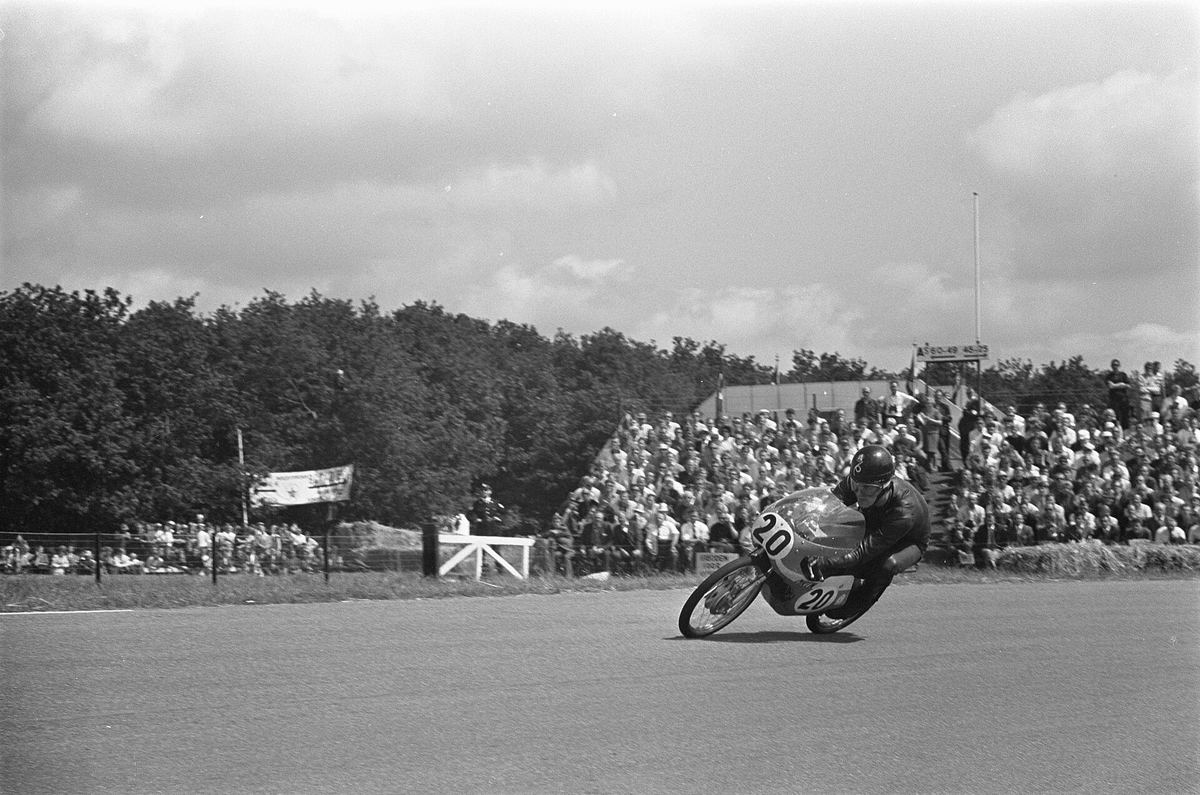
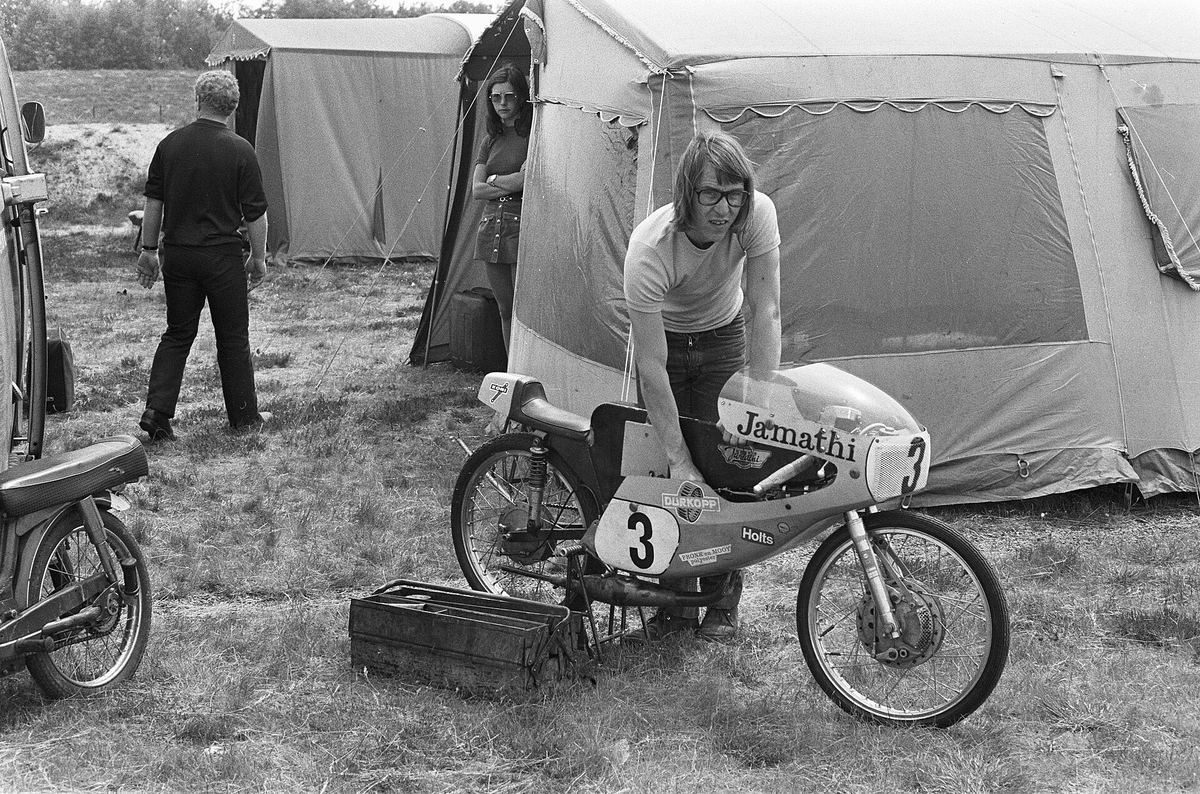
Paul Lodewijkx, number 20, on the Jamathi at Assen, 1968.. Photo: Anefo / Nationaal Archief, CC0
Hans-Georg Anscheidt began the eighth and final lap of the 50cc race at the 1968 Dutch TT about 40 metres clear. The double world champion was riding a Suzuki RK67, a twin-cylinder factory machine with 14 gears. Behind him, on a single-cylinder Jamathi built by two friends in a Dutch village, was Paul Lodewijkx, 21 years old and riding in front of his home crowd at Assen.
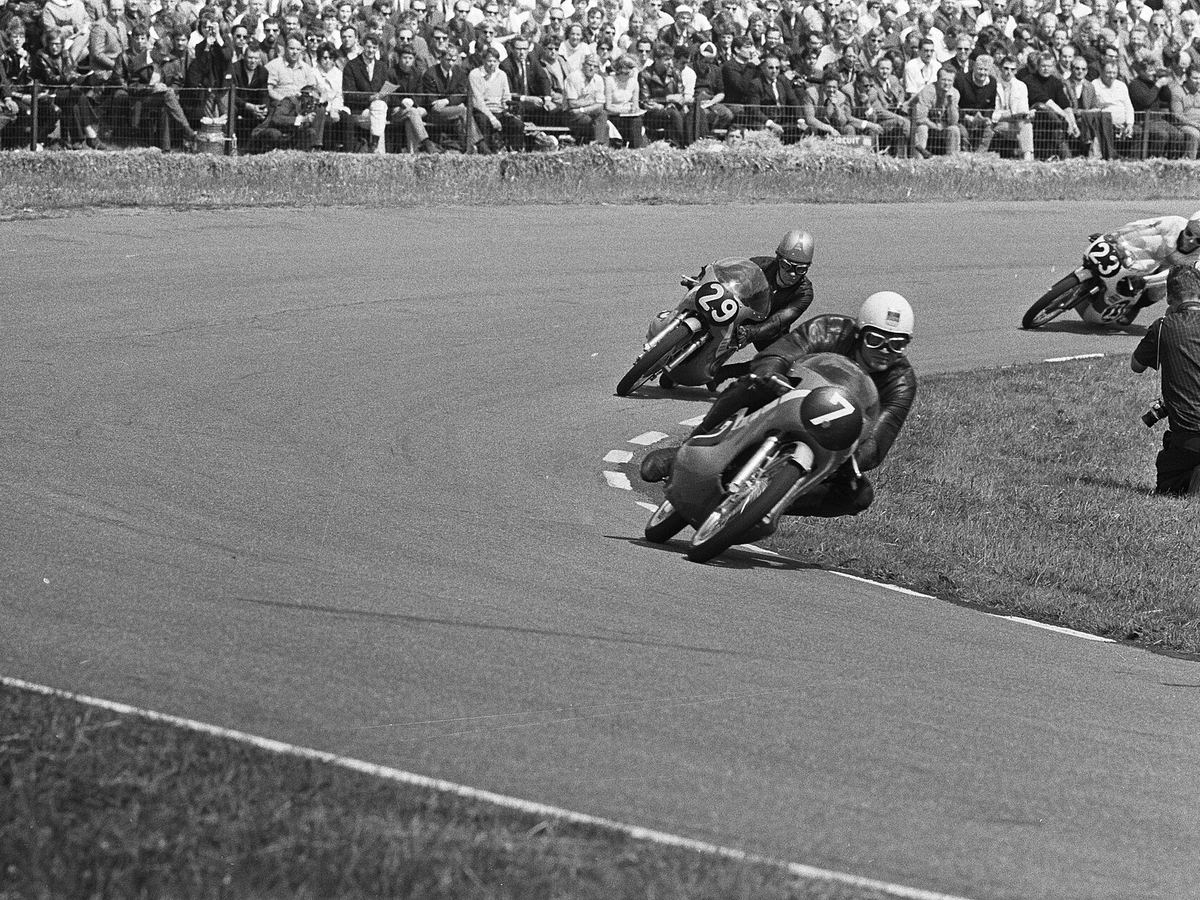
In 1968 the 50cc was the smallest class in Grand Prix racing, for engines the size of a moped's, and races were often decided by slipstreaming, tucking in behind a rival to cut through less air. Over the next 7.7 km the gap closed. Near the end of the lap Anscheidt came up behind slower riders he was about to lap, and Lodewijkx came past. The Jamathi crossed the line first by a tenth of a second.
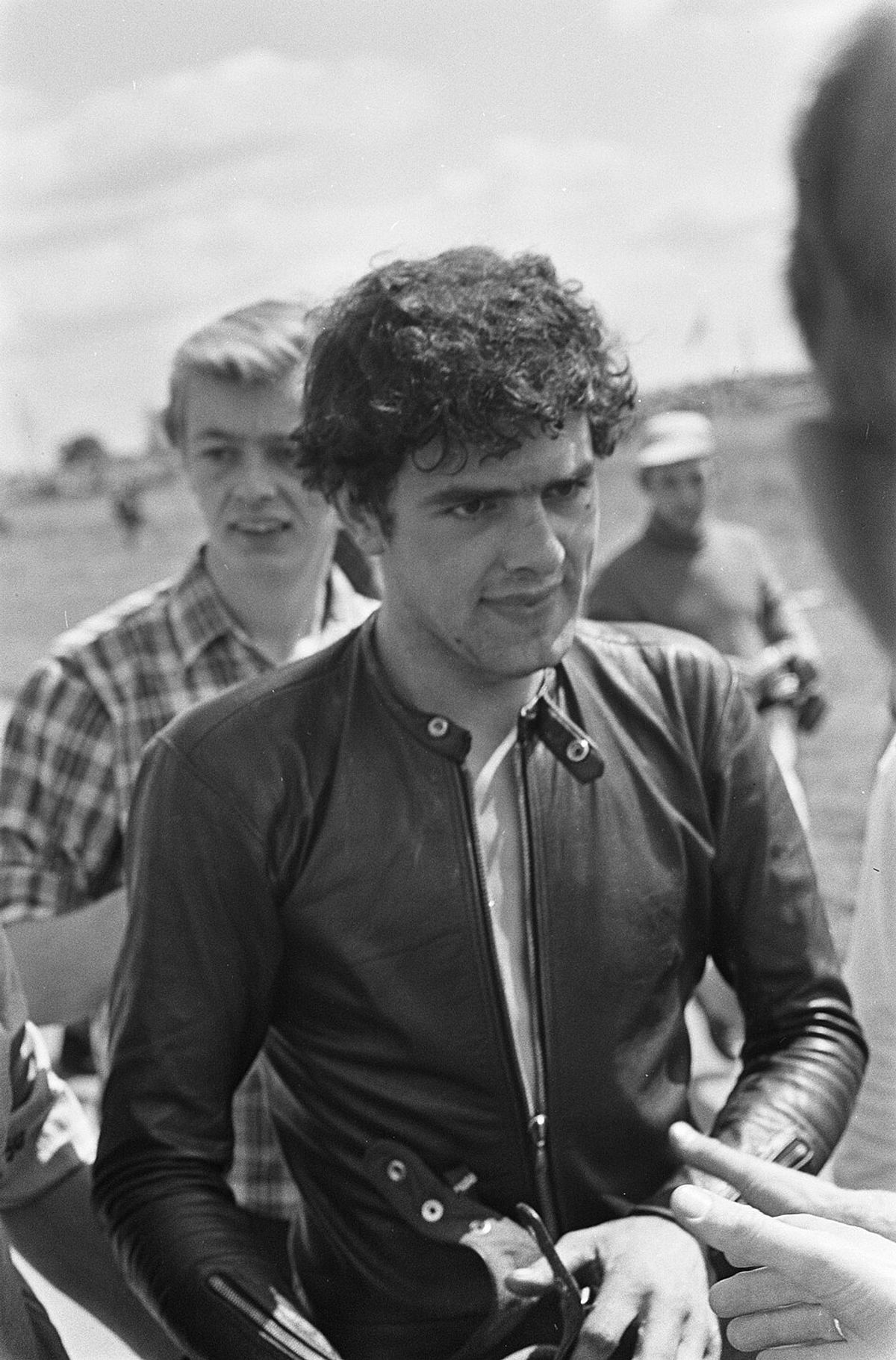
It was the first Grand Prix win for Lodewijkx and for Jamathi, a 50cc racer designed and built in Nederhorst den Berg by Jan Thiel and Martin Mijwaart. A rival protested. The engine was measured. It was legal.
Before the flag: a factory twin against a garage single
The 1968 50cc world championship was a strange one, because the factory that dominated it had already left. Suzuki had won the 1967 title with Anscheidt and the RK67, a water-cooled two-stroke parallel twin that made 17.5 hp at 17,300 rpm and weighed 58 kg (128 lb), according to Bike EXIF. Then the FIM announced that from 1969 50cc racing engines would be limited to one cylinder and six gears, and Suzuki withdrew from the world championship.
Honda had already quit before the 1968 season, leaving Yamaha and Kawasaki as the only Japanese factories in Grand Prix racing. The RK67 could reach 176 km/h (109 mph) in factory hands.
Anscheidt carried on alone. According to the rider's own history on Motoracers, Suzuki gave him 50cc and 125cc machines, a stock of spare parts and a pickup truck, and he went racing as a privateer with one German mechanic.
The opposition at Assen came from a very different place. Jan Thiel, who handled the engine, and Martin Mijwaart, who built the chassis, had met as young enthusiasts in 1962 and founded Jamathi in 1965. Cycle World reported that they paid for it from their day jobs. Their machine was a water-cooled single-cylinder two-stroke, and their rider, Paul Lodewijkx, came from the same village. He had made his Grand Prix debut at Assen a year earlier.
The last lap of the 1968 Dutch TT
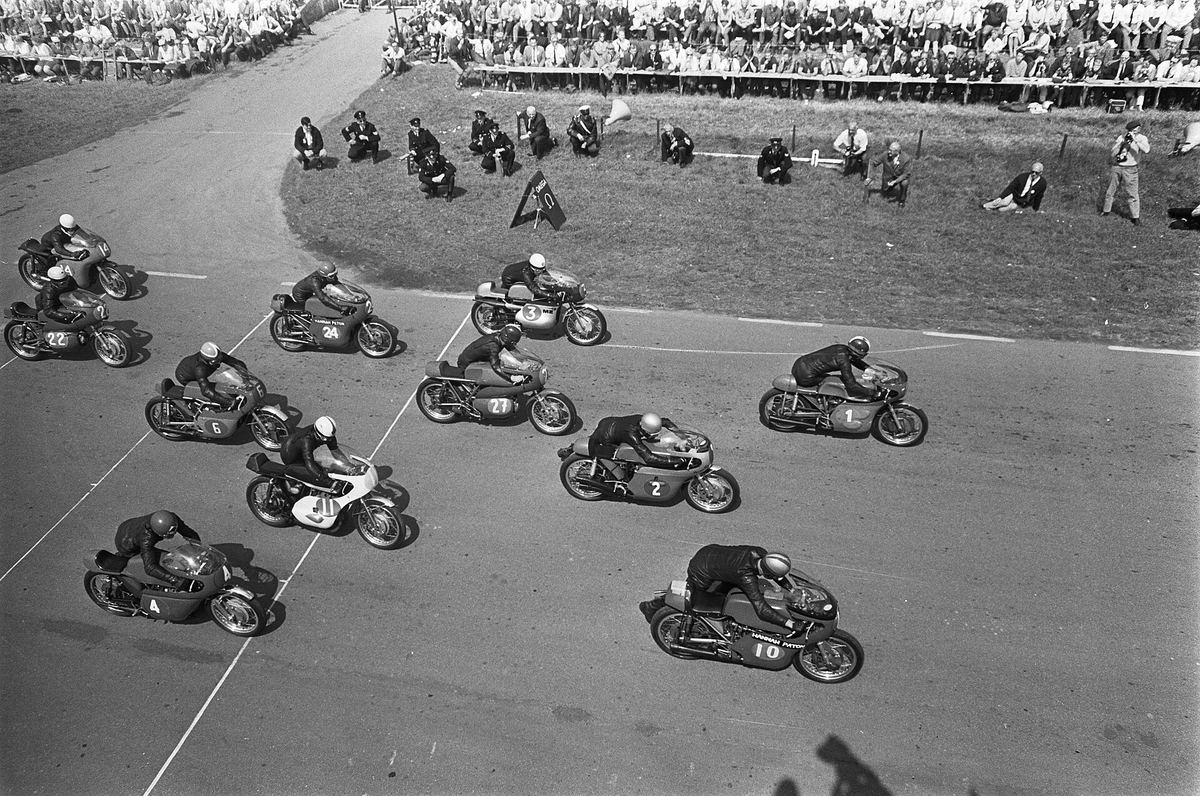
The 1968 Dutch TT was held on 29 June [⚠ VERIFY: Motor.NL gives 26 June; the race was traditionally run on the last Saturday of June] on the 7.7 km TT Circuit Assen, and the 50cc race ran over eight laps. It was the fourth of only five 50cc rounds that season. Anscheidt arrived as the favourite. He had won the first two rounds, in West Germany and Spain, and only the best three results counted towards the title.
Lodewijkx stayed with him. Anscheidt started the last lap with a lead of around 40 metres, then ran into lapped traffic close to the finish. Lapped riders are slower competitors a full lap behind, and on machines this evenly matched, the few seconds it takes to get past them can decide a race. Accounts differ on where the pass happened: Motorsport.com says Lodewijkx took Anscheidt at the last corner, while Motoracers' history of Anscheidt says the Dutchman got by right at the line. Both agree on the margin, a tenth of a second. Aalt Toersen finished third on a Kreidler.
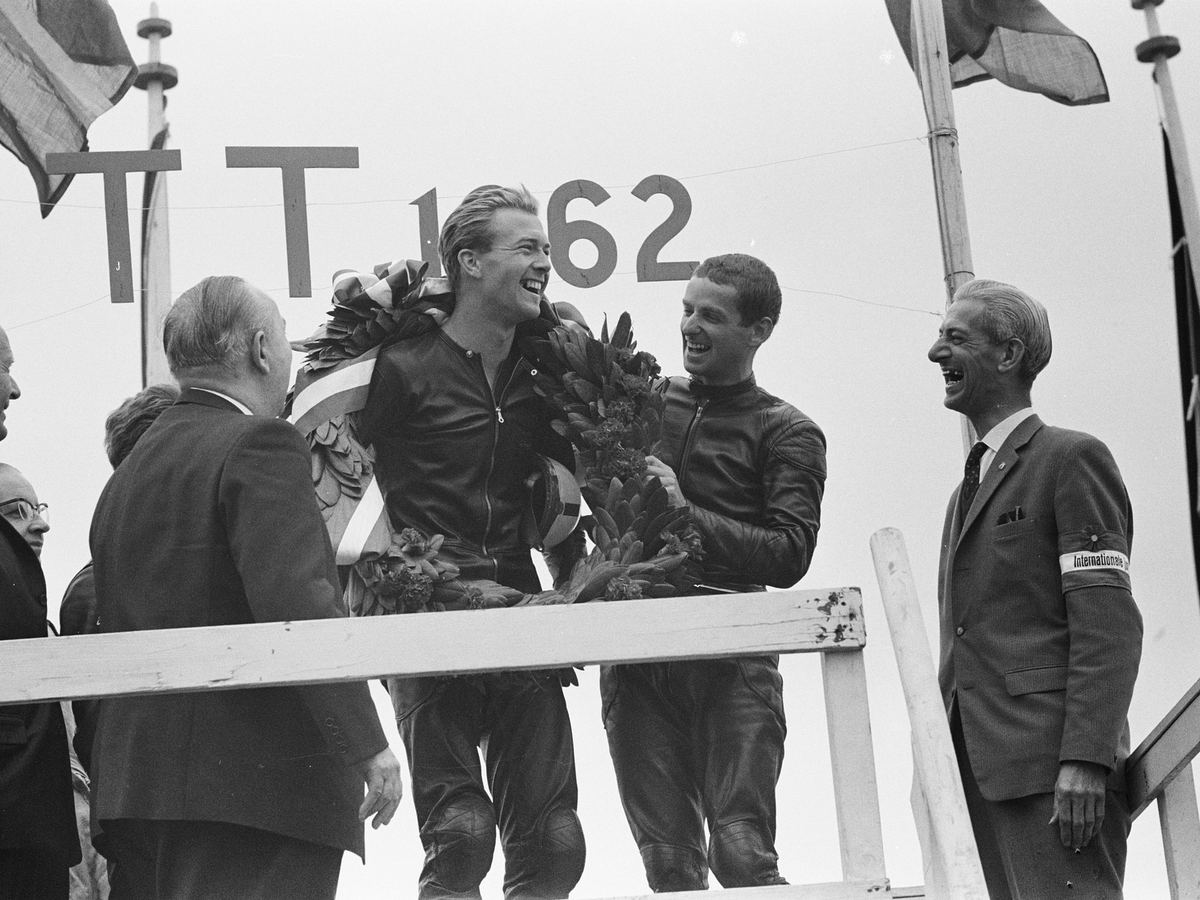
Crash.net called it the first time a Dutch rider had stood on the top step at his home Grand Prix. The full claim needs one qualification. Han van Kooten had won the 350cc race in 1927 and Dirk Renooy the 125cc in 1948, according to Motorsport.com. Lodewijkx was the first Dutch winner at Assen in the world championship era, which began in 1949.
Then came the protest. According to Motoracers, Ángel Nieto, racing for Derbi that season, questioned the size of Lodewijkx's engine. It measured 49.6cc, just under the 50cc limit. The figure is the volume swept by the piston in cubic centimetres, and a Jamathi a fraction too big would have lost the win at the scrutineers' bench.
Anscheidt won again at Spa a week later and took his third consecutive 50cc title with 30 points. Lodewijkx finished the championship second, on 17. Suzuki took the 50cc manufacturers' title as well, in a season it had officially sat out.
After the flag
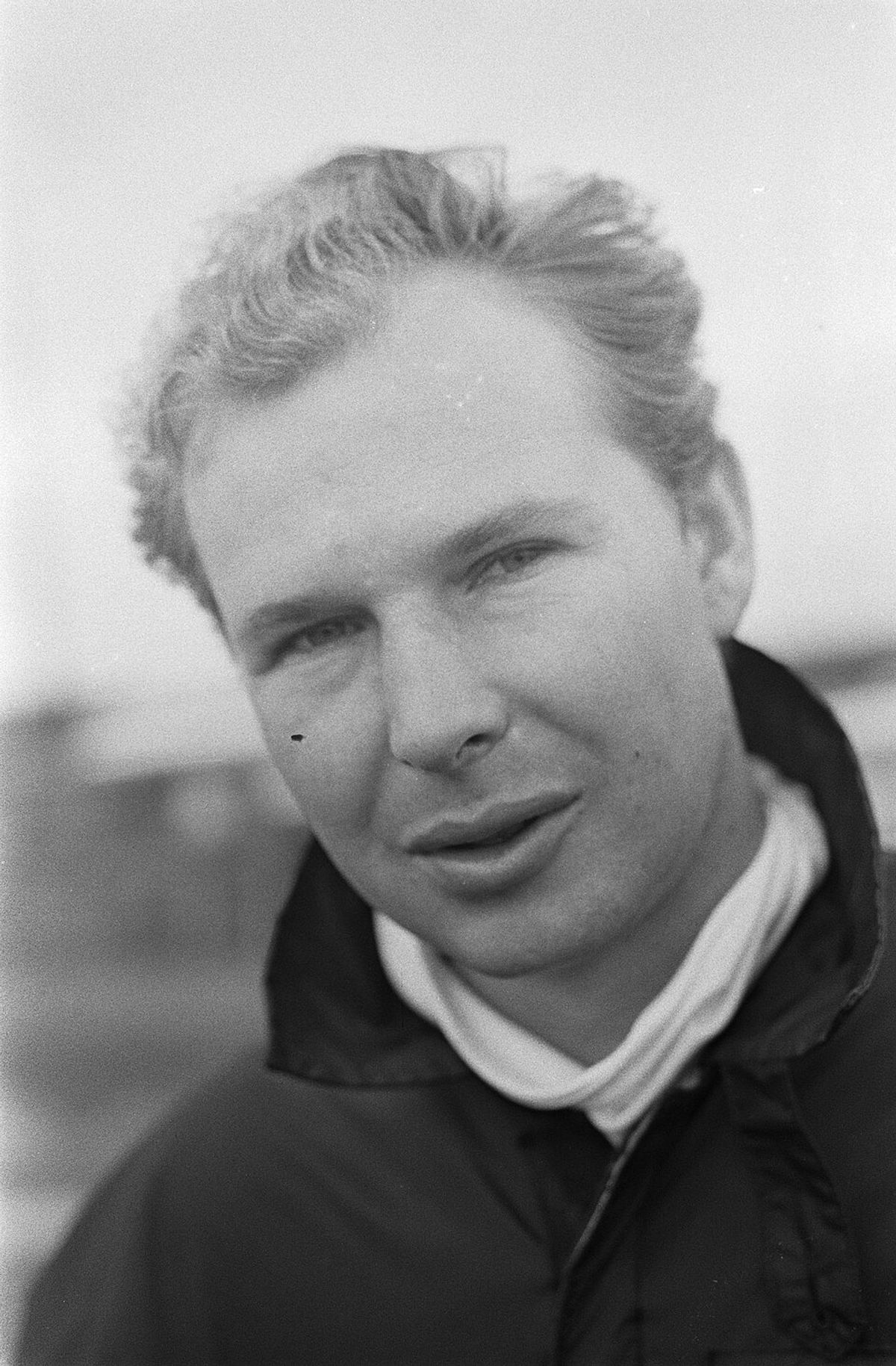
Paul Lodewijkx won three more Grands Prix for Jamathi in 1969, in Czechoslovakia, at Imola and in Yugoslavia, and finished fifth in the championship. A road accident that year effectively ended his career; a comeback in 1972 did not work out. He died in 1988, aged 41.
Jamathi kept going. Aalt Toersen finished second in the 1970 50cc championship [⚠ VERIFY: that Toersen rode a Jamathi in 1970, against the MotoGP.com rider profile], and the team's bikes won Grands Prix between 1968 and 1974. Its Grand Prix activity officially ended at Imatra, in Finland, on 28 July 1974.
The machines did not stop there. For 1975 Egidio Piovaticci, an Italian maker of woodworking machinery, hired Thiel and Mijwaart, who went with their bikes first to Italy and later to Spain, and Eugenio Lazzarini finished second in the 50cc championship on bikes with rebadged Jamathi engines and a stainless steel monocoque, a chassis in which a stressed shell carries the loads instead of a frame of tubes.
When Piovaticci's business ran into trouble, Nieto persuaded the Spanish federation to buy the team, which moved to Barcelona under Bultaco. Nieto won the 1976 and 1977 50cc titles on those bikes, and Ricardo Tormo won in 1978 with five wins and two second places from seven rounds.
MCNews notes that the 1976 title was the first won by a bike with a monocoque chassis, and that the works Bultacos always used the original Jamathi crankcases, machined from solid.
Why it still matters
The 1968 Dutch TT sits on a hinge in racing history. The Japanese factory had gone home, the multi-cylinder rules were about to go too, and two friends with day jobs got there first. Their water-cooled single already fitted the one-cylinder rule that arrived in 1969.
Jan Thiel spent the next half-century proving it was no accident. He worked for Minarelli, Garelli and Aprilia, where his riders included Valentino Rossi, Max Biaggi and Jorge Lorenzo, and Moto.it credits his engines with around fifty world titles in the small classes. Nico Cereghini, writing his obituary for Moto.it, remembered a man of few words with a dry sense of irony, who could work on an engine for whole days without eating. He died in Bangkok in March 2026.
In 2018 the Jamathi club still had eight of the bikes in the Netherlands, and displayed them at Assen alongside Anscheidt's Suzuki, while Dutch 50cc veterans including Jan de Vries, Aalt Toersen and Theo Timmer were due to ride a lap of the circuit.
Nieto protested a Jamathi in 1968. Eight years later he won a world title with its crankcases.
Quick answers
Who won the 50cc race at the 1968 Dutch TT?
Paul Lodewijkx won the 50cc race at the 1968 Dutch TT on a Jamathi, beating Hans-Georg Anscheidt's Suzuki RK67 by a tenth of a second on 29 June 1968. It was his first Grand Prix win and the first for Jamathi, a 50cc racer built in Nederhorst den Berg.
What was Jamathi?
Jamathi was a Dutch 50cc racing motorcycle built by Jan Thiel, who designed the engine, and Martin Mijwaart, who built the chassis, in Nederhorst den Berg. Founded in 1965 and financed from their day jobs, it won Grands Prix between 1968 and 1974 with riders including Paul Lodewijkx.
Are Bultaco's 50cc world title bikes related to Jamathi?
Yes. Bultaco's works 50cc racers that carried Ángel Nieto to the 1976 and 1977 world titles, and Ricardo Tormo to the 1978 title, descended from the Jamathi via Piovaticci. According to MCNews, the works bikes always used the original Jamathi crankcases machined from solid.
Was Paul Lodewijkx the first Dutch winner of the Dutch TT?
Not quite. Paul Lodewijkx in 1968 was the first Dutch winner at Assen in the world championship era, which began in 1949. Han van Kooten won the 350cc race in 1927 and Dirk Renooy the 125cc in 1948, before the championship existed.