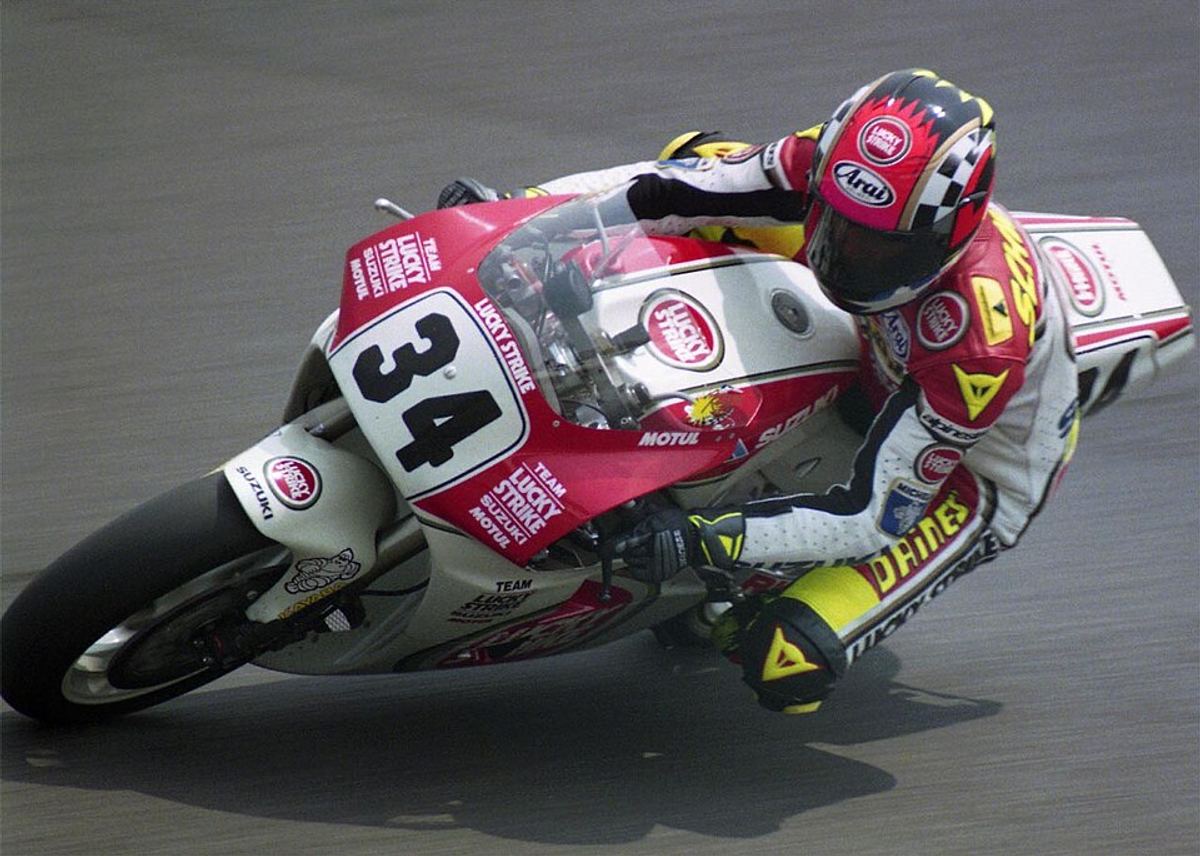
Kevin Schwantz on the Suzuki RGV500 at the 1993 Japanese Grand Prix, the year he became world champion.. Photo: Rikita / Wikimedia Commons (CC BY-SA 3.0)
Hockenheim, 26 May 1991, last lap of the German Grand Prix. Kevin Schwantz is tucked behind Wayne Rainey's Marlboro Yamaha at around 180 mph (290 km/h), the two Americans alone at the front after Mick Doohan's rear tyre has given up. Schwantz's Lucky Strike Suzuki RGV500 is slower on the straights. His only chance is the braking zone before the stadium.
Then Rainey brakes early. He has come out of the last chicane on the wrong side of the track, and his reference points are off. Schwantz has to swerve to miss him, the Suzuki squirming under him as he dives up the inside.
He crosses the line less than two hundredths of a second ahead, and Rainey is furious. Motor Sport's Mat Oxley calls it possibly the greatest overtake in Grand Prix history. By Schwantz's own account, it wasn't even planned.
Who Kevin Schwantz was
Kevin Schwantz was born on 19 June 1964 in Houston, Texas, into a motorcycle family. His parents took on a Yamaha dealership the year he was born, and his uncle, Darryl Hurst, raced AMA dirt track. Hurst's racing number was 34. Kevin borrowed it and never gave it back.
Schwantz learned to ride before he started school and began competing in observed trials, the slow-speed discipline where riders pick their way over rocks and logs without putting a foot down. His first racing hero was the British trials star Mick Andrews, who came to the family shop once a year to run clinics. Trials taught him balance. Motocross, which he took up in his mid-teens, taught him aggression, and he became one of the top regional motocross riders in Texas.
A heavy crash in qualifying for the 1983 Houston Supercross ended that. Schwantz quit motocross at 19 and tried a local road race on a flat-track bike borrowed from his uncle. At the end of 1984 he got a test ride with Yoshimura Suzuki. In 1986 he finished second to Eddie Lawson in the Daytona 200 on Suzuki's new GSX-R750.
Kevin Schwantz vs Wayne Rainey: from Daytona to Suzuka
Kevin Schwantz's rivalry with Wayne Rainey started in American superbikes. In 1987 Rainey won the AMA Superbike title, even though Schwantz won five of the last six races. That year they were nominal team-mates for the US at the Transatlantic match races in Britain, and raced each other harder than the British. [⚠ VERIFY: specific incidents at the 1987 Transatlantic match races]
In March 1988 Suzuki asked Schwantz to ride one last Daytona 200 before leaving for Europe. He fractured his left forearm in a practice crash and won anyway, on a Yoshimura GSX-R750, giving Suzuki its first Daytona 200 victory. Three weeks later he won the season-opening Japanese Grand Prix at Suzuka in the wet. It was only his seventh Grand Prix start.
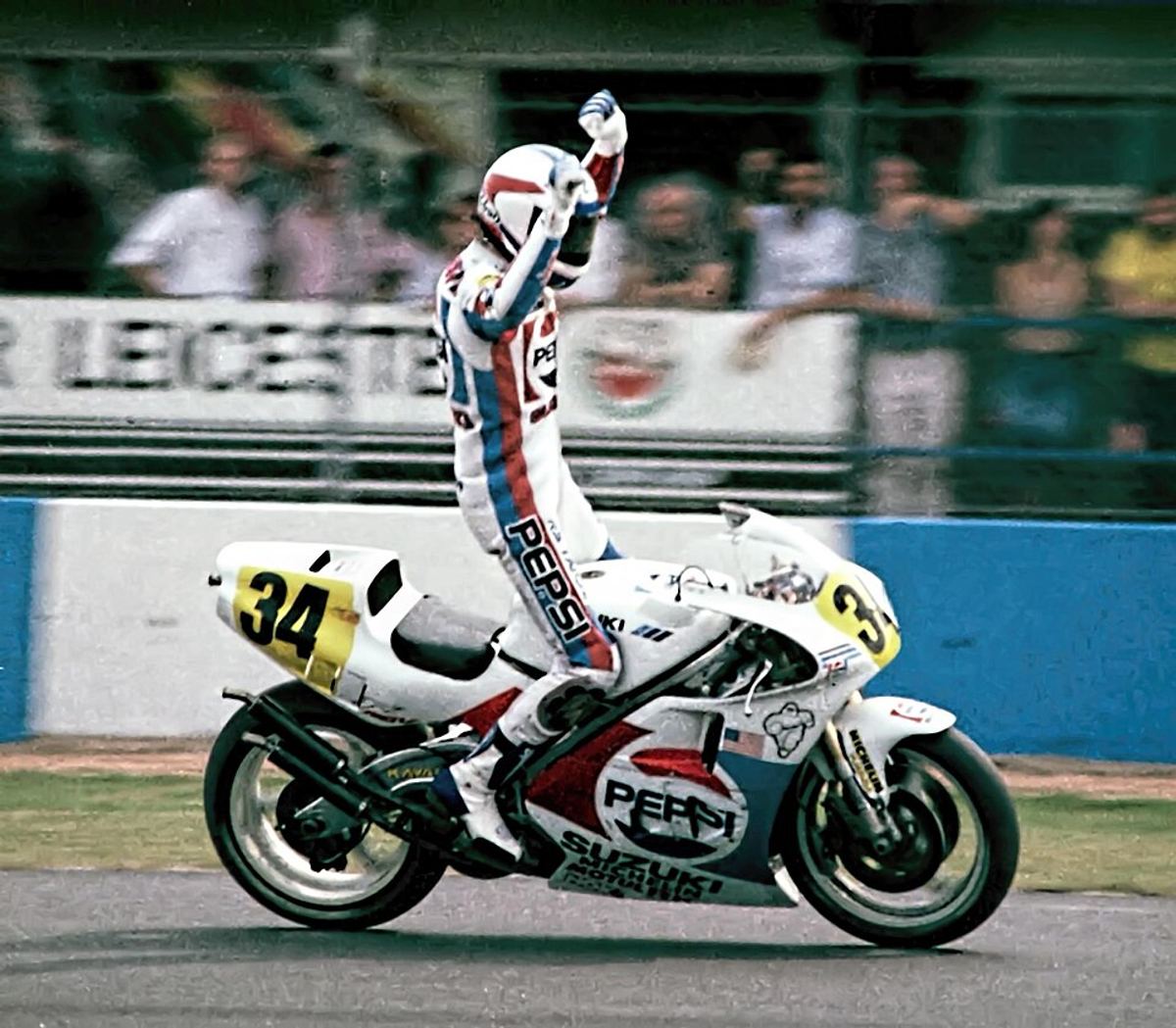
Rainey arrived in the 500cc class at the same time, on a Marlboro Team Roberts Yamaha, and the feud moved to Europe. Schwantz won six Grands Prix in 1989 and five in 1990, when he finished runner-up to Rainey. His trouble was consistency: he tended to win or crash.
The season-by-season record makes the point. Going into 1993, Rainey had 20 Grand Prix wins and three world titles, from 1990, 1991 and 1992. Schwantz had 19 wins and no title.
Hockenheim 1991 and the 1993 title
Kevin Schwantz's pass at Hockenheim in 1991 looked like genius, but he later told Mat Oxley it was mostly survival. When Rainey braked early, Schwantz's first thought was to avoid him. He knocked the gearbox down to first for a second-gear corner, the over-revving engine cut out, and he had to grab another gear before the final left-hander. "My first intention is to not hit him," he said.
Rainey later admitted he could have leaned on Schwantz and taken them both down, but that would only have handed the title to Doohan. Rainey won the 1991 championship anyway. Schwantz finished third, both men riding on Dunlops after Michelin chose to supply only Honda that year.
1993 was different. Schwantz rode more calmly, won four races in the first half of the season and arrived at Donington Park for the British Grand Prix more than 20 points clear. On the first lap Mick Doohan, still hampered by a badly injured right leg, crashed into Alex Barros and Schwantz at the chicane. Schwantz broke bones in his right hand. At Brno he could only manage fifth while Rainey won, and Rainey took the lead.
The next race was the Italian Grand Prix at Misano on 5 September 1993. Rainey was leading when he crashed into the first-corner gravel trap. The crash broke his back and left him paralysed from the chest down. Schwantz finished third, retook the points lead and was crowned world champion before the season was out. He later called the moment he heard about Rainey, from Italian reporters crowding his motorhome, the worst of his career.
Mugello, 1995: Kevin Schwantz walks away
Kevin Schwantz's body gave out before his speed did. In his eight-year Grand Prix career, 15 of his crashes broke bones, according to Cycle World's Michael Scott. At the 1994 Dutch TT he dislocated and fractured his left wrist. He raced on, won his 25th and last Grand Prix at Donington Park, and finished the year fourth. That winter surgeons removed three bones from the wrist, which came back too weak to lock his arm under braking.
Early 1995 was worse. He crashed in testing at Phillip Island, then had what he called the fastest crash of his life at Eastern Creek, when both pistons seized at about 185 mph (298 km/h). At Suzuka, where he had won four times and never finished off the podium, he came home seventh.
After Suzuka he flew home with Rainey, by now a friend. Rainey told him that by the end he had been racing because other people wanted him to, not because he enjoyed it, and Schwantz recognised himself. A few weeks later he was due to fly to Spain for a test with his team-mate Daryl Beattie. He turned up to collect Beattie without a suitcase.
At Mugello in June 1995, before the Italian Grand Prix, Schwantz announced his retirement. He was 30. The press room gave him a standing ovation, and his number 34 was retired, the first racing number ever retired in Grand Prix racing.
What Kevin Schwantz left behind
Kevin Schwantz finished with 25 premier-class wins, one more than Rainey, and one title to Rainey's three. That arithmetic is his whole career: more wins, more crashes, more people out of their seats. Mick Doohan, according to Crash.net, called him the fastest rider he ever raced.
Schwantz was inducted into the AMA Motorcycle Hall of Fame in 1999 and named a Grand Prix Legend in 2000. Back in Texas he co-designed the Circuit of the Americas in Austin. Valentino Rossi's VR46 company later produced a Brand 34 clothing line with him, designed by Aldo Drudi. When Francesco Bagnaia reached 25 premier-class wins in August 2024, MotoGP marked it as drawing level with Schwantz.
The hatred with Rainey did not survive Misano; the two became close friends.
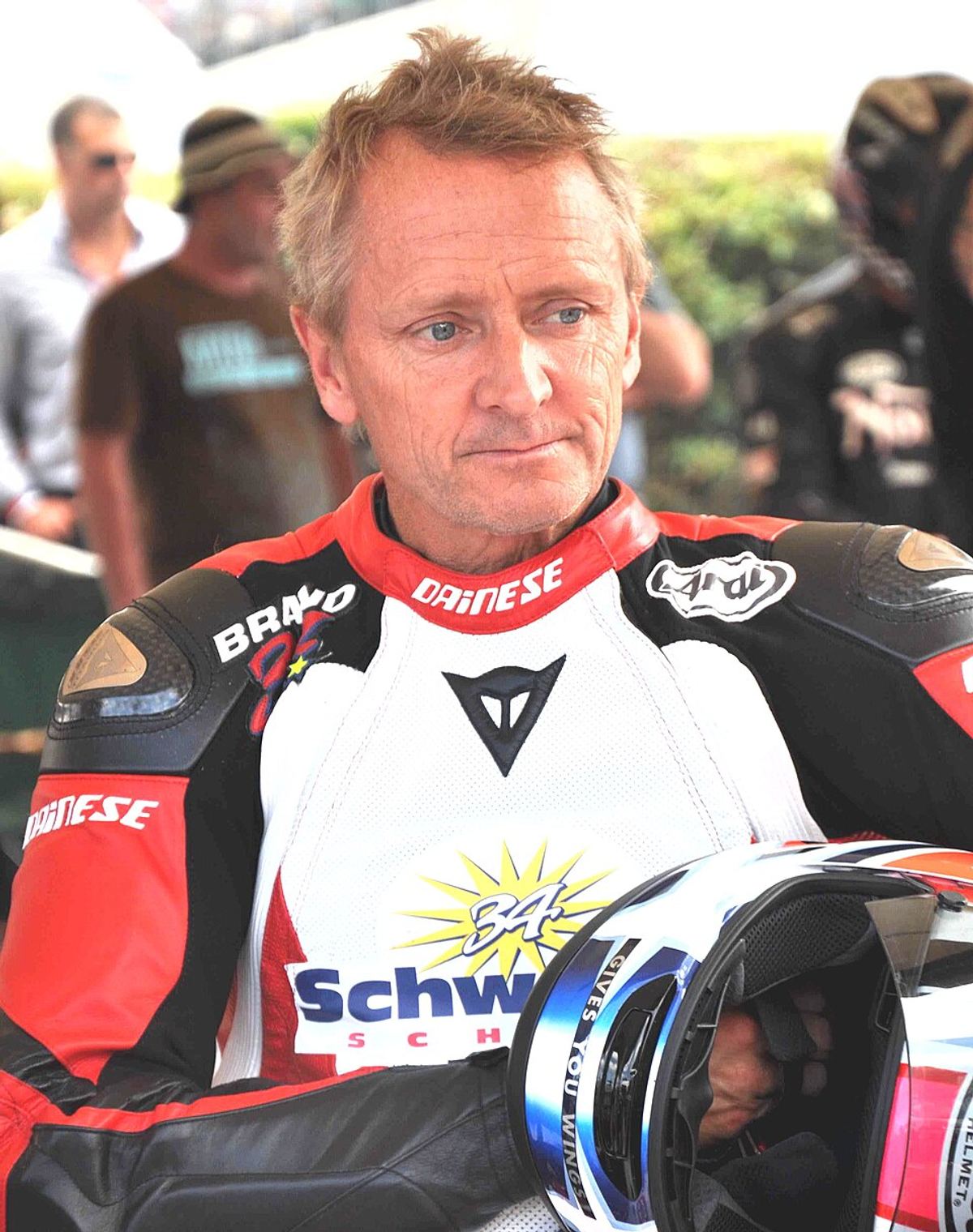
Thirty years after Mugello, number 34 is still retired. Rainey got the titles. Schwantz got the number nobody else can use.
Quick answers
How many Grands Prix did Kevin Schwantz win?
Kevin Schwantz won 25 premier-class Grands Prix between 1988 and 1994, all on the Suzuki RGV500, one more than his rival Wayne Rainey. He also took 29 pole positions and won the 1993 500cc world title.
What happened between Schwantz and Rainey at Hockenheim in 1991?
On the last lap of the 1991 German Grand Prix, Kevin Schwantz out-braked Wayne Rainey into the stadium section and won by less than two hundredths of a second. Schwantz later said the move was unplanned: Rainey braked early and he dived inside to avoid him.
Why was Kevin Schwantz's number 34 retired?
Kevin Schwantz's number 34 was retired when he announced his retirement at Mugello in June 1995. It was the first racing number ever retired in Grand Prix racing. He had borrowed it from his uncle, the dirt-track racer Darryl Hurst.
How did Kevin Schwantz win the 1993 500cc title?
Kevin Schwantz won four races in the first half of 1993 on his Suzuki before injuries cost him the points lead. Wayne Rainey was leading the Italian Grand Prix at Misano in September when he crashed and was paralysed. Schwantz finished third that day and went on to win the title.