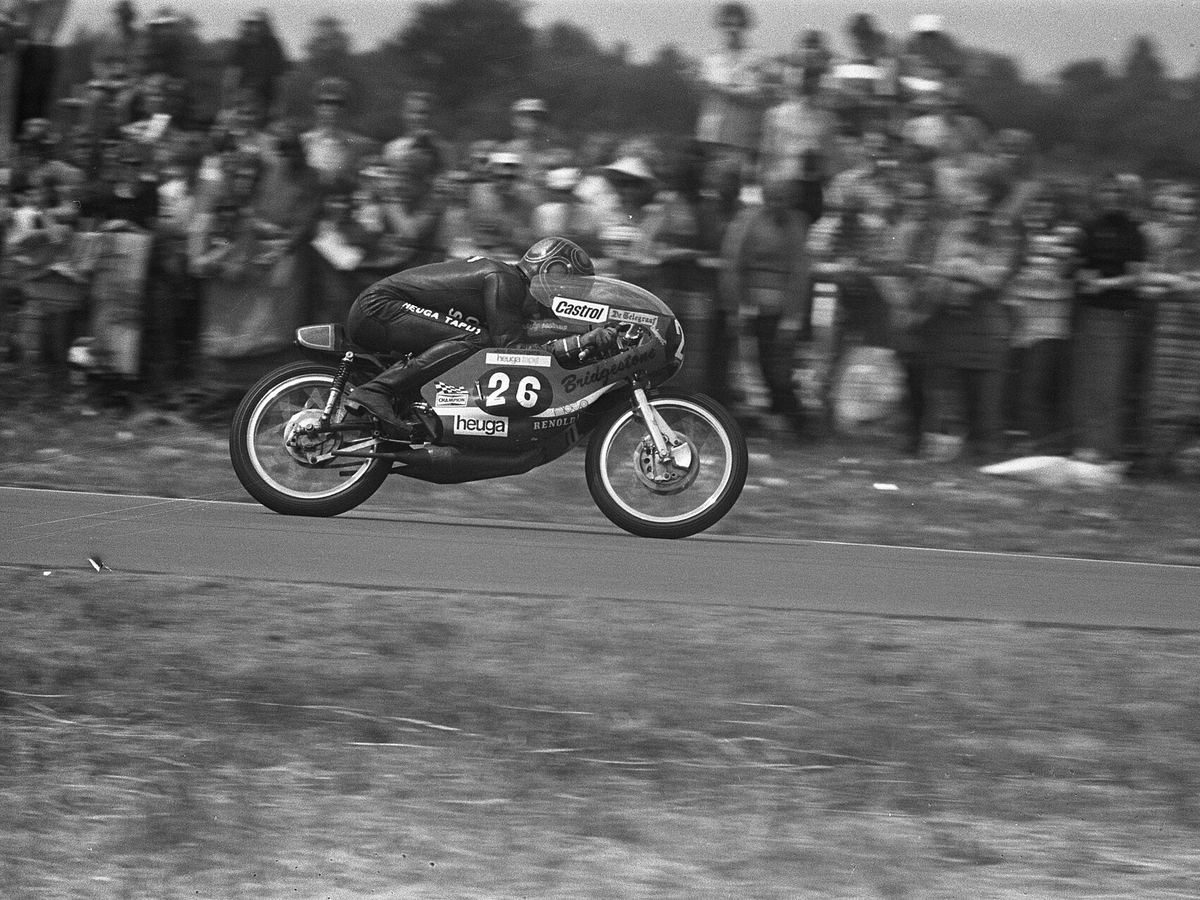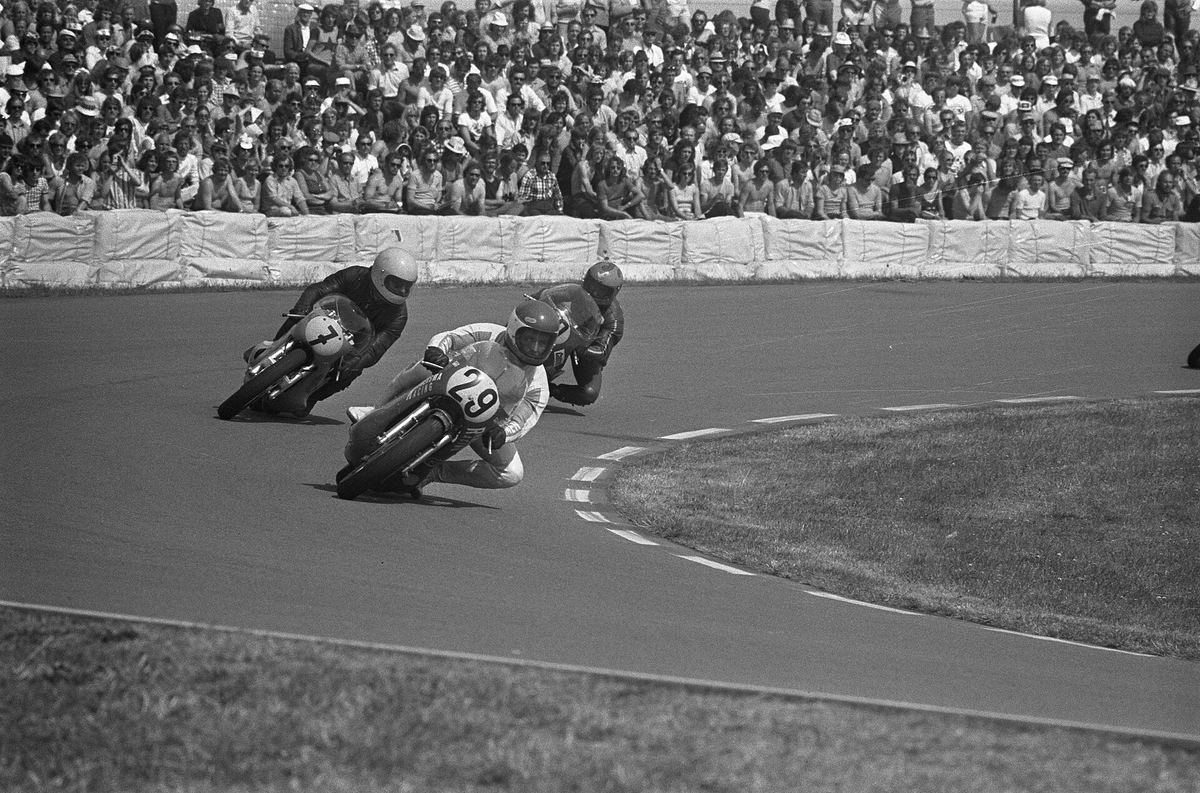
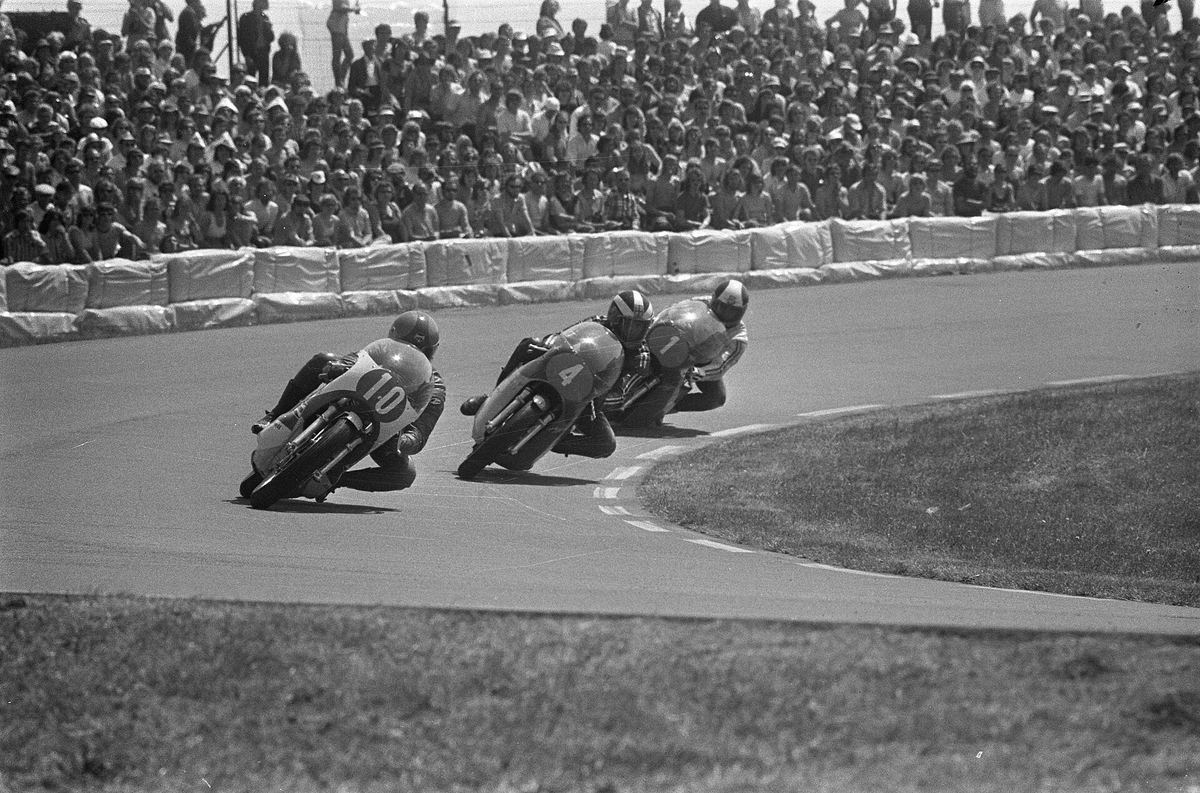
Wil Hartog (29) on his way to fourth in the 500cc race at Assen, 1973, the race in which Kim Newcombe finished second.. Photo: Anefo / Nationaal Archief, CC0
On 17 June 1973, at the Yugoslav Grand Prix in Opatija, Kim Newcombe won the 500cc race on a motorcycle he had largely built himself. The circuit was a road course on the Adriatic coast, lined with brick walls, houses and a cliff face. Newcombe, 29, set a new lap record on the way to the win, in only his second full season of Grand Prix racing.
His König had started life as a racing outboard engine, the kind that pushed hydroplanes across lakes. An outboard is a self-contained engine and propeller unit clamped to the back of a boat; König built racing versions. It was a 494cc two-stroke with four cylinders laid flat, two facing forward and two facing back, and Newcombe, a New Zealander who had come to Germany for a different job, had spent five years turning it into a Grand Prix motorcycle.
The win was the first in the premier class by a New Zealander. It also put Newcombe at the top of the 500cc world championship, on 31 points, one ahead of Jarno Saarinen, who had been killed at Monza four weeks earlier, and four ahead of Phil Read on the factory MV Agusta.
Kim Newcombe and a boat engine in Berlin
Kim Newcombe was born in Nelson, New Zealand, on 2 January 1944. He started as an apprentice motor mechanic, finished second in the New Zealand motocross championship on a Greeves he prepared himself, and raced and prepared hydroplanes while working as a marine mechanic in Melbourne.
In 1968 he moved to Germany with his wife, Janeen, for an engineering job at Maico. According to Australian Motorcycle News, the job would not be available until the following year, so he took a short-term post at König Motorenbau in Berlin. There he found one of König's outboard engines fitted into a modified BSA chassis, a project begun by the German racer Wolf Braun and abandoned after Braun was injured. Dieter König persuaded Newcombe to make it a 500cc contender. The Maico offer was forgotten.
The engine's power-to-weight ratio was excellent. Cooling it was not. Newcombe worked through what AMCN calls innumerable cooling problems, adapted a Norton clutch housing and a six-speed gearbox, and later redesigned the chassis, with a frame built by Colin Seeley in Reynolds 531 tubing. By 1972 the König made more than 80 hp. Classic Racer puts it at 85 hp in 1973, and says it was faster in a straight line than the factory MV.
John Dodds raced the König for 1971 but retired from all but one of his races and left for Yamaha. Newcombe took over the riding himself. In 1972, in his first Grand Prix, at the Nürburgring, he finished third, before broken neck vertebrae ended his season.
Opatija and Assen: leading the world
The 1973 season began with Saarinen's Yamaha winning the first two rounds. Newcombe was fifth at Paul Ricard and third at the Salzburgring. His mechanic, Rod Tingate, told Classic Racer: "We were all ecstatic seeing Kim on the podium." He retired at Hockenheim. After Saarinen and Renzo Pasolini were killed at Monza on 20 May, the 500cc race there was cancelled and Yamaha withdrew for the rest of the year. Newcombe did not race the Isle of Man TT, which Agostini and other leading riders boycotted over safety. He was not the only König rider in the field: Ernst Hiller finished the season ninth on another one.
Opatija came next. Newcombe won and set the fastest lap, and the König team, which was Newcombe, Tingate and Janeen with their baby son, Mark, led the world championship. Tingate remembered that "Kim took it all in his stride – he realised there were more meetings to go."
Six days later, at the Dutch TT, his König carried a small kiwi emblem on its tail fairing, cut by hand by Tingate for the race. Newcombe made a poor start in front of about 150,000 spectators and came through to finish second behind Read, whose MV Agusta was a new four-cylinder machine that season. Read's win cut the gap to a single point: Newcombe 43, Read 42. Wil Hartog, the Dutch rider who would win at Assen four years later, finished fourth.
At Spa he was running fourth until a failed O-ring on the water-pump drive let Jack Findlay past on the last lap. At Anderstorp in Sweden he led for ten laps before a mistake let Read through, and finished third. At Imatra he was fourth, and Read, second behind Agostini, clinched the title with a round to spare. It was the first world championship won on Lockheed disc brakes.
After the flag
The final round in Spain could not change the title, so Newcombe went instead to a non-championship race at Silverstone, the British International 1000, with an over-bored König of 680cc. AMCN reports that he had raised the lack of hay bales at Stowe Corner with the Clerk of the Course.
On 11 August 1973 he led for the first six laps. Visordown notes that the bigger engine's extra speed was too much for the König's drum brakes. On the sixth lap they failed at the entry to Stowe, and he hit the timber wall there. He never regained consciousness, and died in hospital on 14 August 1973, aged 29.
He was classified second in the 1973 500cc world championship, with 63 points to Read's 84 and ahead of Agostini on 57. Dieter König withdrew the factory from Grand Prix racing immediately after his death, according to the organisers of the Classic GP Assen, having produced around 100 bikes and engines for privateers around the world. The company went back to marine engines. Newcombe's career was the subject of the 2007 documentary Love, Speed and Loss, and at its European premiere in Berlin three restored examples of his König were put on display.
Why it still matters
Read took the 1973 title on a factory MV with disc brakes. Newcombe came second on a bike he had designed around a boat engine, with a mechanic, his wife and a baby son as his team. Unlike his main rivals, he developed, built, maintained and raced the König himself, and he had been road racing for less than four years.
The Classic GP Assen organisers describe it as turning a marine motor into a title contender. The König was powerful enough to pass the champion MV Agustas on the straights, and for a week in June 1973 it led the world. A surviving 1971 König, raced at the Classic GP by the Dutchman Hans de Wit with modern carburettors and ignition, now makes about 95 hp.
Read beat him to the title with a factory behind him. Newcombe beat the factory once, at Opatija, with a boat engine.
Quick answers
What was the König 500?
The König 500 was a Grand Prix motorcycle built around a 494cc two-stroke, four-cylinder boxer engine from König, a Berlin maker of racing outboard motors. Developed largely by New Zealander Kim Newcombe, it made about 85 hp in 1973 and won that year's Yugoslav Grand Prix.
Who was Kim Newcombe?
Kim Newcombe was a New Zealand engineer and rider, born in Nelson in 1944, who developed and raced the König 500. He won the 1973 Yugoslav Grand Prix, the first premier-class win by a New Zealander, and finished second in the 1973 500cc world championship.
How did Kim Newcombe die?
Kim Newcombe crashed at Stowe Corner during a non-championship race at Silverstone on 11 August 1973, riding an over-bored 680cc König. Leading after six laps, his brakes failed and he hit the timber wall. He died in hospital on 14 August 1973, aged 29.
Who won the 1973 500cc world championship?
Phil Read won the 1973 500cc world championship on an MV Agusta with 84 points and four wins. Kim Newcombe, killed in August, was classified second on his König with 63 points, ahead of Giacomo Agostini on 57.