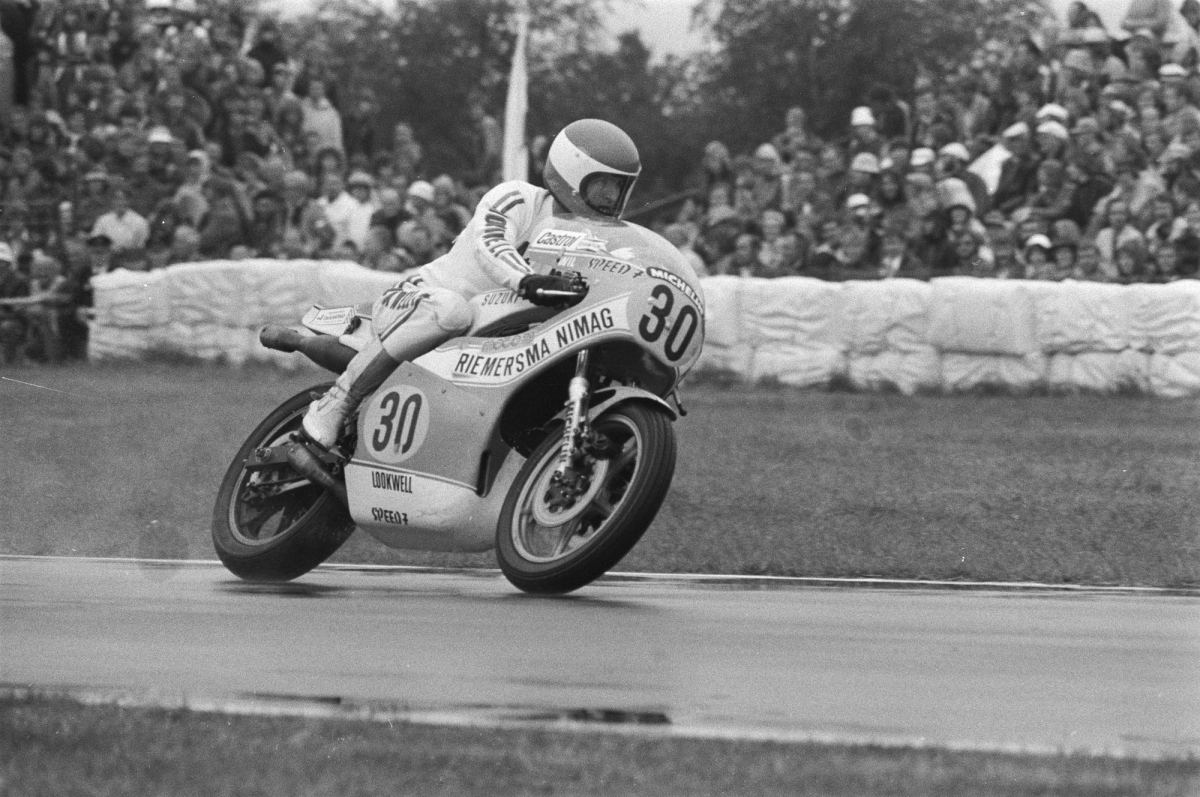
Wil Hartog on his way to the first Dutch win in the 500cc class, Assen, 25 June 1977.. Photo: Koen Suyk / Anefo / Nationaal Archief (CC0)
Four laps from the end of the 500cc race at the 1977 Dutch TT, Christian Estrosi's Suzuki slid off at the Geert Timmer corner, and Wil Hartog was suddenly alone in the lead at Assen. The track was wet. The grandstands were full of Dutch fans who had never seen one of their own win a premier-class Grand Prix.
Hartog was easy to spot. He stood over 1.80 m, tall for a racer of the time, and rode in white leathers, which is why the Dutch called him De Witte Reus: the White Giant. His Suzuki was privately entered. The men behind him were on factory bikes, and one of them was the reigning world champion, Barry Sheene.
The circuit was starting to dry, and Sheene was coming. For the next four laps, the hardest part was keeping his nerve.
The stakes: Wil Hartog, a privateer against the factory Suzukis
Wil Hartog arrived at the 1977 Dutch TT as a 29-year-old privateer from Abbekerk, in North Holland, who still worked in his father's grass-drying business. Racing had started as a hobby. According to NOS, he won the Dutch 125cc title in 1968, then stepped away from racing after his mentor, Jaap Mooijen, was killed in a race in Austria a month later.
He came back when a backer asked him to lead the Riemersma Racing team. What made a privateer competitive was the Suzuki RG500. Suzuki sold production versions of its 500cc Grand Prix bike to riders who could pay for them, and in 1976 all but one of the top 12 points scorers in the class rode one, according to Motor Sport. Its engine was a square-four two-stroke: four cylinders arranged in a square, like two parallel twins sitting one behind the other.
The factory teams still had more. NOS recalls how the young children of Hartog's mechanic, Willy van Wanrooij, rummaged through the factory teams' bins in the paddock as if it were a game.
Hartog had already shown what he could do at Assen. In 1976 he finished third there behind Sheene and Pat Hennen, his first Grand Prix podium. In 1977, Sheene was the reigning world champion on a Texaco Heron factory Suzuki, and he took pole position at Assen with a lap of 2:57.4.
Full wets and a push start: the opening laps at Assen
Wil Hartog nearly went into the 1977 Dutch TT unwell. A stomach problem had troubled him in the run-up to the meeting, and the cure came from an unlikely place: Barry Sheene gave him a drink, a story MotoGP.com later told as Sheene's magic potion. Hartog still felt weak on race day.
Race day was wet. Hartog read the sky the way he had learned to at the grass-drying works, decided the rain would last, and told his team to fit full wet tyres.
Grand Prix races then began with a push start: riders ran beside their bikes on the grid and bump-started the engines. Hartog was known for his starts, and from tenth on the grid he decided at the last moment to fire the engine in three steps. It caught first time. By the S-bend he was leading, and he later said the adrenaline made him forget he was ill.
Then a rider came past: the Frenchman Christian Estrosi, on another Suzuki, who would later become better known as a politician and government minister. Hartog reasoned that if Estrosi could go that fast in the rain, so could he. He followed, and the two of them pulled away from the rest of the field.
Four laps alone: how Wil Hartog held off Barry Sheene
Wil Hartog's race became a solo ride four laps from the end, when Estrosi crashed at the Geert Timmer corner. It should have been the easy part. Hartog told NOS it was the opposite: his rhythm vanished, he swore at the bike, and he could already picture the newspaper headline about the Dutch leader who fell off.
The track was drying and Sheene was closing fast. Hartog held on. After 16 laps and 52 minutes 35.4 seconds, he crossed the line 5.9 seconds ahead of Sheene, with Pat Hennen third on the other factory Suzuki, 10.5 seconds back.
Sheene set the fastest lap of the race at 3:03.7, more than six seconds slower than his pole time. That gap gives a measure of the conditions.
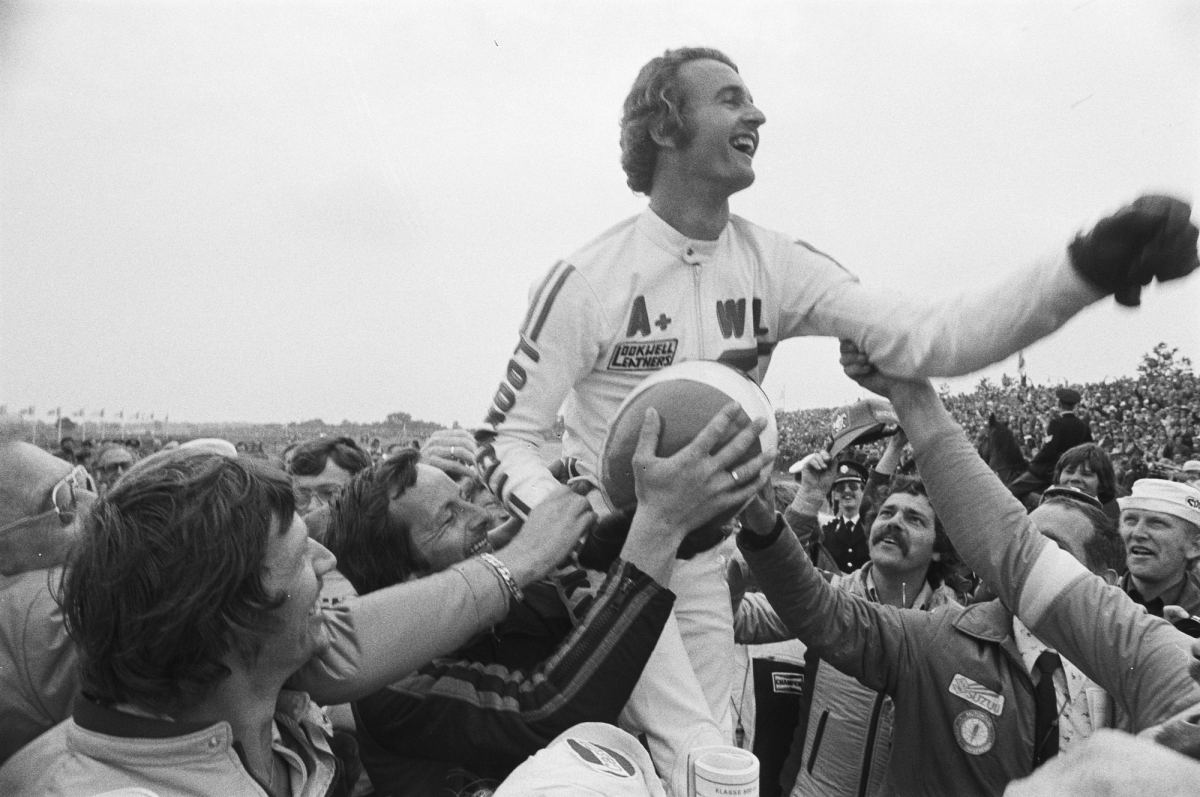
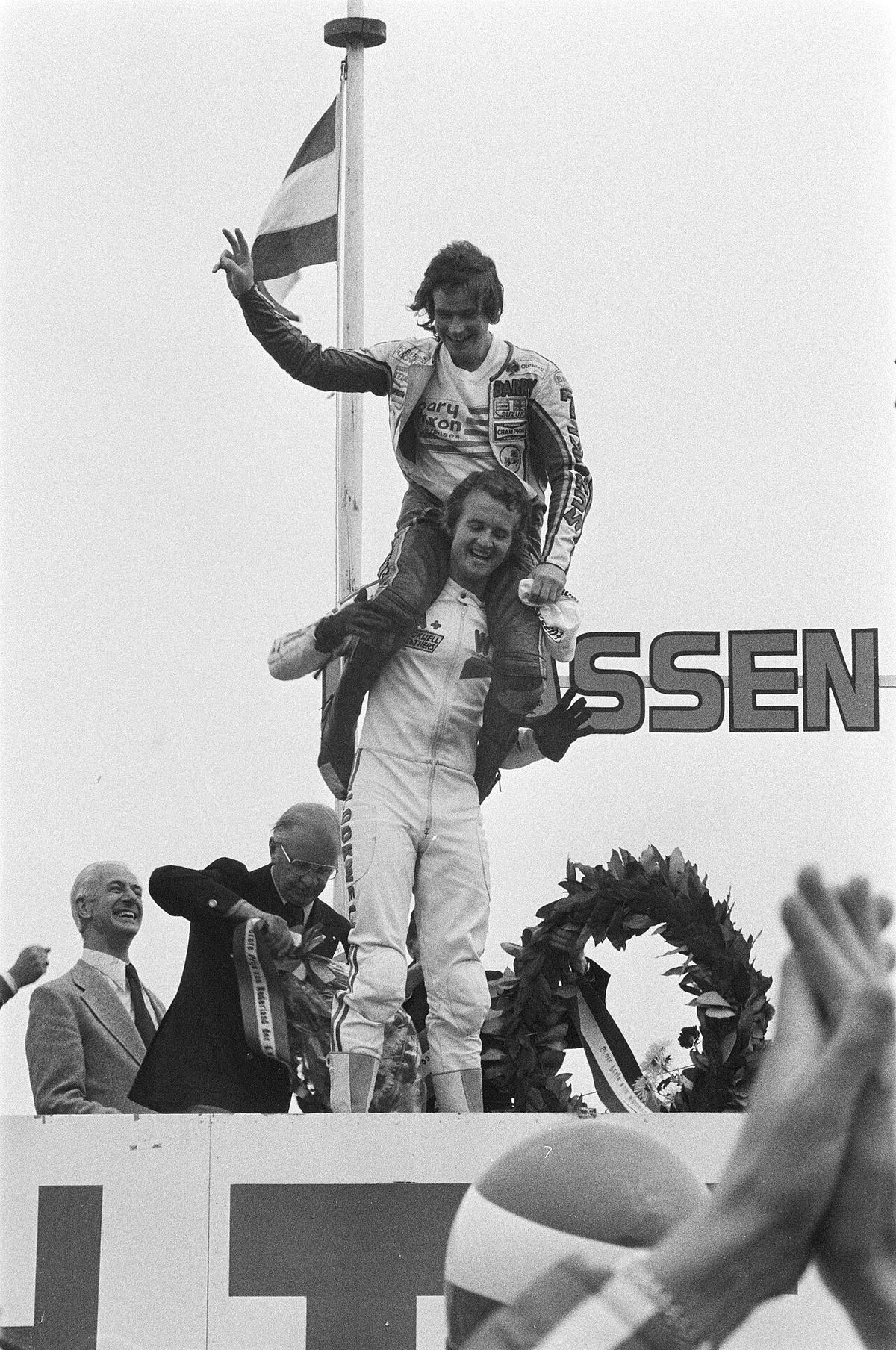
Hartog was so happy that he rode straight through the red flags at the finish and did an extra lap. On the podium, the White Giant lifted the world champion onto his shoulders.
After the flag: from privateer to factory Suzuki rider
The 1977 Dutch TT changed Wil Hartog's career. In 1978, after Pat Hennen suffered career-ending injuries at the Isle of Man TT, Suzuki brought Hartog into its factory team to help Sheene defend the title.
Hartog did not always play the supporting role. At the 1978 Belgian Grand Prix at Spa he chose intermediate tyres while Kenny Roberts and Sheene went for cut slicks. The weather worsened and Hartog won by 16 seconds. According to Classic Racer, Sheene was not pleased. Roberts went on to take the title in his rookie season in Europe.
Hartog won five 500cc Grands Prix in all: Assen in 1977, Belgium and Finland in 1978, West Germany in 1979 and Finland in 1980. Sheene, for his part, turned 1977 into his second consecutive world title.
Why Wil Hartog's 1977 Dutch TT win still matters
Wil Hartog's win opened the premier class to Dutch riders. Boet van Dulmen and Jack Middelburg followed him with 500cc successes, and Middelburg won at Assen in 1980. Writing for MotoGP.com in 2024, the commentator Nick Harris still described that 1980 race as the last Dutch home victory in the premier class.
In 2017, for the 40th anniversary, Hartog rode a lap of Assen during the Dutch TT on the Suzuki he won with, alongside Freddie Sheene, Barry's son, on one of his father's bikes.
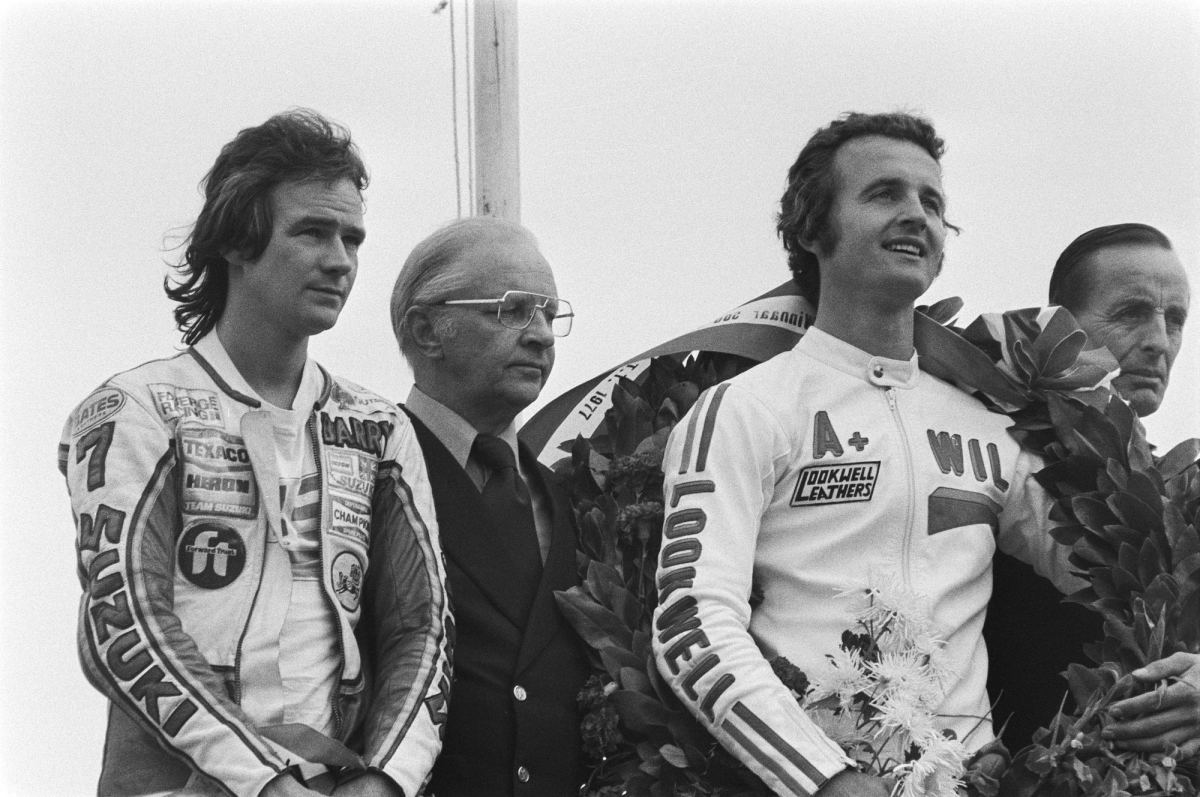
In the run-up to Assen, Barry Sheene had cured Hartog's stomach. On race day, the patient beat the doctor by 5.9 seconds.
Quick answers
Who was the first Dutch rider to win a 500cc Grand Prix?
Wil Hartog. He won the 500cc race at the 1977 Dutch TT at Assen on 25 June 1977, riding a privately entered Riemersma Racing Suzuki RG500, and finished 5.9 seconds ahead of the reigning world champion, Barry Sheene.
Why was Wil Hartog called the White Giant?
Wil Hartog was nicknamed the White Giant, De Witte Reus in Dutch, because he was unusually tall for a motorcycle racer, at over 1.80 m, and raced in all-white leathers. The name refers to both his height and his riding suit.
Who finished on the podium at the 1977 Dutch TT 500cc race?
Wil Hartog won, Barry Sheene was second, 5.9 seconds behind, and Pat Hennen was third, 10.5 seconds behind. Sheene and Hennen rode factory Texaco Heron Suzukis; Hartog rode a privately entered Suzuki RG500. The 16-lap race was run in the wet.
How many Grands Prix did Wil Hartog win?
Five, all in the 500cc class. After his 1977 Dutch TT breakthrough, Wil Hartog won the 1978 Belgian and Finnish Grands Prix as a factory Suzuki rider, the 1979 West German Grand Prix and the 1980 Finnish Grand Prix.