Zündapp KS 601: the Green Elephant that won Six Days gold and gave its name to a winter rally
The Zündapp KS 601 was post-war Germany's big sidecar twin, painted lime green and built for torque. A German journalist called it the Green Elephant, and a winter rally still carries the name.
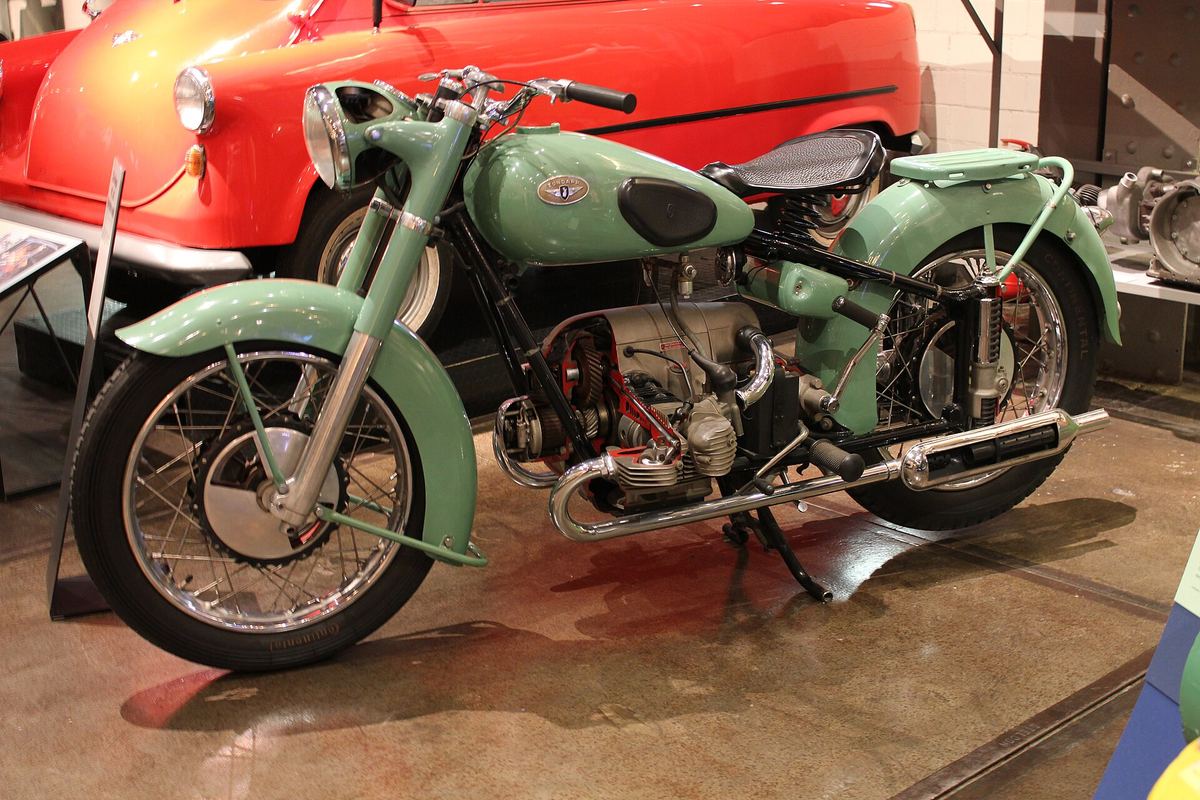
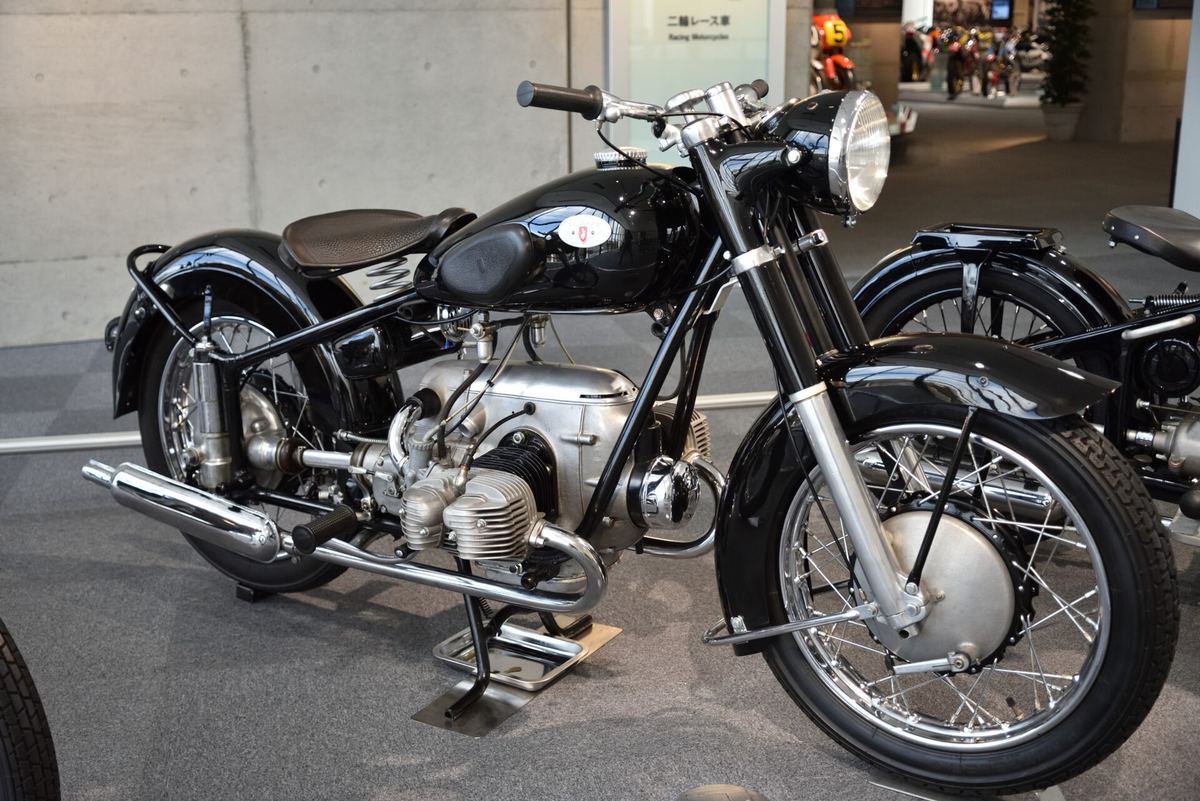
A Zündapp KS 601 at the Museum Industriekultur in Nuremberg, the city where it was built.. Photo: Sam Gamdschie / Wikimedia Commons, CC BY 3.0
Carl Hertweck, of the German magazine Das Motorrad, gave the new Zündapp its nickname in the early 1950s. Because of its lime-green paint and its tremendous torque, he called it the Green Elephant, according to the Museum Industriekultur in Nuremberg. The name stuck.
The Zündapp KS 601 was a 600cc flat twin with shaft drive, built in Nuremberg from 1950 and designed to pull a sidecar. It won gold medals at the International Six Days Trial, took a sidecar outfit around the world and gave its name to one of motorcycling's best-known winter rallies.
It was also Zündapp's last big motorcycle. The German market for heavy bikes collapsed as buyers moved to cars, and the Elephant was the last four-stroke the company ever built, the Deutsches Technikmuseum in Berlin notes.
Why Zündapp built the KS 601
Zündapp was founded in Nuremberg in 1917 and built its first flat twin, the K 500, in 1933. The K stood for Kardan, the German word for shaft drive. During the war Zündapp built the heavy KS 750 sidecar outfit for the German army.
Then it had to start again. The Allied occupation rules first limited German motorcycle makers to engines of no more than 60cc, and the ban was lifted only gradually after 1947, the Nuremberg museum explains. Zündapp built a few dozen of its pre-war KS 600 for the German authorities, but the bike's pressed-steel chassis dated from 1932.
Cycle World's history of the company, published in 1973, says Zündapp resumed production of the 28bhp KS 600 in 1950, with its rigid pressed-steel frame and girder fork. It had barely reached the market when it was replaced.
The replacement began almost by accident. An unnamed Zündapp employee took scissors and glue to some old brochures and stuck a picture of a KS engine onto a drawing of a tubular frame with telescopic suspension at both ends, according to the Nuremberg museum. Ernst Schmidt, Zündapp's designer, liked the result and had it built straight away.
The prototype went through durability testing at the Nürburgring in 1950, the museum says. The KS 601 was announced that year, and the first fully market-ready bikes followed in 1951.
What made the Zündapp KS 601 different
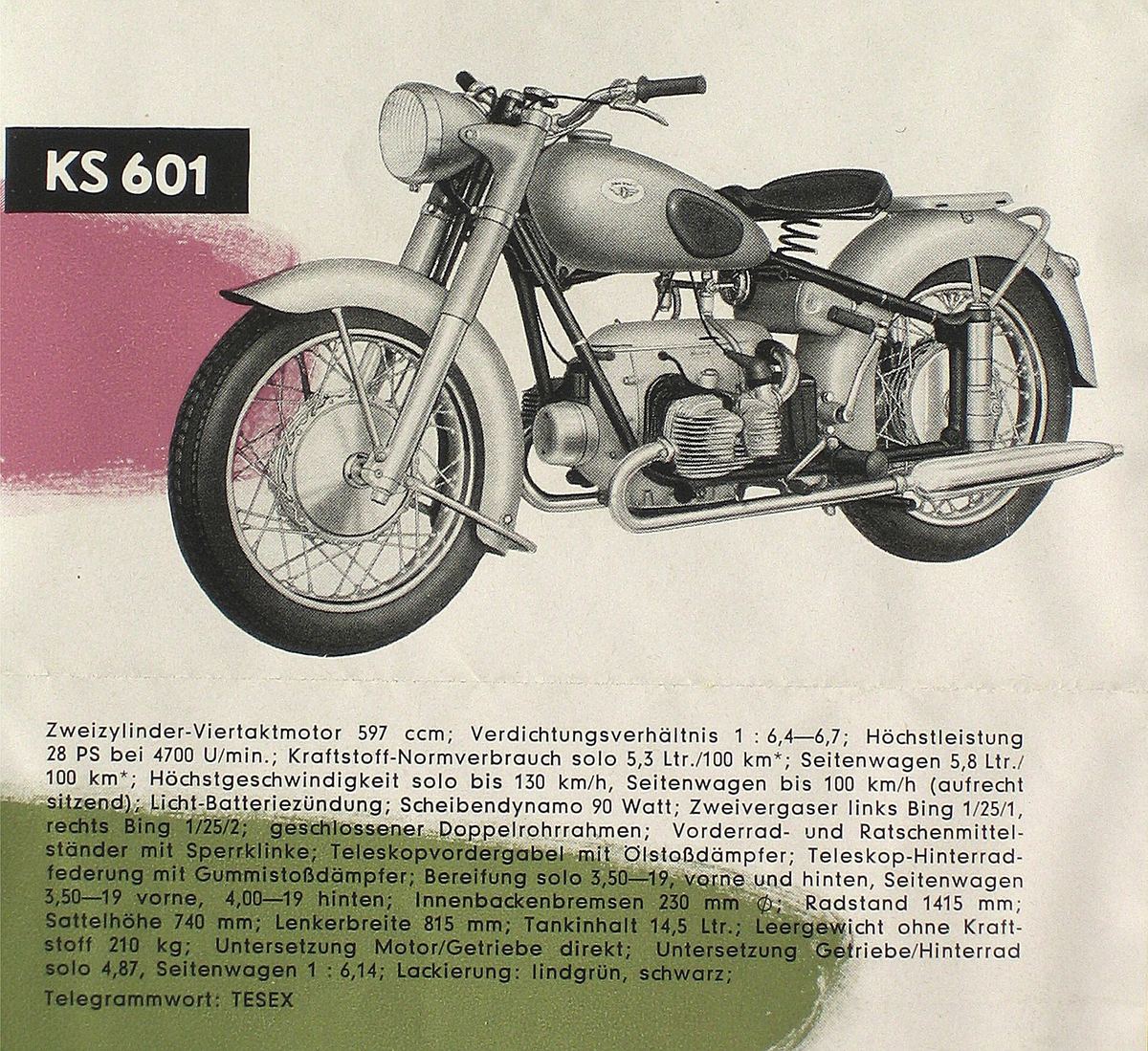
The Zündapp KS 601 combined an old engine with a modern chassis. The overhead-valve flat twin came from the KS 600, with a bore and stroke of 75 x 67.6mm, a mild 6.4:1 compression ratio and 28bhp at only 4,700rpm, Cycle World reported. The letters KS stood for Kardan Sport.
The frame was the big change. Where the KS 600 had a pressed-steel box frame, the KS 601 had a twin-tube frame, a telescopic fork, plunger rear suspension and a foot gearchange, the Deutsches Technikmuseum says. It also had four mounting points for a sidecar, because Zündapp was aiming squarely at the large sidecar market of the time.
The layout suited that job. A flat twin keeps its weight low and its cylinders out in the cooling air, and a shaft needs none of the cleaning and adjusting a chain demands. Both mattered on a machine expected to cover long distances with a sidecar and a passenger.
The new chassis was not light. Cycle World put the weight at 463lb, listed the standard model's top speed at 90mph and called the bike "a luxurious touring model". It was also the first Zündapp to be sold in America, the magazine noted.
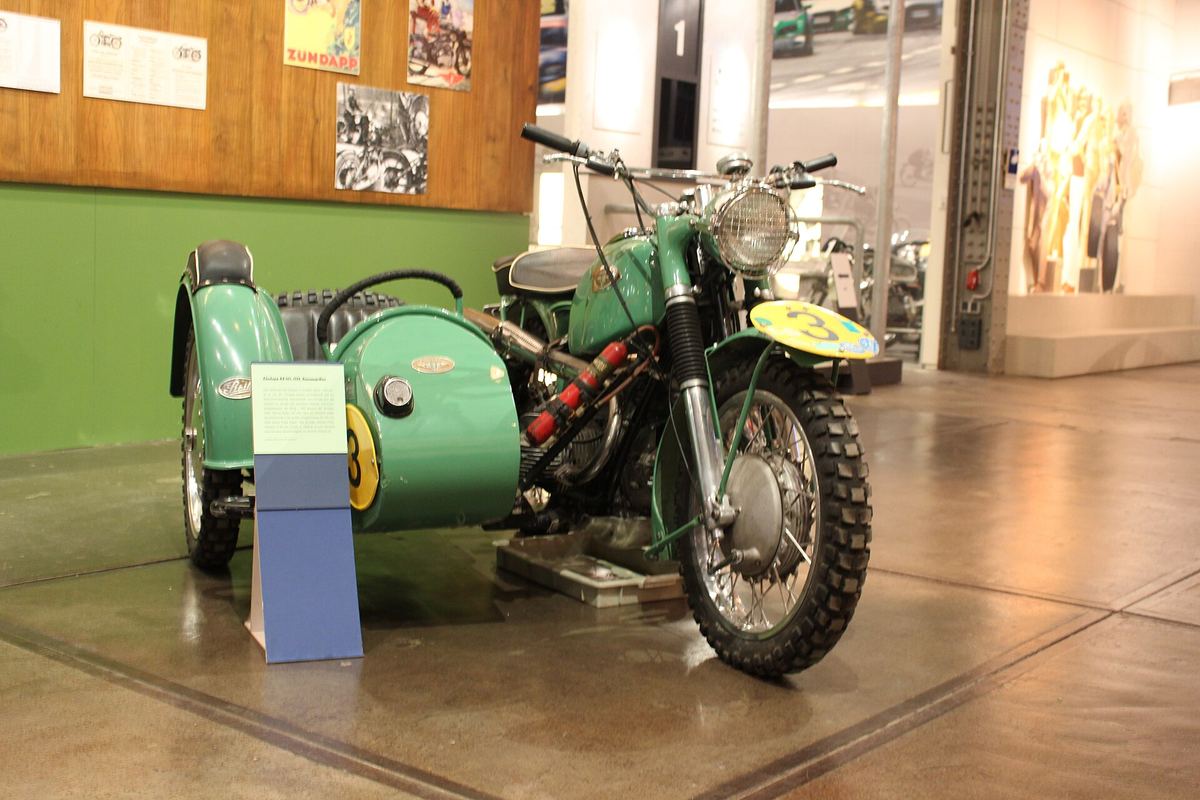
A Sport version followed, with 32 to 34bhp depending on the source. Cycle World wrote that it "would crowd the century mark", meaning close to 100mph. A Sports trim for off-road competition, the magazine added, had 33.5bhp, an upswept exhaust, knobbly tyres, a racing seat and different mudguards.
On the road
The Zündapp KS 601 was quick for its day. Classic Velocity describes it as the fastest German production motorcycle of 1951. But speed was never the point. The engine made its power at low revs, and that torque suited a heavy sidecar.
The nickname described the experience. Iconic Auctioneers, offering a 1954 KS 601 in February 2026, put it down to the bike's size, strength and remarkable durability. Owners got a heavy machine that pulled from low revs and kept going, solo or with a sidecar attached.
It was also expensive. The Technikmuseum lists a new price of 3,195 marks in 1952. Most buyers were customs officers, police forces and a few foreign armies. Many private buyers, especially family men, skipped the big motorcycle altogether and moved straight from a bicycle or a moped to a car, the museum says.
The bike's toughness became its best advertisement. In 1953 and 1954 a KS 601 sidecar outfit made a widely reported journey around the world, according to the Deutsches Technikmuseum, and Zündapp sponsored the trip, Classic Velocity says.
In the United States the reception was more mixed. Americans tended to think of Zündapp as a sidecar brand, Bike-urious notes, even though magazines of the time found the later swing-arm KS 601 EL handled better than BMW's 600.
In competition: the Elephant Team
The Zündapp KS 601 was built for endurance, not speed. Zündapp entered a 600 twin in the 1950 International Six Days Trial, Cycle World recorded, and the results followed quickly. The Six Days tested reliability as much as speed: a gold medal meant finishing every day on time, without losing points, on a sound machine.
In 1951 the KS 601 riders Hans Ernst, Gustav Keitel and Georg Weiss won the best country ranking at the Alpine Rally, and Ernst and Weiss took two gold medals at the Six Days in Varese, Italy, according to the Nuremberg museum. In 1952 Zündapp riders won three gold medals at the Six Days in Austria, the museum says. Cycle World counts four Zündapp golds that year, and adds wins in the Warsage 24 Hours and the Paris–St Etienne.
In 1953 Werner Kritter won a gold medal at the Alpine Rally, and Weiss won an Edelweiss award. That same year, at the Six Days in Wales, Zündapp won one gold, Cycle World recorded. In 1954 Zündapp's riders won three golds at the Alpine Rally and became known as the Elephant Team. In 1955, at the Six Days in Czechoslovakia, Zündapp took three golds, a silver and a bronze, Cycle World recorded.
Between 1955 and 1960, Zündapp's sidecar crews won six German off-road championships, with Kritter among the winners. Cycle World noted that Zündapp won five straight open-class titles with its big 600cc twin.
The KS 601 today
The Zündapp KS 601 did not last. The German market for heavy motorcycles collapsed at the end of the 1950s, exports lagged behind BMW's, and Zündapp withdrew the KS 601 in 1957 without a successor, the Technikmuseum says. The KS 601 EL, or Elastic, arrived for the United States in 1956 but was too late to save it. Bike-urious puts EL production at about 200. By then Zündapp's attention had moved to smaller vehicles, and its Janus microcar of 1957 and 1958 nearly ruined the company, the Nuremberg museum says. Zündapp sold its Nuremberg works in 1958, Cycle World reported, and production moved to Munich. Zündapp went bankrupt in 1984.
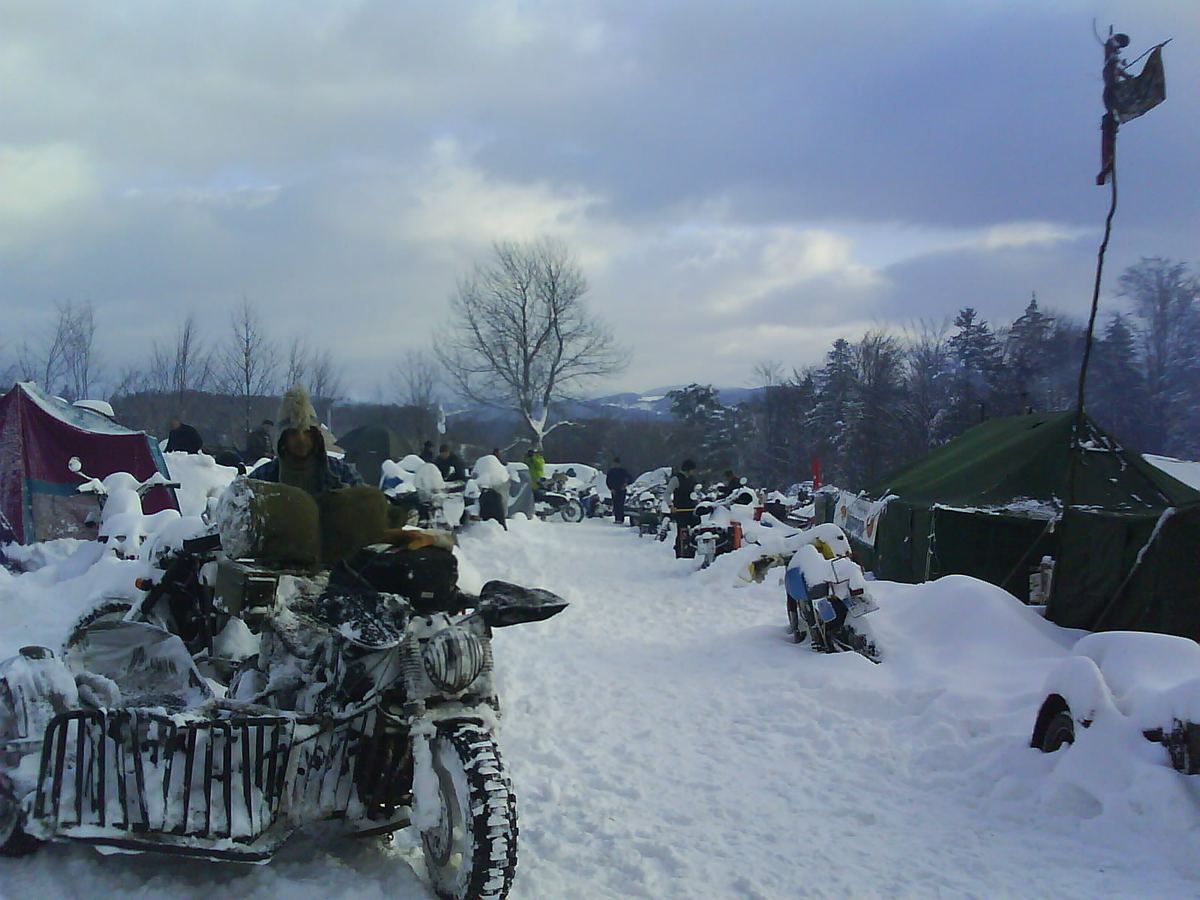
The name outlived the bike. In 1956 riders gathered for a winter meeting at the Solitude circuit near Stuttgart, and named it the Elephant Rally after the KS 601. It is still held every winter in Bavaria, the Nuremberg museum says. The museum also displays an off-road sidecar outfit restored by Gustav Franke in 2018 and 2019. The Deutsches Zweirad- und NSU-Museum in Neckarsulm has also shown a Green Elephant, and the Technikmuseum in Berlin keeps a 1952 cutaway in its collection.
Good examples still change hands. In January 2025 Mecum sold a 1953 KS 601 for $9,350 at its Las Vegas auction, according to Classic.com. In April 2026 Bonhams offered a 1951 example at its Stafford sale, part of a private collection. For Zündapp, the Technikmuseum concludes, the bike was never a commercial success, but it brought the company a great deal of prestige.
Quick answers
What is the Zündapp KS 601?
The Zündapp KS 601 is a 597cc flat-twin motorcycle with shaft drive, built in Nuremberg, Germany, from 1950 to 1957. Designed to pull a sidecar, it made 28bhp and was known for its lime-green paint. It was Zündapp's last large motorcycle and its last four-stroke.
Why is the Zündapp KS 601 called the Green Elephant?
Carl Hertweck of the German magazine Das Motorrad gave it the name. He was referring to its lime-green paint and its tremendous torque, according to the Museum Industriekultur in Nuremberg, the city where the bike was built.
How many Zündapp KS 601s were made?
Sources disagree. The Museum Industriekultur in Nuremberg says 5,680 were built, while the Deutsches Technikmuseum in Berlin lists 4,990 standard bikes plus 1,440 of the more powerful KS 601 Sport.
Is the Elephant Rally named after the Zündapp KS 601?
Yes. The winter motorcycle meeting first held at the Solitude circuit near Stuttgart in 1956 took its name from the Zündapp KS 601, the Green Elephant. It is still held every winter in Bavaria.