Suzuki GSX-R750: the oil-cooled endurance racer with lights that weighed 388 pounds
The 1985 Suzuki GSX-R750 was an endurance racer made road-legal. Etsuo Yokouchi cut a fifth of the weight from the 750 class, cooled the engine with oil and built what Cycle World called Japan's first racer-replica.
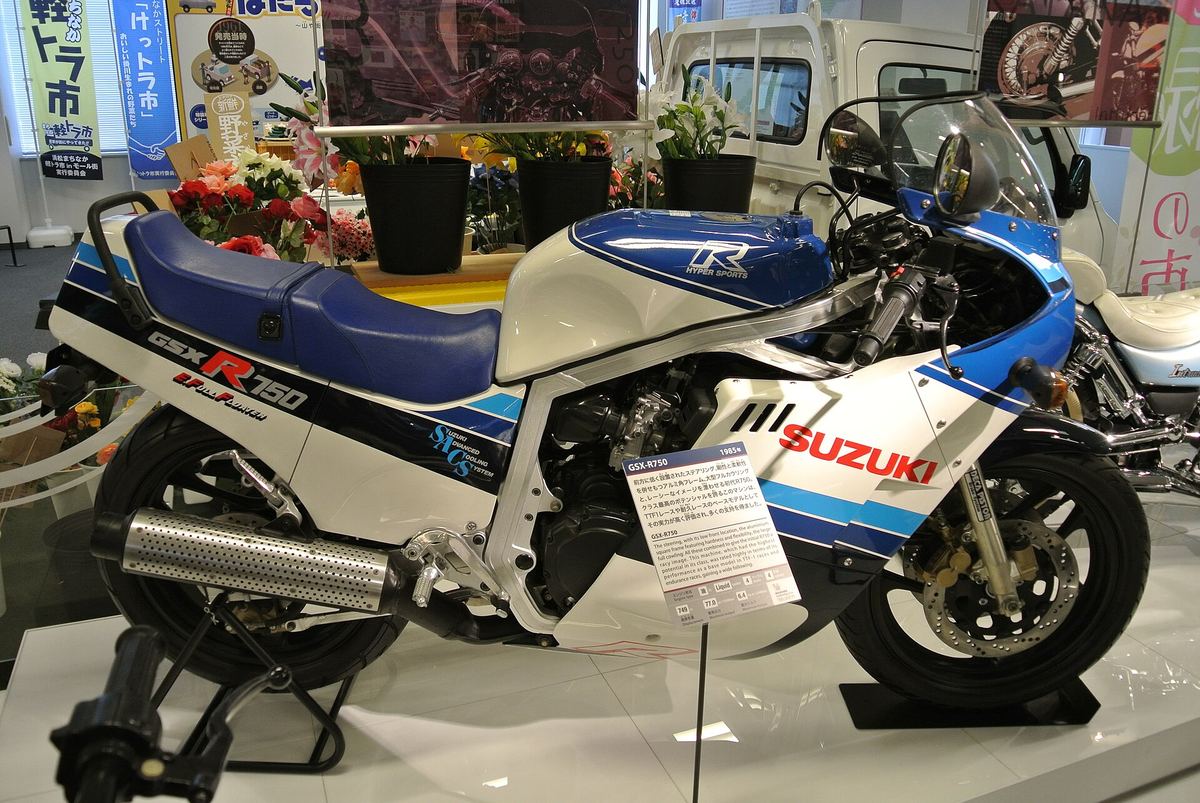
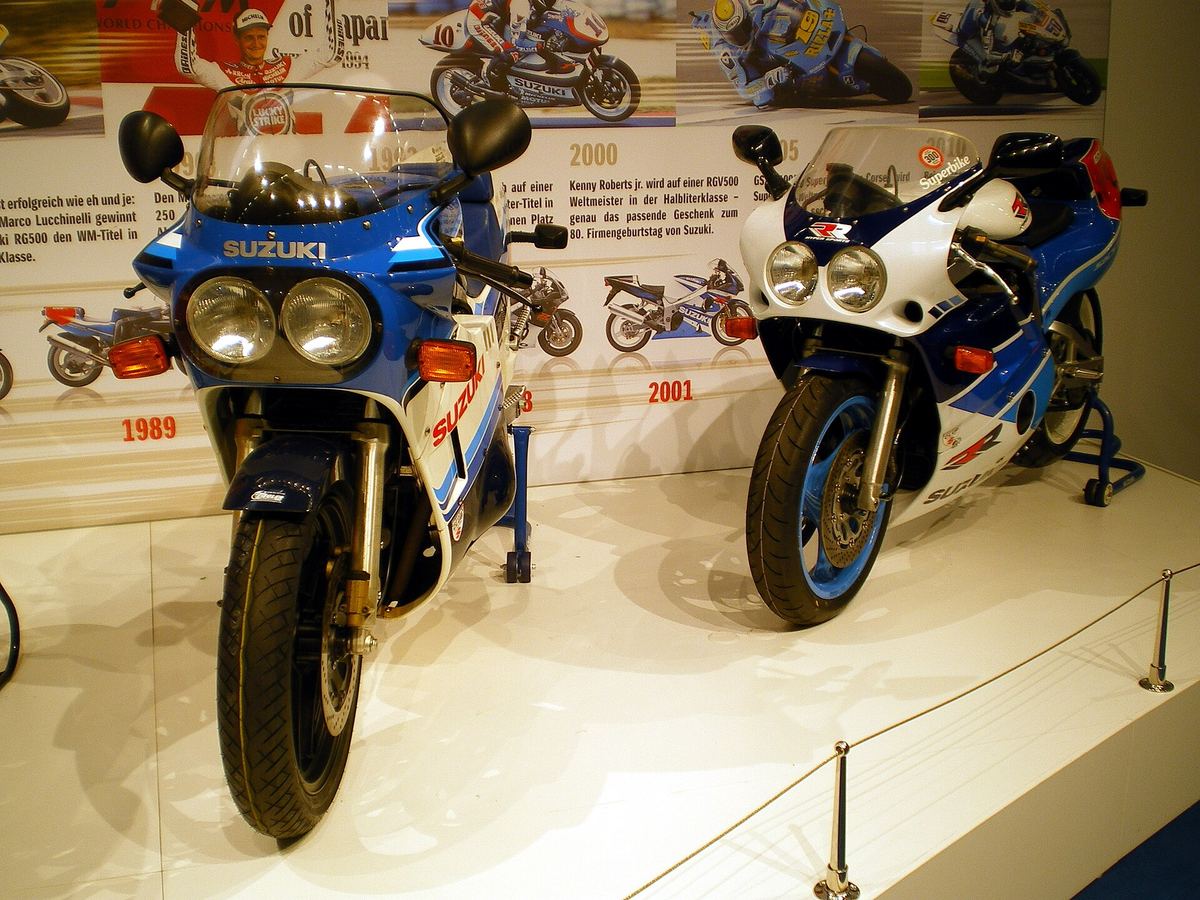
A 1985 GSX-R750 in the Suzuki History Museum, Hamamatsu.. Photo: Rainmaker47 / Wikimedia Commons, CC BY-SA 3.0
Steve Anderson saw the future in March 1985. Writing in Cycle World, he predicted that "sport bikes will soon be divided into two categories: before the GSX-R, and after". The bike he meant was the Suzuki GSX-R750, and its architect, he wrote, was an engineer "you've likely never heard of".
That engineer was Etsuo Yokouchi, Suzuki's head of motorcycle engineering. His belief was simple: the lighter a motorcycle, the better it would perform in every way. The GSX-R750 put that belief into production. Suzuki claimed 388lb dry, at a time when Honda's 750 Interceptor weighed 515lb.
It was built as a road-going copy of Suzuki's endurance racers, with an aluminium frame, a racing-style fairing and an engine cooled by jets of oil. When it was shown at the Cologne show in September 1984, Anderson later recalled, "the motorcycle world could hardly believe what it was seeing".
Why Suzuki built the GSX-R750
Suzuki needed a hit. In the early 1980s, Anderson wrote in 2001, the company "was being killed in the marketplace" by the sales war between Honda and Yamaha. Sports bikes of the time were mostly standard machines with low bars and small fairings, and a lightweight 750 weighed 500lb or more. Suzuki wanted a bike that could single-handedly give it the performance image it lacked in Europe, Anderson wrote in 1985.
Yokouchi had form. He had led the team behind Suzuki's X-6 250cc two-stroke twin in the 1960s and later brought in the German designer Hans Muth to create the Katana 1100, Cycle World says. As head of engineering he first built the GSX-R400, a 400cc aluminium-framed street racer sold only in Japan from 1984. It weighed 18 percent less than its predecessor.
"If we can make a 400 18 percent lighter than its predecessor on our first attempt," Yokouchi reasoned, "surely we can do better on our next." The 750 would weigh 20 percent less than Suzuki's own GS750. It also had to make 100 horsepower, the legal limit in several European countries, and be strong enough to race reliably with 130hp, Anderson reported.
The engineers started by working out which parts of the old GS series never broke in testing. Almost all of them, it turned out, Cycle World says. "We were too conservative. Nothing ever broke. Everything was over engineered," Yokouchi concluded, as quoted by Shannons Club.
What made the Suzuki GSX-R750 different
The Suzuki GSX-R750's cooling was the clever part. A water-cooled engine would have added about 14lb, so Suzuki looked at aircraft piston engines instead. Its 650 Turbo already used oil jets under the pistons, and Yokouchi's engineers added more jets aimed at the tops of the combustion chambers. At peak flow, almost 10 litres a minute hit each chamber crown, Anderson wrote, nearly as much as the water flowing through a TZ750 racing engine. Suzuki called it SACS, the Suzuki Advanced Cooling System.
Getting all that oil back to the sump was the hard part. According to Anderson, the engineers tested baffles and return lines with mock-up engines in the car park, using garden hoses and water. A large oil cooler and close-pitched fins, like those on a Second World War radial engine, did the rest.
Weight came out everywhere. Computer stress analysis trimmed the crankcase, pistons and rods, and smaller bearings cut friction by about 3hp at 11,000rpm. The engine was 24lb lighter than a GS750's, 11lb of it from the four-into-one exhaust. The aluminium frame weighed 18lb, and by combining castings with extruded tubes, Suzuki cut the number of frame parts from 96 to 26, which kept the price down. Even the wheels were pared back: Cycle World said they had the thinnest spokes it had seen on a full-size road bike. The only magnesium part was the cylinder-head cover.
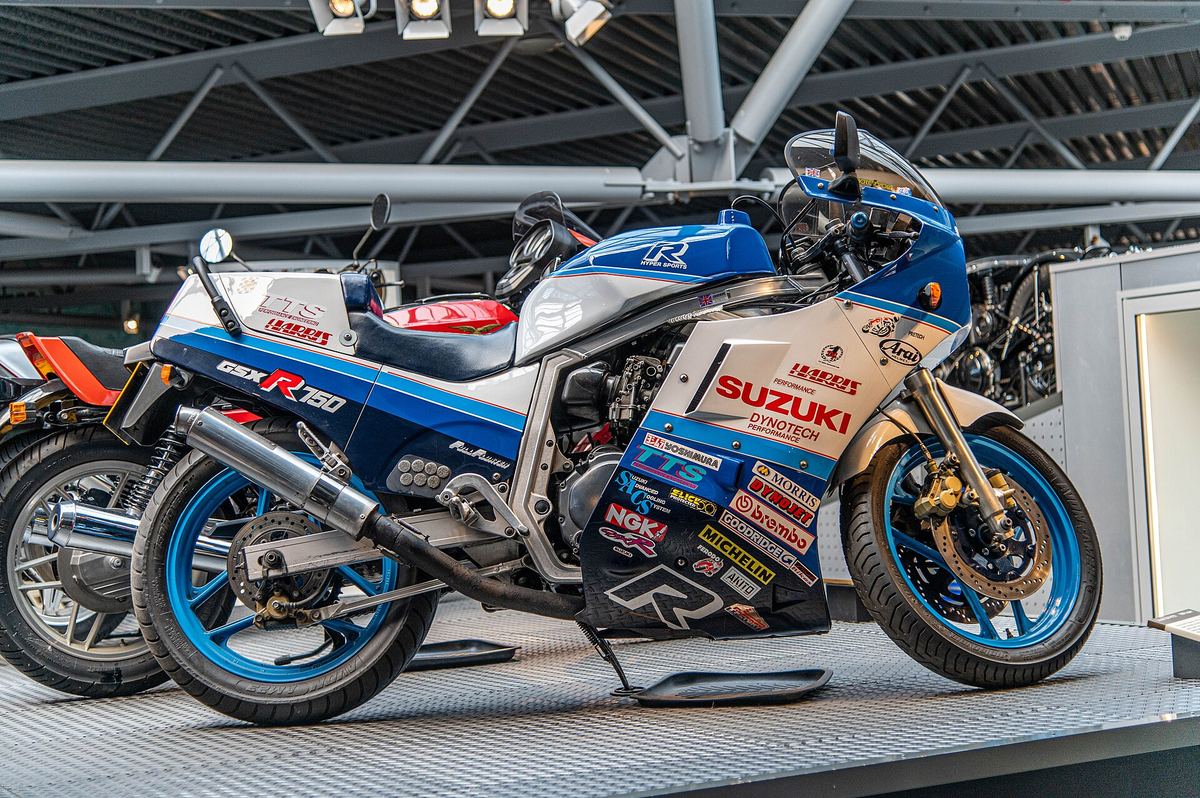
It looked like a racer too. The twin-headlight fairing copied Suzuki's endurance bikes, and there was foam rubber around the instruments. Japanese-market bikes were limited to 77bhp, Cycle World noted; Canadian and most European bikes had 105bhp.
In competition: Le Mans and a 24-hour record
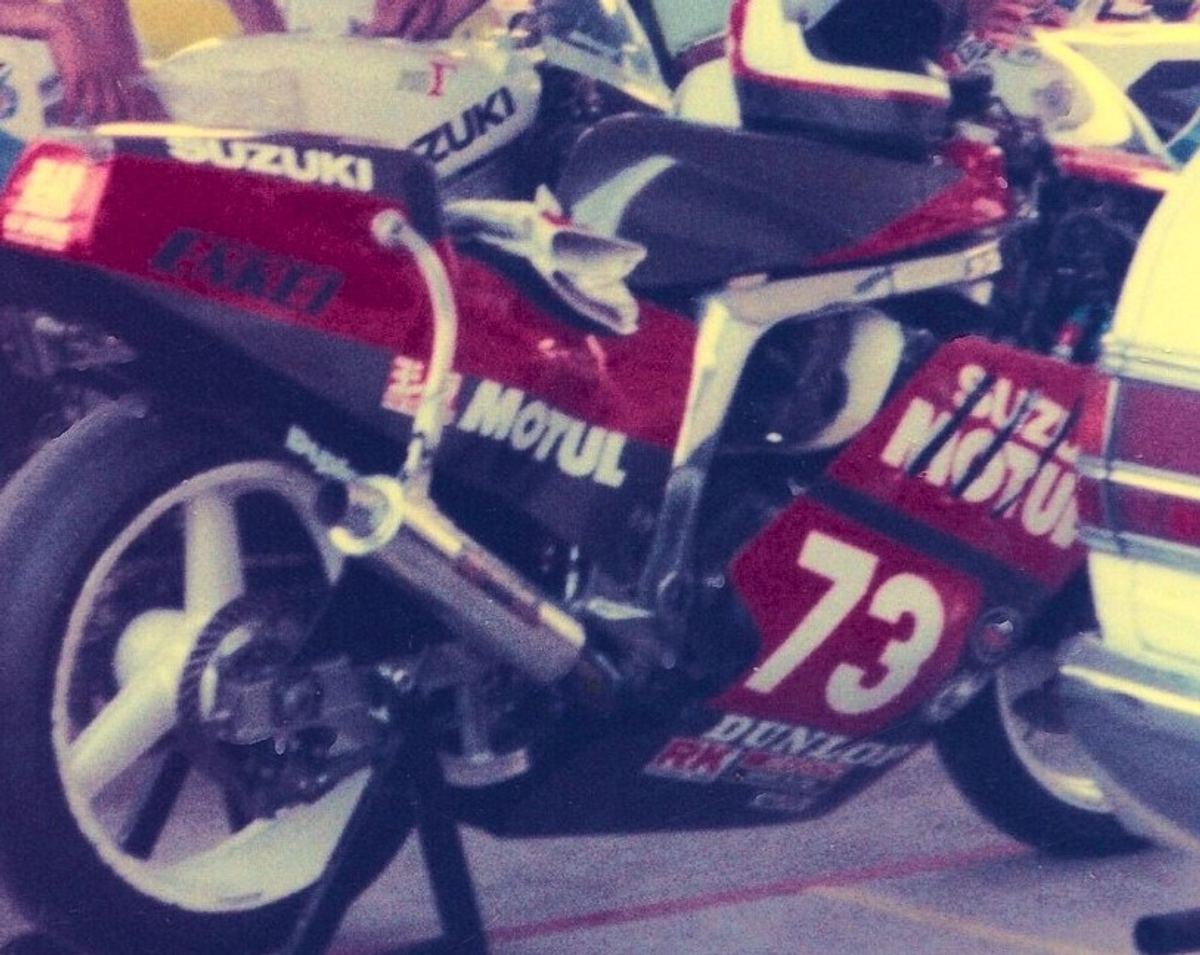
The Suzuki GSX-R750 raced immediately. The racing version won the 1985 Le Mans 24 Hours and the F1 class of the Japanese championship in its first season, webBikeWorld reports. With Yoshimura, it won the All-Japan TT-F1 title three years running, from 1985 to 1987, according to the Japanese magazine Bestcar.
In Britain it dominated the first MCN Superstock championship in 1985, the first series anywhere to use the Superstock name, Alan Cathcart wrote in Cycle News. He recalled the road bike's early reputation as "rewarding if demanding", what the French call a "nervous" motorcycle that would sometimes flap its front end.
Then Cycle World tried something bolder. In December 1985, just before the bike went on sale in the United States, the magazine ran two completely standard GSX-R750s for 24 hours on Uniroyal's 5-mile banked test track at Laredo, Texas. Both bikes finished, and between them they set 12 FIM world records, including a 24-hour average of 128.303mph. That beat the old 24-hour record by about 11mph, and it was a record for all motorcycles, not only 750s, Cycle World noted. The magazine called the bike "running proof that validates the low-mass approach to high-performance motorcycling", according to Motorcycle Classics.
On the road
The road bike demanded a lot. When Cycle World compared a GSX-R750 with Yamaha's FZ750 in June 1985, it found the Suzuki faster: "For sheer performance, the Suzuki GSX-R can't be beaten." Club racer Doug Toland said he would choose it to race, for its high-speed power, brakes and racer-like feel.
As a road bike it was harder to love. The magazine found the riding position "extreme and uncomfortable for anything but full-bore blasting", the steering slower than its weight suggested and the throttle springs heavy. It "feels like a racebike on which someone has done an exceptionally thorough job of conversion", the testers wrote. As an all-round sports bike, they preferred the Yamaha. In a later road test Cycle World found the bars too low and the pegs too high, and concluded: "It simply is not a very good street bike." Buyers did not seem to mind. Cycle Guide named it Motorcycle of the Year in 1987, Motorcycle Classics says.
Anderson had a different memory of the press launch at Suzuki's Ryuyo test track. Four journalists crashed on the first day, which he blamed on excitement rather than the bike. The GSX-R reached well over 145mph down the straight, he wrote, and "braked and turned and growled like the racer it was".
The GSX-R750 today
The Suzuki GSX-R750 became Suzuki's most important sports bike. It went on sale in March 1985, reached the United States in 1986 alongside the bigger GSX-R1100, and stayed in Suzuki's range in several forms until 2016, MCN says. The oil-cooled engine survived in other models, from 400cc to 1400cc, until 2006, according to RideApart. Cycle World later argued that it eventually forced much larger companies, Honda among them, to recognise the value of racetrack-based performance. Not every successor worked: the magazine called the short-stroke 750 of 1988 one of the line's "rare missteps", and the first liquid-cooled GSX-R750 arrived in 1992.
First-generation bikes are still affordable. In September 2025 Iconic Motorbike Auctions sold a 1986 US-model GSX-R750 for $6,848, and in July 2026 another went for $7,758. The rarer 1986 Limited Edition made $17,600 at Mecum's Las Vegas sale in January 2026.
Anderson counted himself lucky to have been at the launch. "Something new was born with that first GSX-R," he wrote in 2001, "something that lives on to this very day."
Quick answers
What is the Suzuki GSX-R750?
The Suzuki GSX-R750 is a 749cc four-cylinder sports motorcycle launched in 1985. Designed under Etsuo Yokouchi as a road-going copy of Suzuki's endurance racers, it had an aluminium frame, an oil-cooled engine and a claimed dry weight of 176kg. It is often called Japan's first race replica.
What is Suzuki's SACS oil cooling?
SACS, the Suzuki Advanced Cooling System, uses jets of engine oil sprayed onto the undersides of the pistons and the tops of the combustion chambers, plus a large oil cooler. Suzuki chose it for the 1985 GSX-R750 because water cooling would have added about 14lb.
How fast is the 1985 Suzuki GSX-R750?
Cycle World's Steve Anderson saw well over 145mph on the Ryuyo straight at the 1985 launch. In December 1985, two standard GSX-R750s set 12 FIM world records at Laredo, Texas, including a 24-hour average of 128.303mph.
When did the GSX-R750 come to America?
The GSX-R750 went on sale in Europe, Canada and Japan in 1985 but did not reach American dealers until 1986, when it arrived alongside the GSX-R1100. Cycle World's 24-hour record run in December 1985 marked its US introduction.