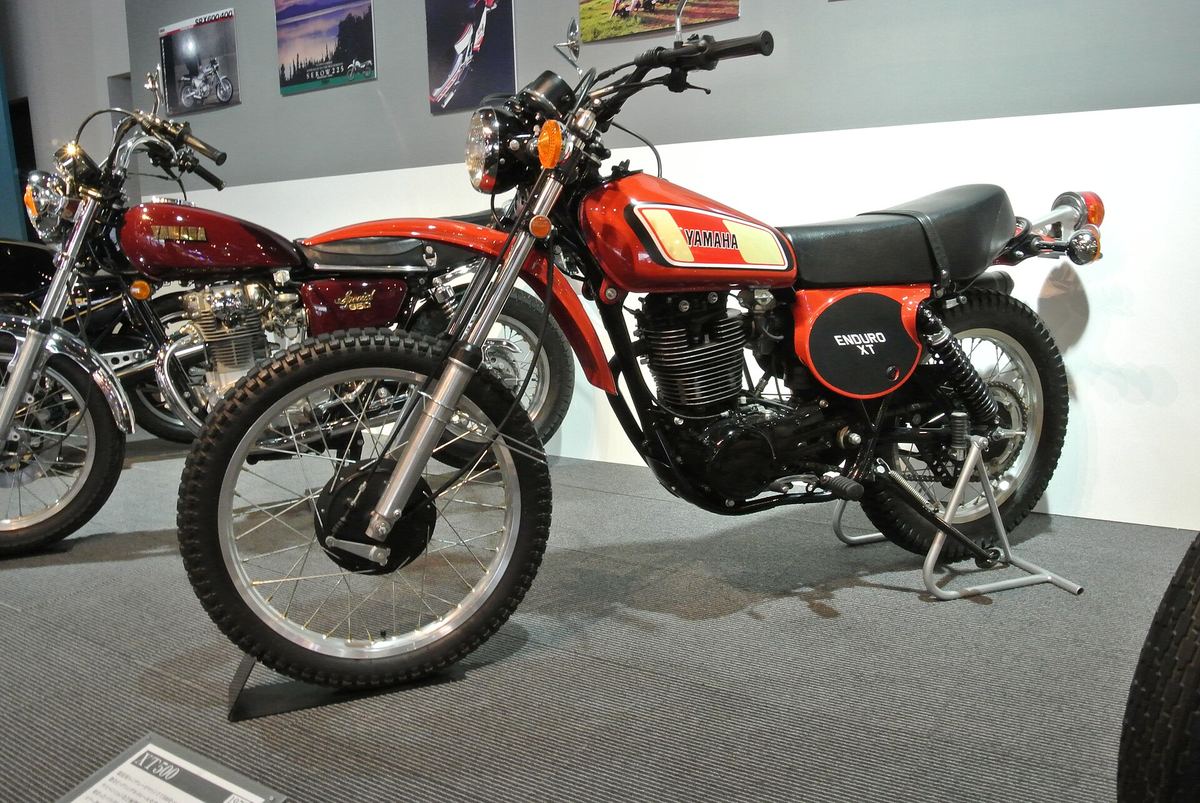
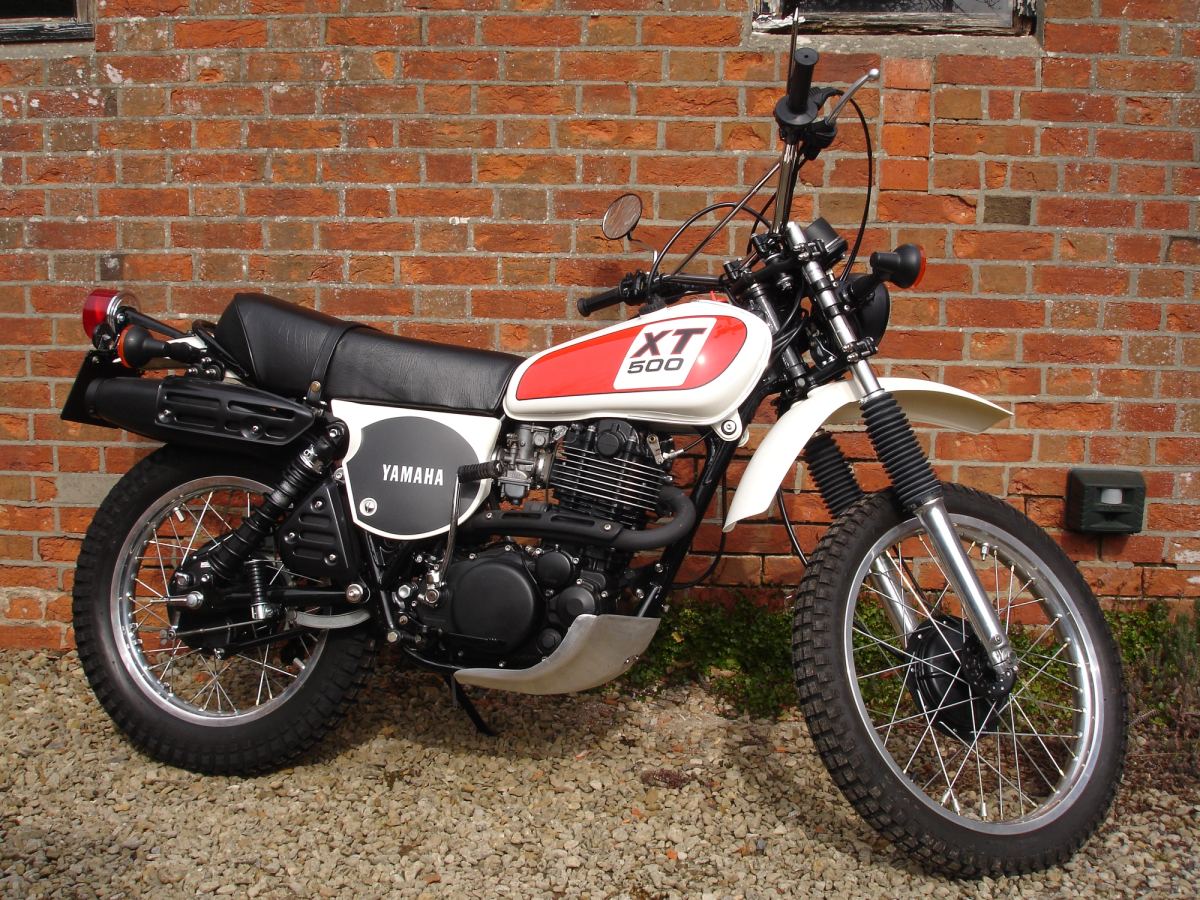
A first-year 1976 Yamaha XT500 in Yamaha's Communication Plaza museum in Japan.. Photo: Rainmaker47 / Wikimedia Commons, CC BY-SA 4.0
Dakar, January 1979. The first rider to reach the finish of the first Paris-Dakar Rally was Cyril Neveu, on a Yamaha XT500, and Gilles Comte made it a Yamaha one-two. Of the 182 starters who had left Paris on Boxing Day 1978, only 74 made it to Senegal. According to Yamaha, the two XT500s also finished ahead of the Range Rovers and Renaults, because cars and bikes then shared one classification.
It was an unlikely result for a bike that Yamaha had never planned to send to Africa. Its engineers had tested it on the roads and trails between Los Angeles and Missouri, not in Algeria or Niger. The Yamaha XT500 was shown in autumn 1975 and went on sale in 1976. It was conceived for something far more ordinary: weekend riders in the deserts of the American West Coast who wanted a big, simple four-stroke to play on. The Sahara was the French importer's idea.
Why the Yamaha XT500 was built
The Yamaha XT500 was built because American riders asked for a four-stroke and Yamaha did not have one to sell them. According to Yamaha's own history, the request came from the planning staff at Yamaha Motor USA in Los Angeles. They wanted a big single-cylinder "play bike" for riding hard across open desert. In the early 1970s the company sold only two-strokes in that market, and the riders on long Californian enduros wanted the strong low-speed pull that a big single gives.
Yamaha already knew trail riders: its 250cc two-stroke DT-1 had arrived in 1968, and the company had shown a trail model at every Tokyo Motor Show since. But its own 500cc two-stroke scrambler, the SC500, had earned a poor reputation, which pushed the engineers towards a four-stroke.
Honda was already there. Its overhead-cam XL350 single of 1974 was drawing exactly the buyers Yamaha wanted, as Clement Salvadori wrote in Rider.
The idea also ran against fashion. Yamaha's own account notes that big singles were seen as outdated in the mid-1970s, and that British makers such as BSA had stopped launching new ones. The engineers still studied the BSA Victor and Ducati's 450 single as references.
Yamaha developed two bikes side by side: the TT500, a pure enduro sold in the US from 1975, and the road-legal XT500 that followed in 1976. Cycle World senior editor Randy Riggs secretly rode a TT500 prototype at Saddleback Park in summer 1975. He later told Motorcycle Classics it was too heavy to be a racer, but perfect as a fire-road companion and play bike.
What made the XT500 different
The XT500 engine was designed to be light, compact and almost impossible to break. Its designer, Nobuaki Oshiro, was 28 and had previously designed two-stroke engines. His first prototype was a 465cc single that borrowed its cylinder head from the TX750 twin. The production engine grew to 499cc, with an 87mm bore and 84mm stroke, two valves and a chain-driven overhead camshaft.
The lubrication was the clever part. The XT500 used a dry sump, which means the oil lives in a separate tank and is pumped round the engine instead of sitting in the crankcase. That matters on a bike that spends its life leaning, climbing and landing: the oil supply never runs dry at an angle. Yamaha went one step further and stored the oil inside the frame tubes, which its archive describes as a first for a Japanese domestic model. The engineers used clear pipes on test rigs to see where the oil collected.
Weight was the obsession. The chassis team worked to the motto "1 gram for 1 yen", meaning they would spend money to save weight. The TT500 got a magnesium engine cover and an aluminium tank. Ryozo Okano, who designed the chassis, recalled hiding a wooden form inside the styling mock-up to win an argument about the size of the 8-litre fuel tank.
Testing was brutal. In October 1974 the team took test bikes to the US and rode them from Los Angeles towards Missouri. On the test rig, the frame behind the engine kept cracking until thicker tubes fixed it. Yamaha says the bike received around 2.5 times its standard full-throttle endurance testing.
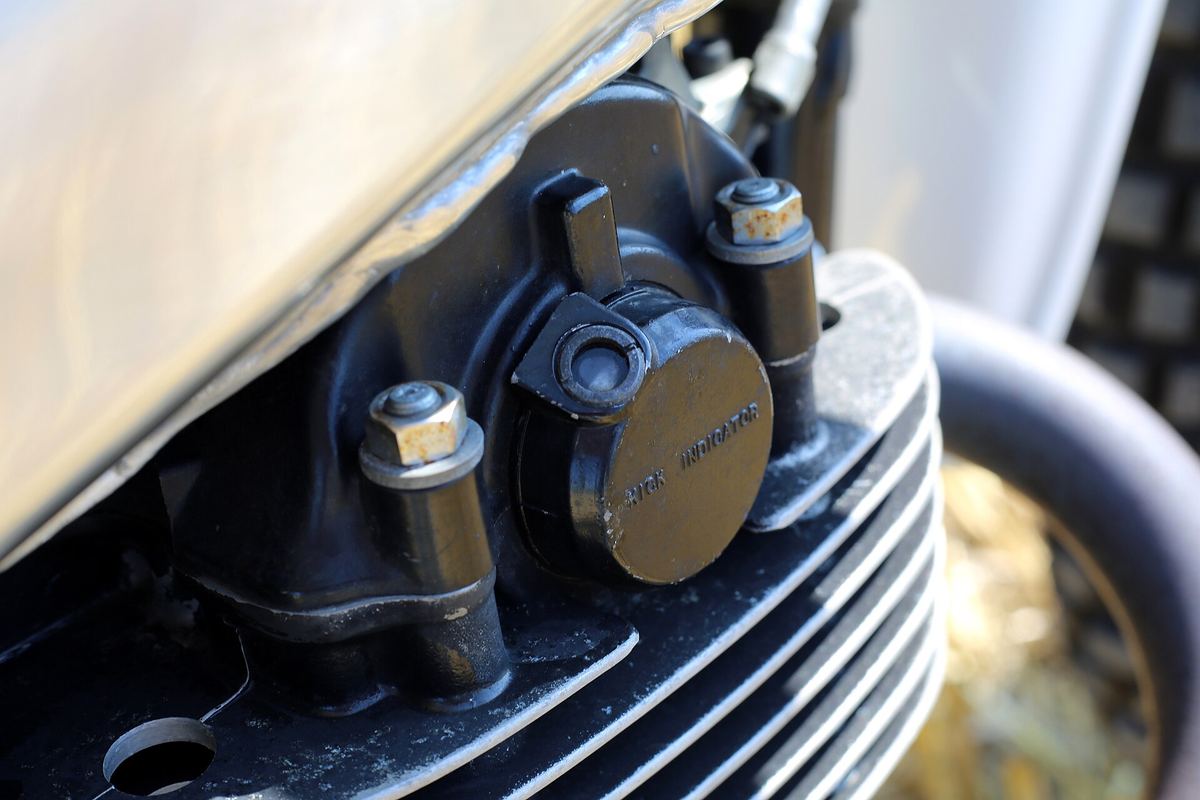
The kick-start got the same treatment. The team performed 10,000 test kicks, 100 per person. Riders got a decompression lever on the handlebar, and from 1977 a small window on the cylinder head showed when the piston was at top dead centre, the right moment to kick.
On the road and across the Sahara
The Yamaha XT500 sold quickly in America as a weekend bike and won enduro, dirt-track and even ice races there, according to Yamaha. In Britain, Motorcycling Monthly tested one in November 1976 at £685. The magazine praised how well it handled on the road, though its testers noted that in some conditions the steering went very light and the bike tended to weave.
Owners soon learned the routine. Salvadori found the XT usually started in two or three kicks, hot or cold. Testing an early XT for Motorrad in 2016, Michael Pfeiffer found it pulled smoothly from below 2,000 rpm and cruised happily at around 110 km/h, though the front drum brake faded after a few hard stops.
Europe loved it more than anyone. Yamaha says its slim chassis and torquey engine made it a natural all-rounder for errands and touring. In Germany, where Motorrad published its first full test in issue 15/1977, the XT outlived its own American career by years.
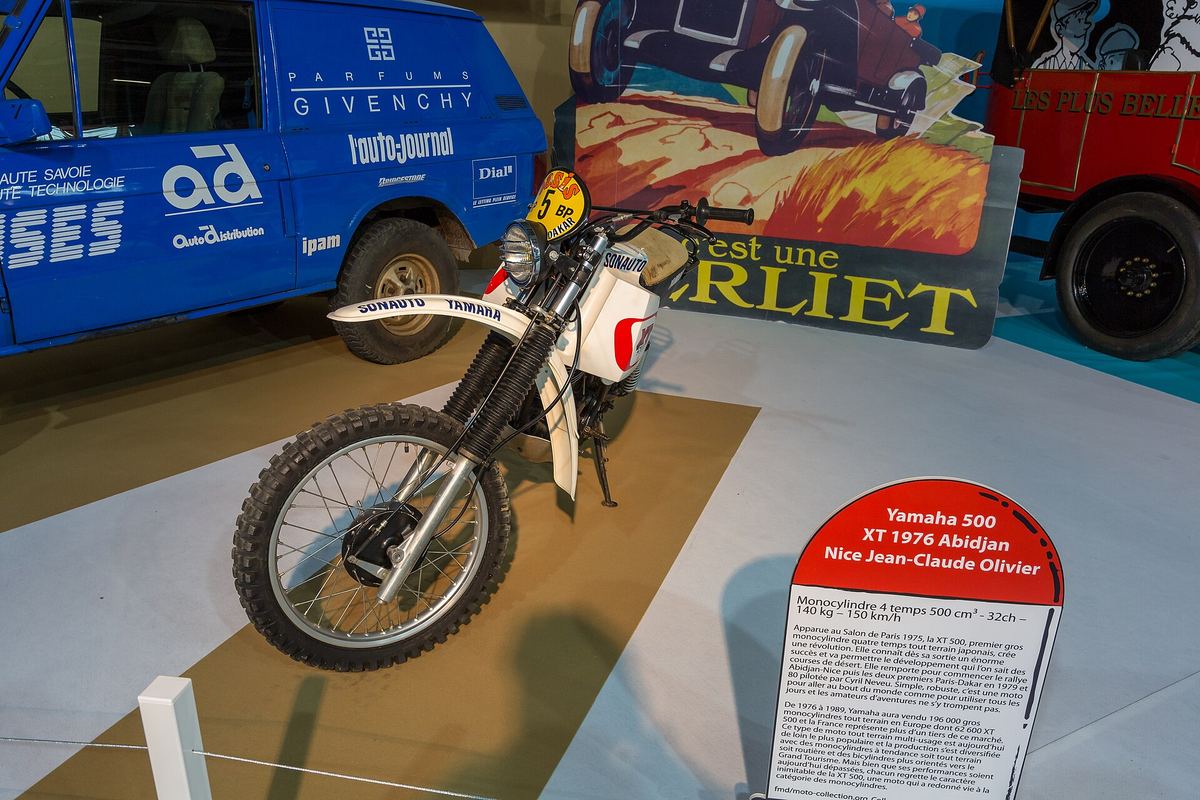
The desert story belongs to Sonauto, the French Yamaha importer, and its manager Jean-Claude Olivier. Olivier rode an XT500 in the Abidjan-Nice rally, a race of about 10,000 km from the Ivory Coast to the Riviera. Thierry Sabine, who later created the Paris-Dakar, was in the same event. [⚠ VERIFY: year of Olivier's Abidjan-Nice ride, 1976 (exhibit plaque, Paris 2018) or 1977 (Yamaha)]
Olivier then led a four-rider Sonauto Yamaha team on XT500s at the first Paris-Dakar in 1978–79. Neveu won it, and in 1980 he won again with XT500 riders in the top four places. Yamaha says 11 of the 25 bikes that finished in 1980 were XT500s. From 1981, factory teams arrived and BMW's flat-twins took over.
The Yamaha XT500 today
The Yamaha XT500 stayed in production for about 14 years and finished in late 1989, according to Motorrad: a long life for a design of the 1970s. Its engine had a second life: in 1978 Yamaha used it in the SR500 and SR400 road bikes, and the SR400 became one of the longest-running models in the company's history. The XT line itself grew into the four-valve XT550 and, at Sonauto's request, the XT600 Ténéré, unveiled in Paris in autumn 1982. By 1985 Olivier himself finished the Paris-Dakar second on a Ténéré, behind Gaston Rahier's BMW.
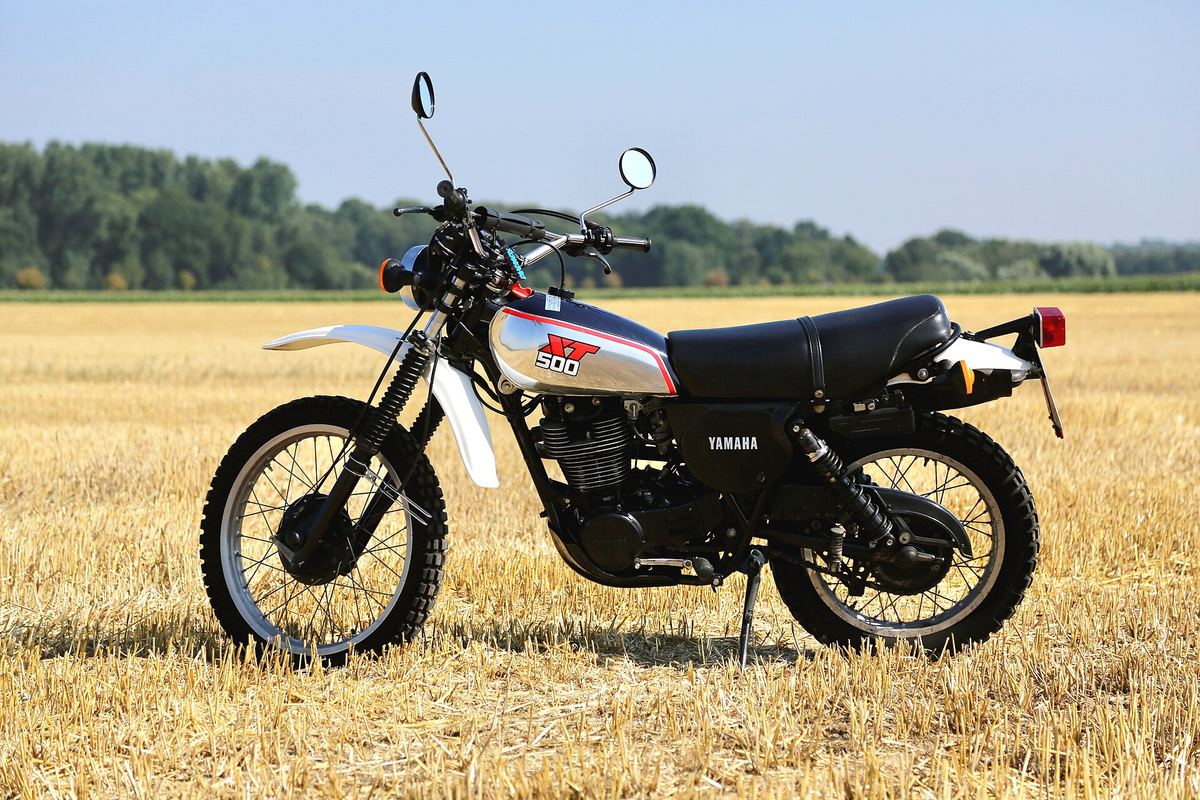
Collectors care about the details. The 1976 bikes have their exhaust header running under the engine, a layout that was easily crushed in falls. Motorrad says only about 200 of them reached Germany. From 1977 the pipe moved up and the kick indicator arrived. Later changes included 195mm fork travel in 1979, a 12-volt electrical system in 1986 and the dressed-up XT 500 S of 1988.
The bike also has a fan club of its own. Motorrad counted about 9,000 XT500s still registered in Germany in 2011, 35 years after launch. Riders still swap stories about the kick: Motorrad opened one 2011 feature with the tale of a man whose kick-start sent him flying onto a first-floor balcony.
Yamaha's planners in Los Angeles asked for a bike to play on in the desert. They got one. They just never said which desert.
Quick answers
When did the Yamaha XT500 come out?
The Yamaha XT500 was shown in autumn 1975 and went on sale in 1976. It followed the TT500 enduro, sold in the US from 1975. In Europe the XT500 stayed in production until late 1989, giving it a run of about 14 years.
Did the Yamaha XT500 win the Paris-Dakar?
Yes. Cyril Neveu won the first Paris-Dakar Rally in 1979 on a Yamaha XT500, with Gilles Comte second on another XT500. Neveu won again in 1980, when XT500 riders took the top four places, according to Yamaha.
How much power does a Yamaha XT500 have?
The Yamaha XT500's 499cc single made 30 PS at 5,800 rpm in Japanese specification, according to Yamaha. Power varied by market: German bikes were restricted to 27 PS, while some export versions made 33 PS, according to Motorrad.
Which Yamaha XT500 is the rarest?
The 1976 first-year Yamaha XT500 is the rarest, recognisable by its exhaust header running under the engine. Motorrad says only about 200 reached Germany. From 1977 the pipe was raised and a kick-start indicator window was added to the cylinder head.