Klaus Nahr
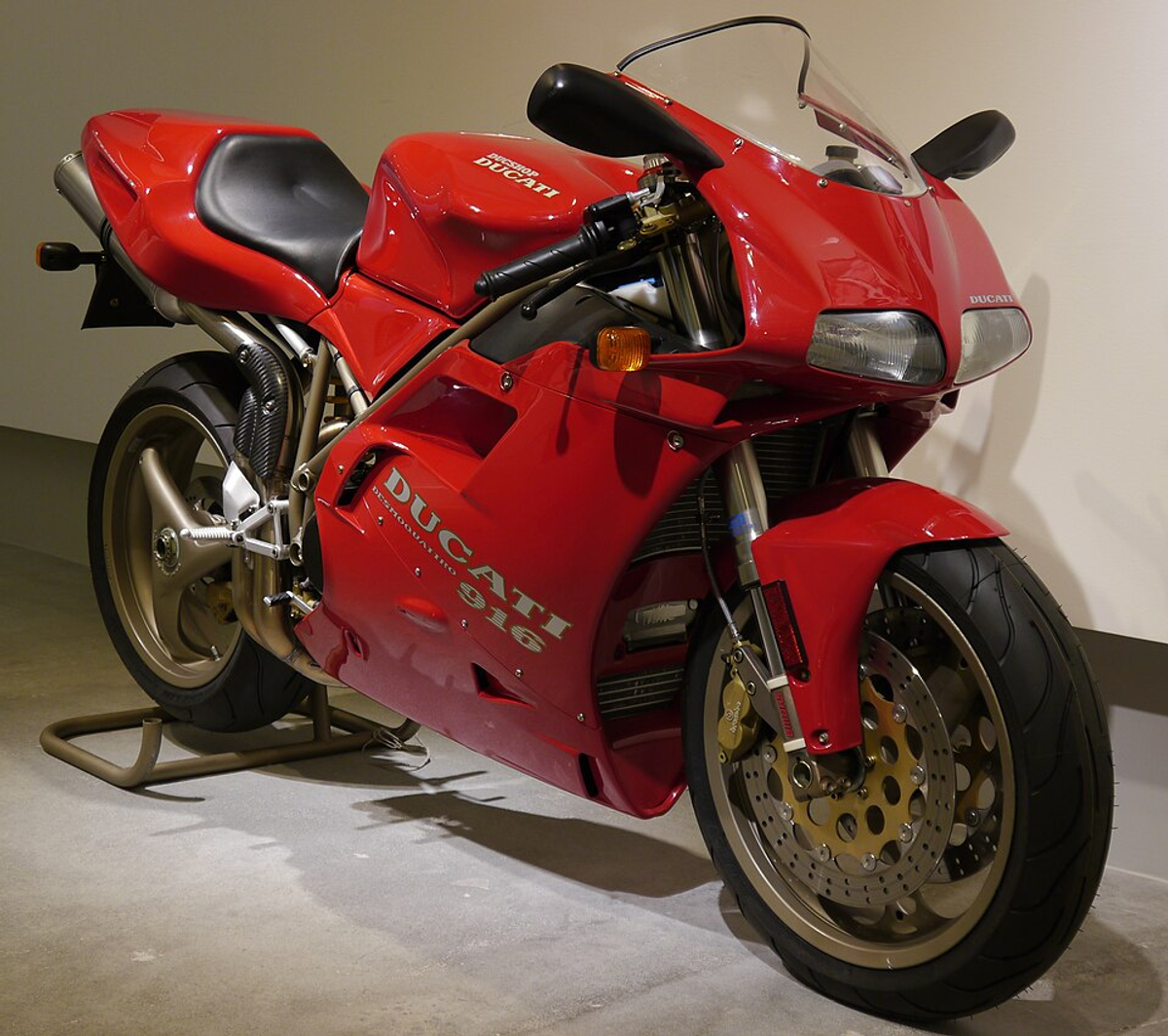
When the curtain fell at the Milan Motorcycle Show in November 1993, the gathering crowd surrounding the Ducati stand stalled hall traffic entirely. Designed by Massimo Tamburini at the Centro Ricerche Cagiva in San Marino, the Ducati 916 looked unlike any sportbike that had preceded it. Within months of its 1994 showroom release, Carl Fogarty rode the factory 916 to victory in the World Superbike Championship, transforming Ducati's flagship into both a design icon and a racing force.
Prior to the 916, Ducati maintained its international racing presence with the 851 and 888 series. While those models established the desmodromic L-twin engine as a championship contender, their traditional boxy styling lagged behind Japanese inline-four competitors in packaging and aerodynamic refinement. Ducati owner Claudio Castiglioni financed a ground-up replacement intended to dominate the racetrack while establishing an aesthetic signature for the Bologna marque.
Why Ducati 916 was built
In the early 1990s, four-cylinder Japanese machines like the Honda CBR900RR FireBlade were reshaping expectations for sportbike weight and agility. Ducati needed a motorcycle that leveraged the FIM World Superbike regulations, which allowed twin-cylinder engines up to 1000cc to compete against 750cc four-cylinder models at a lower minimum weight limit.
Tamburini set out to create a compact chassis built around an evolved version of the liquid-cooled, four-valve-per-cylinder Desmoquattro L-twin engine. The design needed to address the mechanical limitations of the outgoing 888 while optimizing air management, mass centralisation, and rear wheel access during rapid pit stops in endurance and sprint racing.
What made it different
The central engineering feature of the Ducati 916 was its steel tubular trellis frame paired with a single-sided cast aluminum swingarm. Tamburini selected the single-sided swingarm after observing its quick-change capability on Honda’s oval-piston NR750, adapting it to handle the torsional loads of a 916cc L-twin engine. Twin under-seat silencers were placed high to clear airflow around the rear tyre and maximize lean angle capacity.
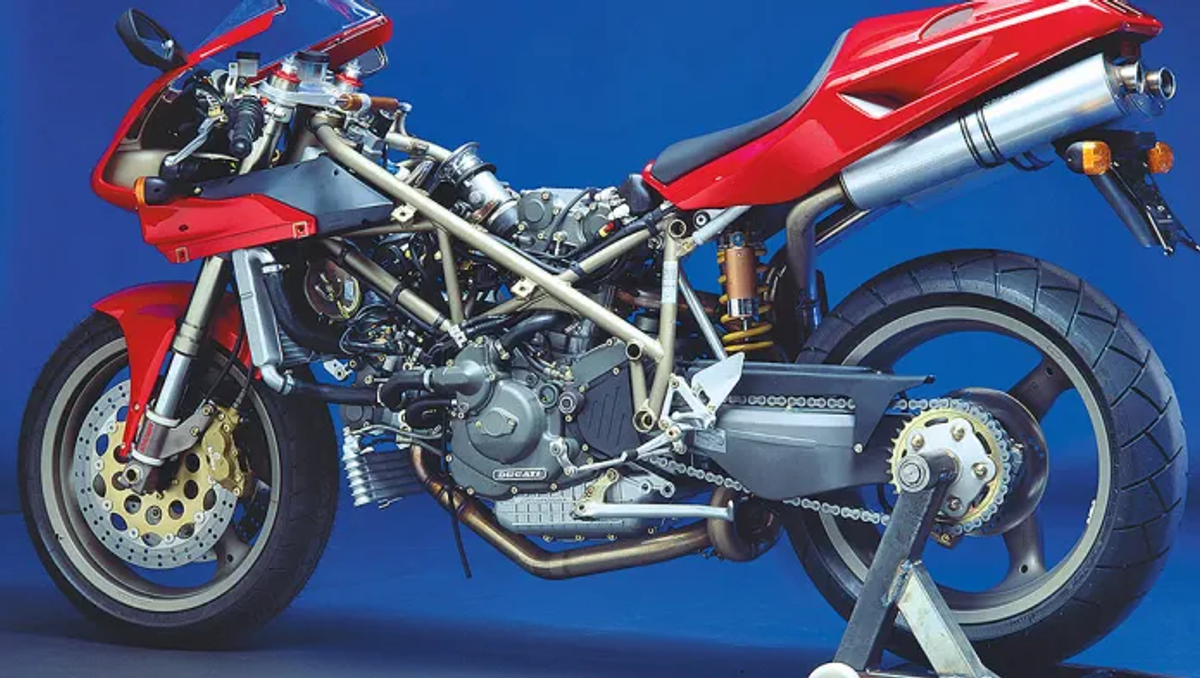
At the front, twin narrow headlight projector units allowed a slimmer fairing nose profile. The liquid-cooled 916cc engine retained Ducati's signature desmodromic valve actuation—where camshafts mechanically open and close the valves without valve springs—andWeber-Marelli electronic fuel injection. In Strada trim, the 90-degree L-twin produced 114 hp at 9,000 rpm and 90 Nm of torque at 6,900 rpm.
"The 916 was not simply fast; it altered the visual language of motorcycle design overnight."
In competition
The 916’s racing record defined 1990s World Superbike competition. Carl Fogarty won the rider’s championship on the factory 916 in 1994 and 1995, while Troy Corser secured the 1996 title aboard the same platform. Fogarty returned to Ducati to take two more world titles on updated 916/996 machinery in 1998 and 1999.
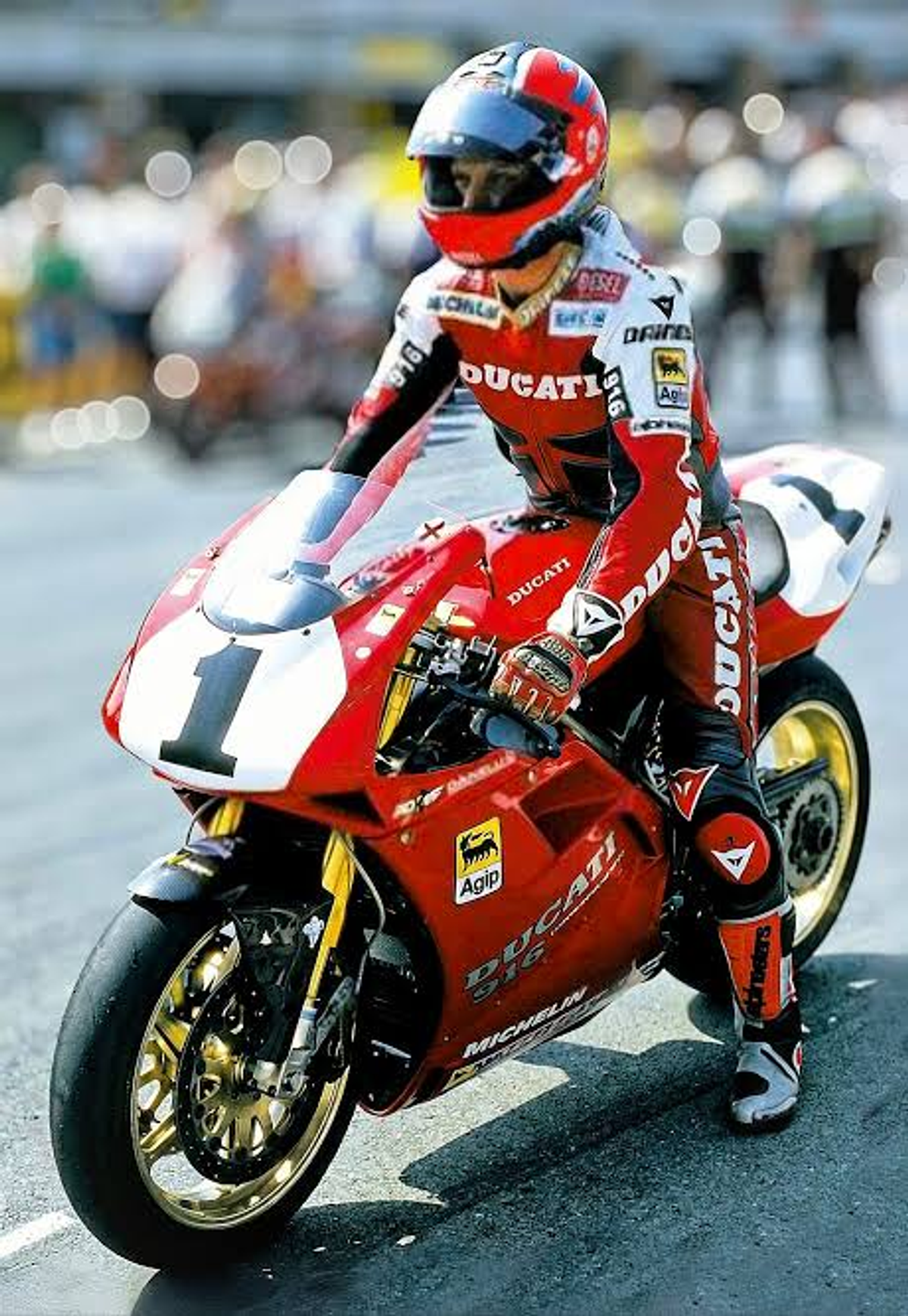
In period road tests, journalists praised the chassis rigidity and front-end feedback offered by the 43mm Showa upside-down forks and adjustable steering head angle. Cycle World recorded a top speed of 159 mph (256 km/h) in its 1994 test, noting that the narrow engine architecture allowed faster direction changes through high-speed chicanes than contemporary four-cylinder rivals.
The Ducati 916 today
Ducati produced the original 916 across several iterations—including the dual-seat Biposto, the upgraded SP (Sport Production), and the ultra-limited Senna homologation editions—before expanding the engine capacity to become the 996 in 1999. Early 1994 "Varese" production models, assembled at Cagiva's Varese factory before assembly moved fully to Bologna, command particular interest among collectors due to their lower production volumes.
Thirty years after its premiere, Tamburini’s creation remains a primary reference point for modern sportbike design. Its combination of under-seat exhausts, twin projector headlights, and single-sided swingarms established styling cues adopted across the industry, ensuring the 916’s position as one of the defining motorcycles of the late twentieth century.
Quick answers
How many World Superbike titles did the Ducati 916 win?
The Ducati 916 chassis won four World Superbike rider championships: Carl Fogarty in 1994, 1995, and 1998, and Troy Corser in 1996.
Why are early 1994 Ducati 916 models called "Varese" bikes?
The first batch of 1994 916 models was built at Cagiva’s factory in Varese following a fire at Ducati's main factory in Borgo Panigale, Bologna.
How much does a Ducati 916 weigh compared to modern superbikes?
The 1994 Ducati 916 Strada has a dry weight of 195 kg (430 lbs), making it heavier than modern 1000cc superbikes, though its narrow engine profile gave it exceptional agility for its era.
Did Ayrton Senna design a version of the Ducati 916?
Formula 1 champion Ayrton Senna approved the dark grey and red colour scheme for the 1995 Ducati 916 Senna edition shortly before his death; profits supported the Instituto Ayrton Senna charity.