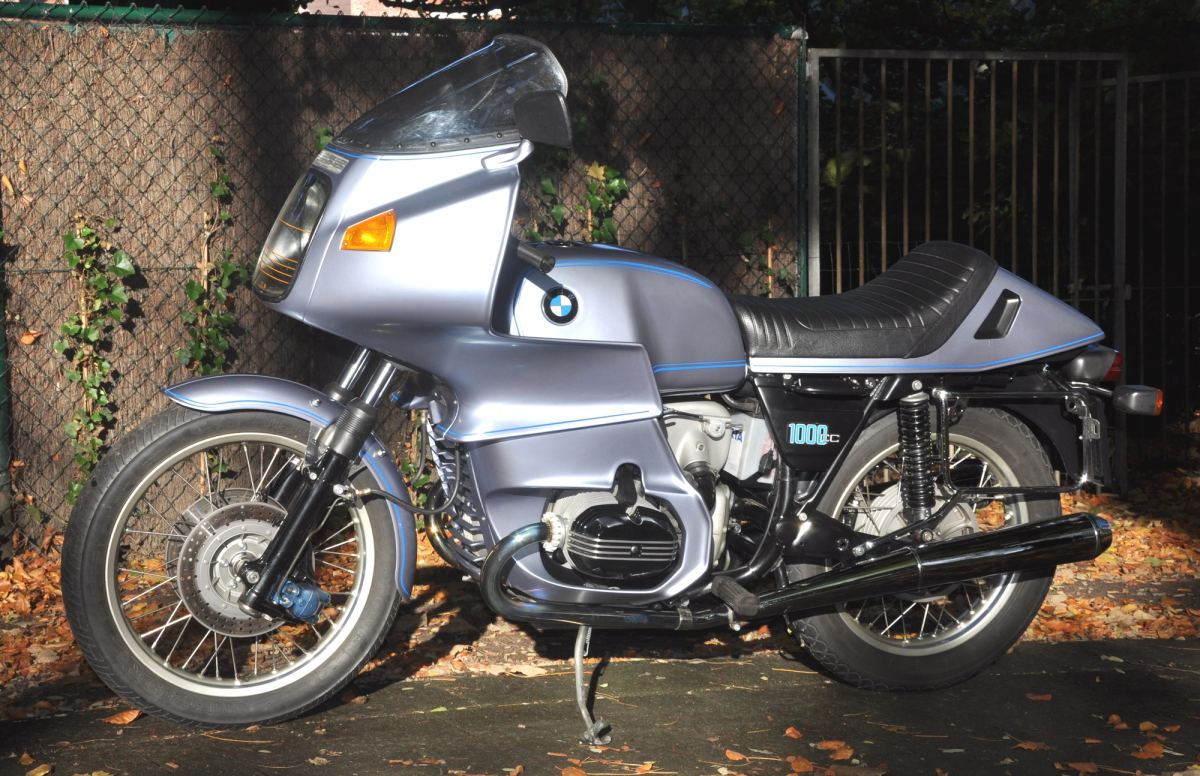
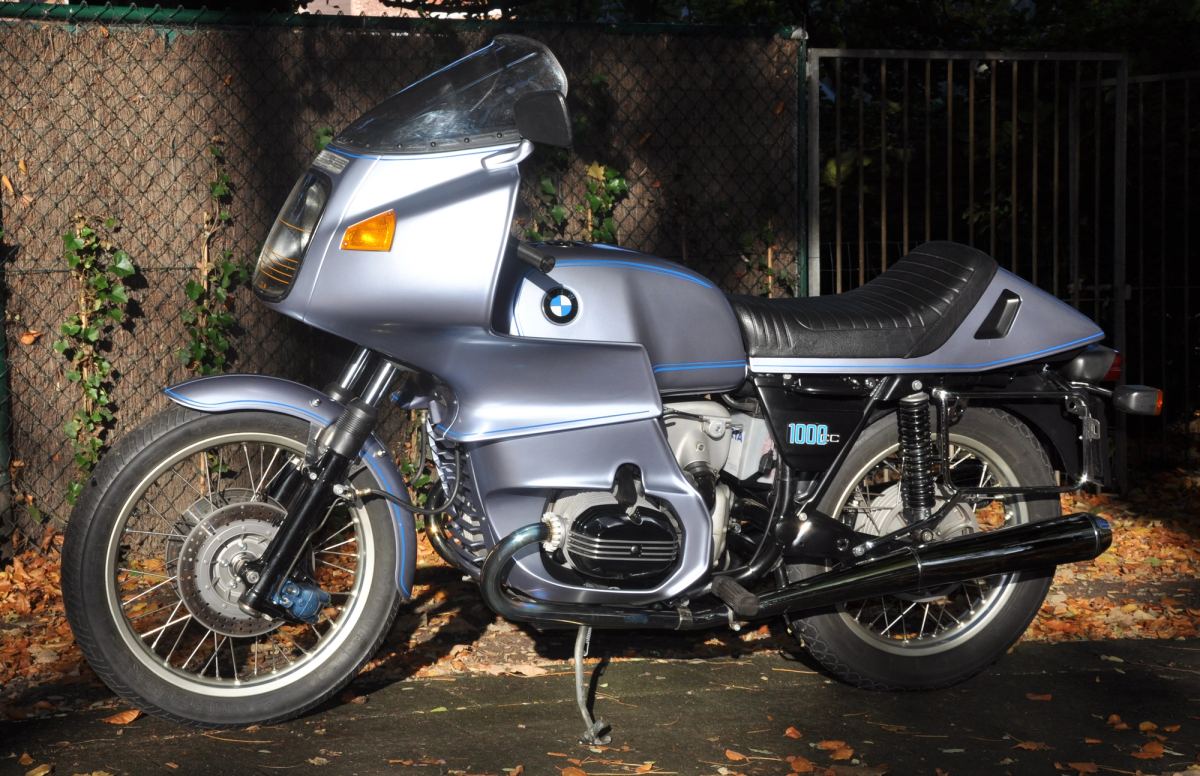
An original 1977 BMW R100RS, still wearing its factory fairing.. Photo: JanH015 / Wikimedia Commons, CC BY-SA 4.0
Rain was falling in the French Alps when BMW handed journalists the keys to its new BMW R100RS, and for once nobody complained. The R 100 RS, unveiled at the IFMA show in Cologne in September 1976, was the first production motorcycle sold with a full fairing developed in a wind tunnel. A wet mountain road was the perfect test, and the press rode home with dry chests and a new kind of motorcycle to describe.
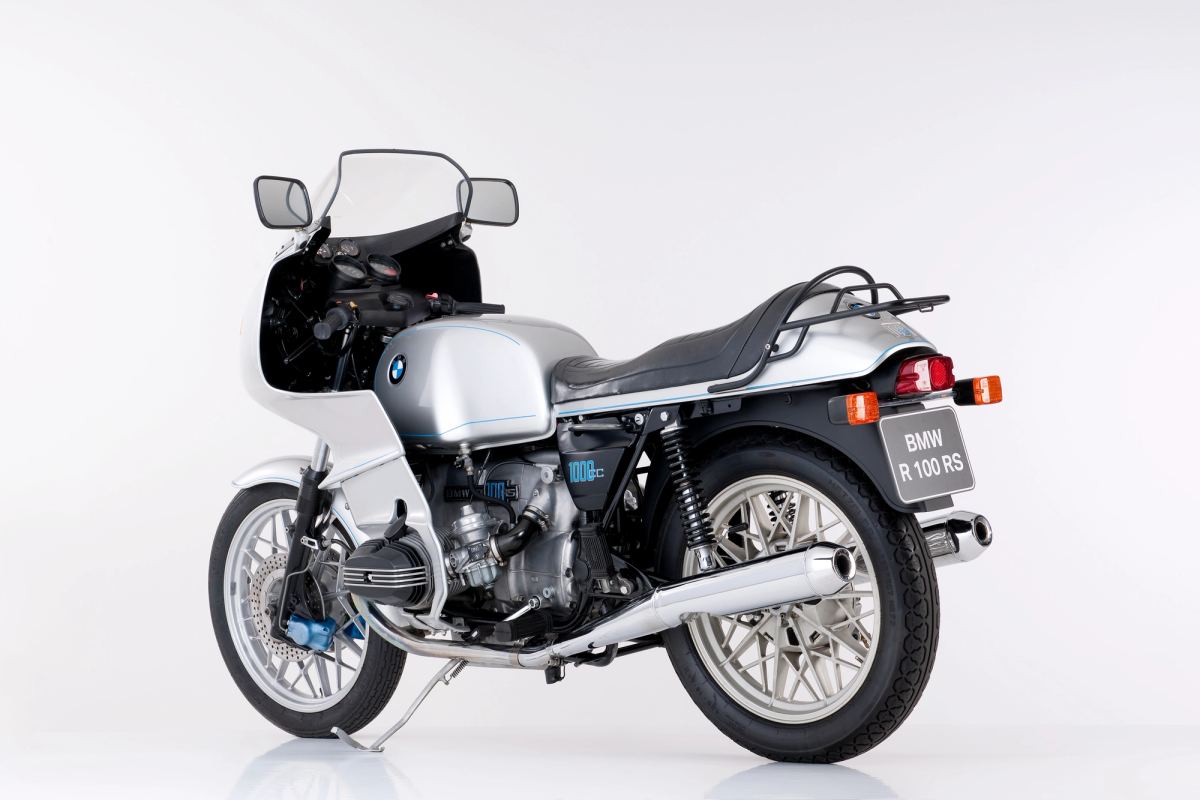
Fifty years later, the silver-blue BMW still looks as if it arrived from slightly ahead of its time. Underneath was a 980cc air-cooled flat-twin, the biggest boxer BMW had built. Around it was bodywork refined in Pininfarina's wind tunnel in Italy. And behind it was a designer who, by his own account, could not stand the fairings of his day.
Why the BMW R100RS was built
The BMW R100RS was built because BMW's previous hit had shown what was possible and what was still missing. The R90S of 1973, styled by Hans Muth with a small handlebar fairing and smoked paintwork, had made BMW exciting to fast riders for the first time in years. But according to motorcycle historian Ian Falloon, it was criticised for its stability at high speed and offered little protection from the weather. Because its fairing turned with the handlebars, it also added weight to the steering.
The market was moving too. Honda's GL1000 Gold Wing and Kawasaki's Z1000 pushed touring bikes towards bigger engines, and BMW answered with the new /7 range, its flat-twin bored out to 980cc. Muth later recalled that the motorcycle department simply wanted to put an extra 100cc into the R90S. He suggested something bolder, which he described as "a kind of aero touring" machine.
There was a practical reason as well. BMW supplied many bikes to police forces, usually fitted with aftermarket fairings. Muth remembered flying to England with colleagues to visit Avon, then a leading fairing maker, and deciding on the flight home that BMW would design its own. He started sketching on the plane.
Hans Muth was an unusual choice for the job. He was a car man who had worked for Ford and on BMW car interiors before Hans-Günther von der Marwitz, head of motorcycle development, encouraged him to work on BMW's motorcycles.
What made the R100RS fairing different
The R100RS fairing was bolted to the frame, and that was the breakthrough. On the R90S the fairing turned with the handlebars. On the RS it stayed still, so it no longer weighed down the steering and could be shaped around the rider as well as the machine. BMW's own archive describes it as the first full fairing fitted as standard to a series-production motorcycle.
Muth had no respect for what came before. Existing fairings, he told Motorcycle Classics writer Bill Stermer, looked "like a consolation letter stating somebody's death".
The shape came out almost right first time: Stermer reports only small later changes, such as larger downforce wings below the headlight. The fine-tuning happened in the Pininfarina wind tunnel at Grugliasco, near Turin. A wind tunnel blows a controlled stream of air over a machine so engineers can measure how the air pushes and lifts it. Falloon writes that the tunnel cost BMW $7,000 a day.
According to Falloon, BMW claimed the fairing cut front-wheel lift by 17.4%, drag by 5.4% and yawing in crosswinds by 60%, for only 9.5 kg of extra weight. Lift matters because a front tyre pressed less firmly onto the road steers less precisely at speed.
Independent figures followed. In 1980 the German magazine Motorrad rented Volkswagen's wind tunnel and measured the drag coefficient, a number for how cleanly a shape slips through the air. An unfaired R100 scored 0.627, the R100S 0.589 and the RS 0.571, as Stermer reports. Sources do not even agree on how many parts the fairing has: Stermer counts seven, while Falloon and Motorcycle News count nine.
One detail was pure theatre: the orange lines in the headlight glass. A man from Butler & Smith, BMW's US importer, admitted to Stermer that he had told journalists they were for demisting. They were only for looks.
On the road: how the R100RS rode in the 1970s
The BMW R100RS was judged the fastest way to cover long distances on two wheels when it arrived. Motorrad's test in issue 3/1977 said the RS had allowed higher average travel speeds than any test bike before it, and 160 km/h (99 mph) became a realistic cruising pace. In the UK, Motorcycle News later singled out its ability to hold 100 mph for hours on end.
Cycle praised its torque so much that it said riders would seldom need to go past 6,500 rpm. Cycle World liked the suspension but found the handlebars tiring after about 50 miles. Stermer, who owns a 1981 RS, adds that the windscreen sends a noisy blast at the rider's collar.
The suspension was soft by sports standards. The fork dived under hard braking, and the shaft drive lifted the rear under power and let it drop when the throttle closed. Germans call this the lift effect, or Fahrstuhleffekt. Fast riders learned to brake early and roll on smoothly through the corner.
There were local quirks too. Motorrad notes that in Germany the RS was never approved for two-up riding on its standard one-and-a-half seat. Cast "snowflake" wheels were planned from the start, but good enough castings only arrived from Italy in spring 1977, at 725 marks extra.
Speed was never in doubt. BMW says a modified R 100 RS with 84 hp and the lower fairing removed set five world records at Nardò in Italy on 29 and 30 October 1977, ridden by a team around Helmut Dähne. Falloon dates the record run to October 1979. [⚠ VERIFY: year of the Nardò records, 1977 (BMW) or 1979 (Falloon)]
The BMW R100RS today
The first BMW R100RS ran until 1984, when BMW signed it off with the Classic 500, a run of 500 bikes in Madison Grey and Alaska Blue with white pinstriping. More than 33,000 had been sold by then. The four-cylinder K 100 RS was meant to replace it, but demand, especially in the USA and Japan according to BMW, brought the boxer back at the 1986 IFMA show.
That second RS used the Monolever rear end, a single-sided swingarm with one shock absorber, and made 60 hp at 6,500 rpm. BMW says it was planned as a 1,000-unit special and built until 1992. Stermer dates it 1987 to 1993. Motorrad's 1997 buying guide counted fewer than 6,000 buyers between 1987 and 1990. [⚠ VERIFY: whether that 6,000 figure covers Germany only]
Falloon rates the 1981–1984 models as arguably the best, with a lighter flywheel, Brembo front brakes and electronic ignition. Rarer variants include the 1978 R100RS Motorsport in white and red, of which only 200 were made, according to Motorcycle Classics.
The idea outlived the bike. In April 2026 BMW celebrated 50 years of RS models, a line that now ends with the 145 hp R 1300 RS. Muth went on to co-found Target Design in 1979, the studio behind the Suzuki Katana, although his partner Hans-Georg Kasten credits that design to himself and Jan Fellström.
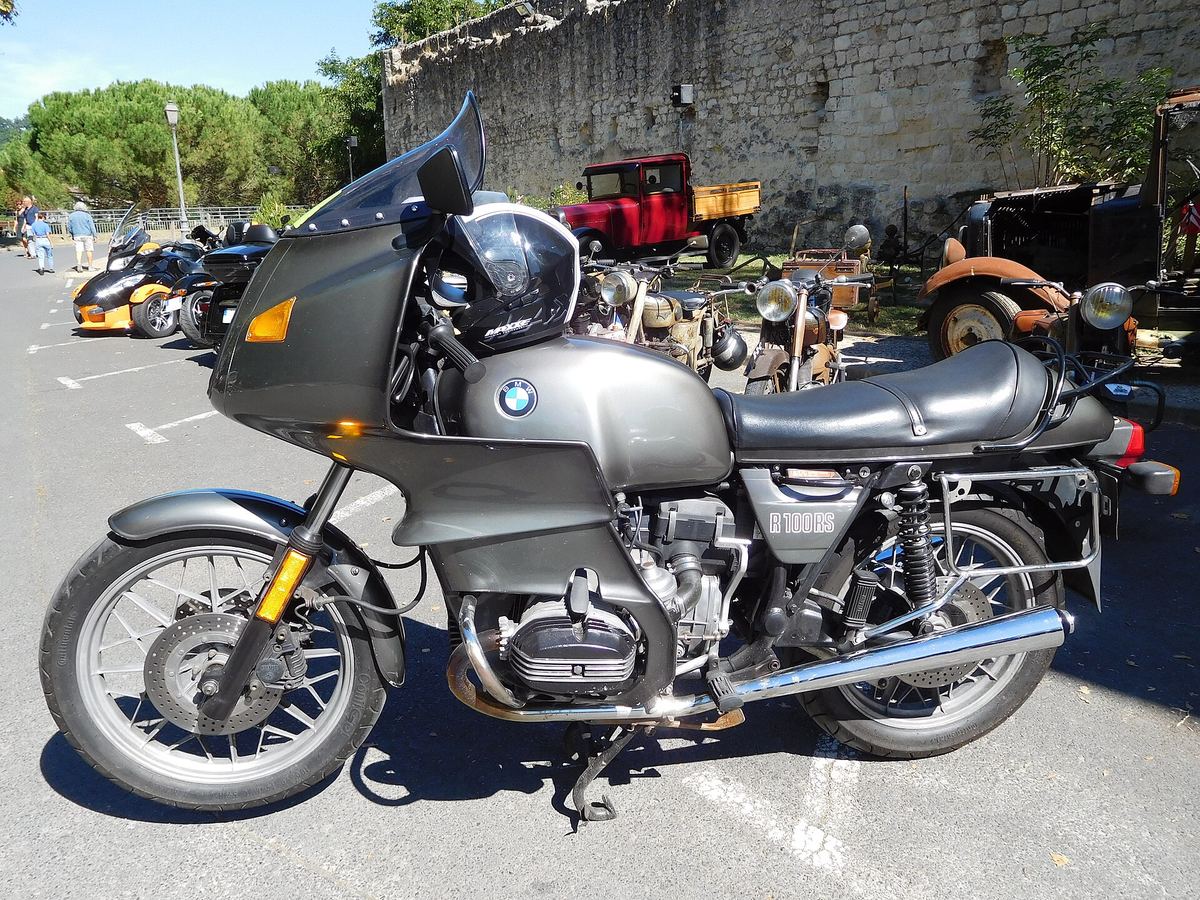
Muth wanted a fairing that didn't look like a letter of condolence. Fifty years on, the RS still gets fan mail.
Quick answers
Was the BMW R100RS the first motorcycle with a full fairing?
The BMW R100RS, launched in 1976, was the first series-production motorcycle with a full fairing fitted as standard and developed in a wind tunnel. Earlier fairings existed as accessories or extra-cost options, but BMW's archive credits the RS as the first to come from the factory with one.
Who designed the BMW R100RS?
Hans A. Muth designed the BMW R100RS. A former car designer who also styled the BMW R90S, Muth sketched the frame-mounted fairing himself and refined it in the Pininfarina wind tunnel near Turin. He later co-founded Target Design, the studio behind the Suzuki Katana.
How fast is a BMW R100RS?
BMW claimed a top speed of 200 km/h (124 mph) for the R100RS, from 70 hp at 7,250 rpm. Motorrad measured just over 190 km/h in testing. Its real strength was sustained speed: testers found 160 km/h (99 mph) a comfortable cruising pace.
How many BMW R100RS were made?
More than 33,000 first-generation BMW R100RS were sold between 1976 and 1984. BMW then revived the model with a Monolever rear end from 1986 to 1992, a version originally planned as a limited run of 1,000 bikes that stayed in the range because of demand.