Triumph Bonneville T120: the British twin born on Utah's salt flats
Named after Johnny Allen’s 214 mph land speed record at Bonneville, the 1959 T120 introduced twin-carburettor performance, creating the quintessential British cafe racer.
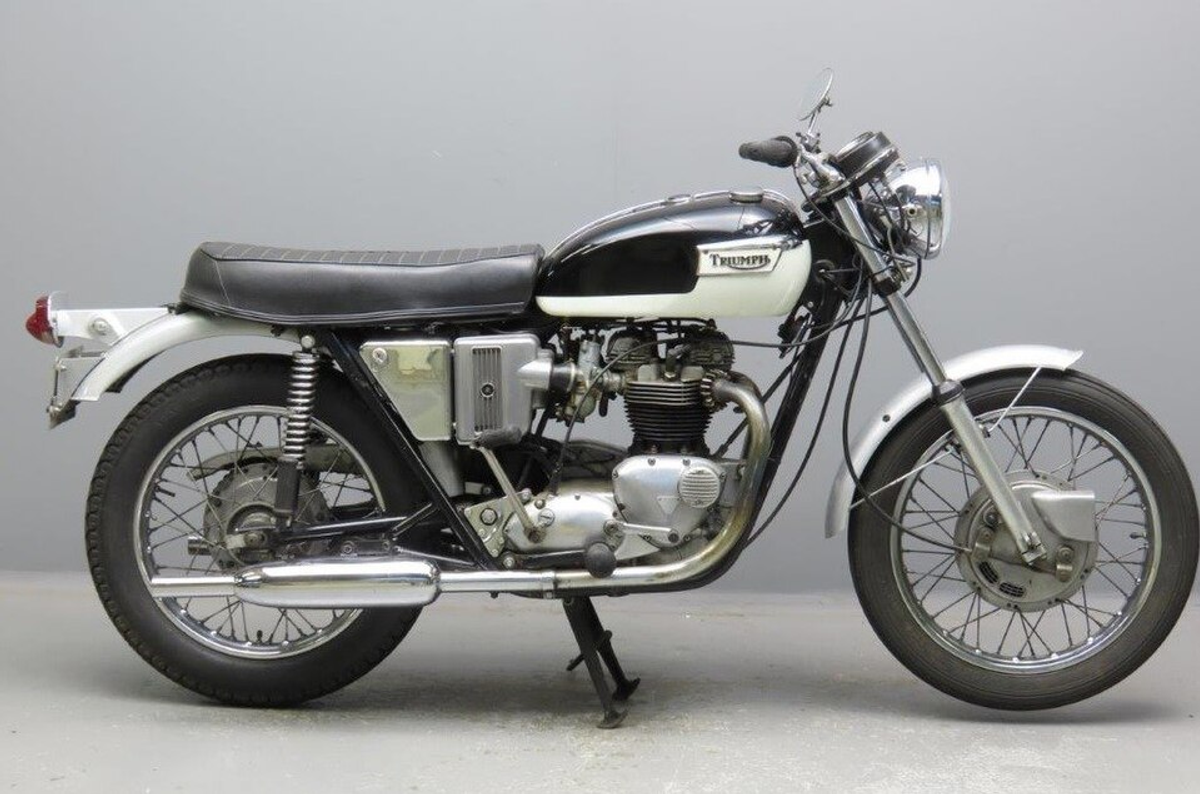
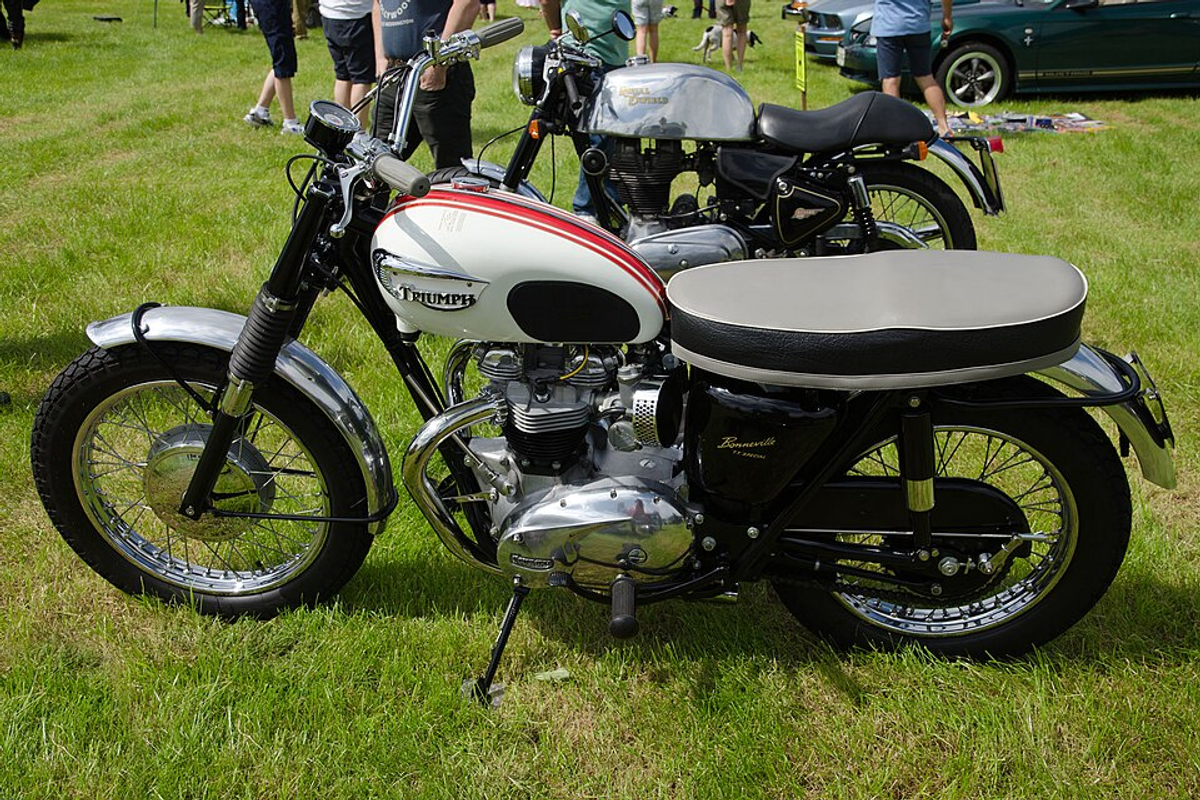
Triumph T120R Bonneville. Yesterdays Antique Motorcycles
In September 1956, Texan racer Johnny Allen piloted a streamlined motorcycle powered by a heavily modified 650cc Triumph twin engine across Utah’s Bonneville Salt Flats. The machine, known as the "Devil’s Arrow," recorded a two-way average speed of 214.40 mph (345.04 km/h), establishing a land speed record for two-wheeled vehicles. When Triumph designer Edward Turner sought a name for a high-performance derivative of the Tiger T110 roadster, he looked to the salt flats. The Triumph Bonneville T120 debuted at the Earls Court Motorcycle Show in London in November 1958, promising genuine 115 mph performance directly from the factory showroom.
The timing matched an emerging subculture in post-war Britain. Young riders gathered at transport cafes along newly constructed bypasses—most famously the Ace Cafe on London’s North Circular Road—demanding motorcycles capable of reaching 100 mph (the "ton"). The Bonneville T120 quickly became the preferred platform for these cafe racers due to its power-to-weight ratio and sharp handling capabilities.
Why Triumph Bonneville T120 was built
During the late 1950s, the United States accounted for the vast majority of Triumph's export sales volume. American distributors like JoMo (East Coast) and Johnson Motors (West Coast) repeatedly petitioned Meriden management for a faster machine to compete against Harley-Davidson Sportsters and rival British twins from BSA and Norton.
While the single-carburettor Tiger T110 offered smooth touring performance, riders in North America modified their cylinder heads to accept twin carburettors for drag racing and desert competition. Edward Turner initially resisted dual-carburettor layouts, viewing them as prone to synchronization problems, but commercial demand forced Triumph engineering to develop a factory high-compression twin-carburettor engine.
What made it different
The core of the T120 was an air-cooled, OHV, 360-degree parallel-twin engine displacing 649cc, featuring a 71mm bore and 82mm stroke. To boost power over the single-carburettor Tiger, Triumph fitted a high-performance inlet camshaft and an alloy cylinder head fed by twin Amal Monobloc carburettors. In its 1959 debut specification, the 360-degree crank engine produced 46 bhp at 6,500 rpm.
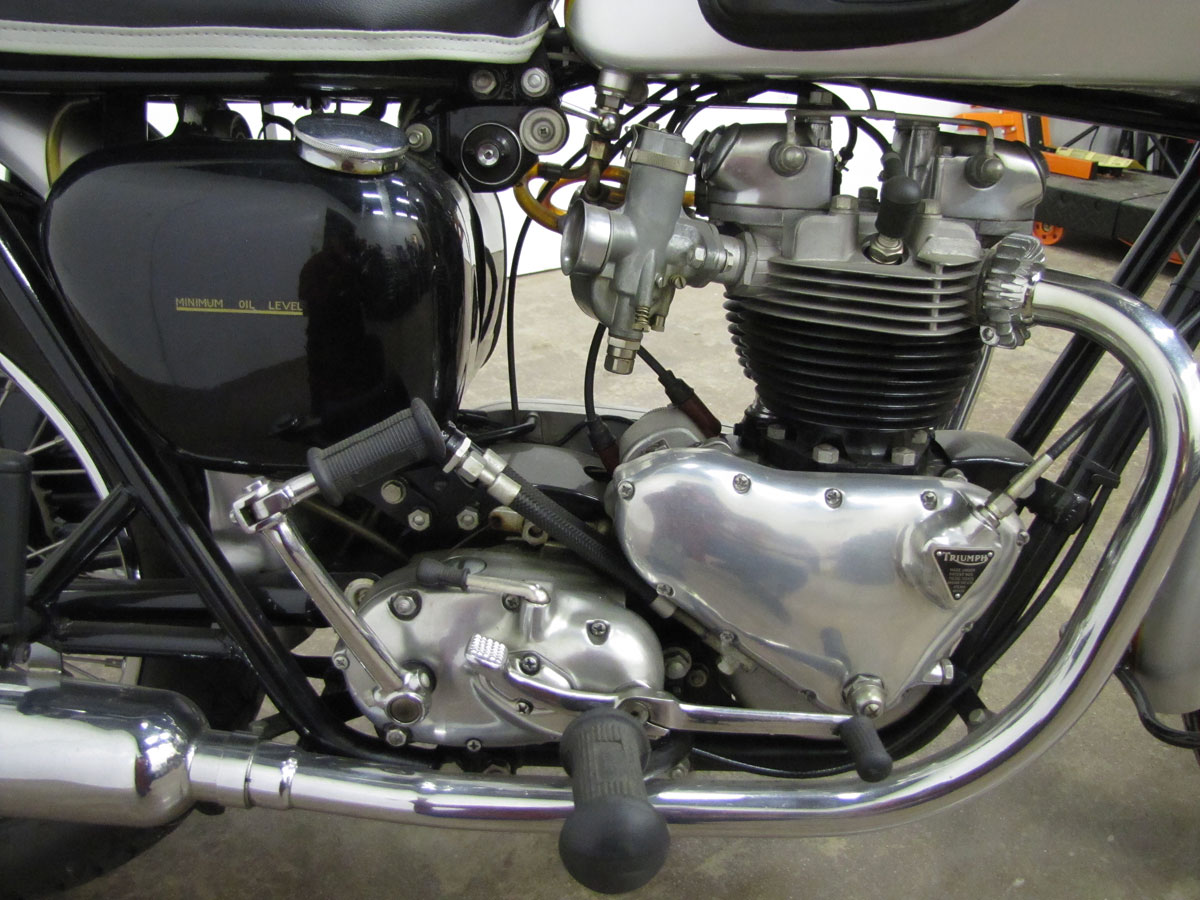
Early 1959 models utilized a "pre-unit" construction architecture, where the engine, four-speed transmission, and primary drive existed in separate castings bolted within a steel cradle frame. In 1963, Triumph transitioned the T120 to unit construction, integrating the crankcases and gearbox into a single rigid structure that eliminated primary chain misalignment and increased chassis stiffness.
"The Bonneville brought genuine 100-mph performance from Utah's salt flats straight to the suburban high street."
On the road and in competition
Period road tests praised the T120 for its immediate throttle response and lightweight agility. In a June 1961 road test, Motorcycling recorded a top speed of 115 mph (185 km/h) and a 0–60 mph sprint under 7 seconds. The narrow engine layout allowed steep lean angles, while the single leading-shoe drum brakes provided adequate stopping power for the era's traffic conditions.
The T120 achieved major racing milestones in production competition. At the 1969 Isle of Man TT, Welsh rider Malcolm Uphill won the Production 750cc race aboard a Bonneville T120R, recording the first-ever 100 mph (160.9 km/h) lap on a production motorcycle over the Mountain Course. Later that summer, T120s swept the top three places at the Thruxton 500 endurance race.
The T120 today
Triumph updated the T120 continuously throughout the 1960s, introducing twin leading-shoe (TLS) front brakes in 1968 and five-speed gearboxes in late production runs before the model evolved into the 750cc T140 in 1973. Early 1959 pre-unit models with full mudguards and Tangerine/Pearl Grey paint schemes are among the most valuable British classic motorcycles in collectors' hands.
The T120's aesthetic—sculpted fuel tank, parallel-twin engine cooling fins, and twin peashooter exhausts—became the universal visual template for British motorcycles. Its combination of road-going agility and salt-flat provenance cemented the Bonneville name as an enduring symbol of 1960s motorcycling culture.
Quick answers
Why was the Triumph Bonneville T120 named after Bonneville?
It was named in honour of Johnny Allen’s 1956 land speed record of 214.40 mph at the Bonneville Salt Flats in Utah, set using a streamliner powered by a Triumph 650cc engine.
Who designed the original Triumph Bonneville T120?
Triumph’s Chief Designer and Managing Director, Edward Turner, designed the T120, basing it on the existing Tiger T110 platform.
What is the top speed of an original 1959 Triumph Bonneville T120?
Period road tests recorded top speeds between 108 mph and 115 mph (174–185 km/h), making it one of the fastest road bikes of its time.
What is the difference between pre-unit and unit Triumph Bonnevilles?
Pre-unit models (1959–1962) used separate castings for the engine and gearbox. Unit construction models (1963 onwards) integrated the engine and gearbox into a single crankcase for better frame rigidity.