Vincent Black Shadow: the black-engined British twin with a 150 mph speedometer
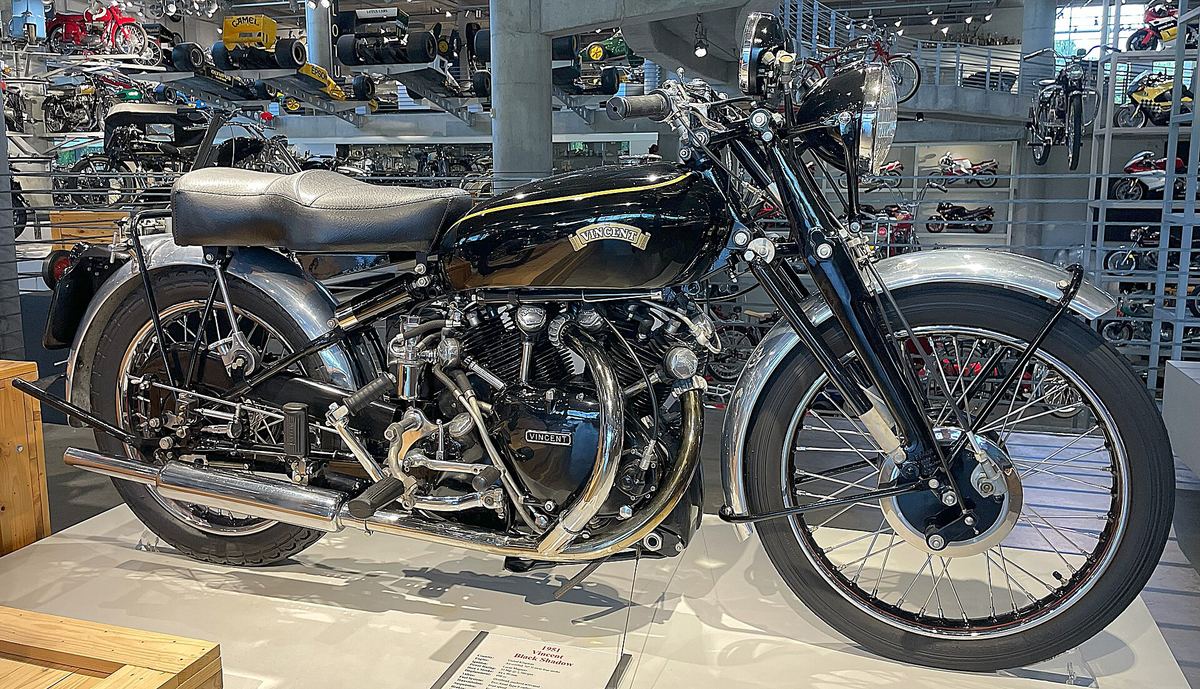
The Vincent Black Shadow of 1948 was a tuned Rapide with a black engine and a speedometer reading to 150 mph. Vincent sold it as the world's fastest standard motorcycle.
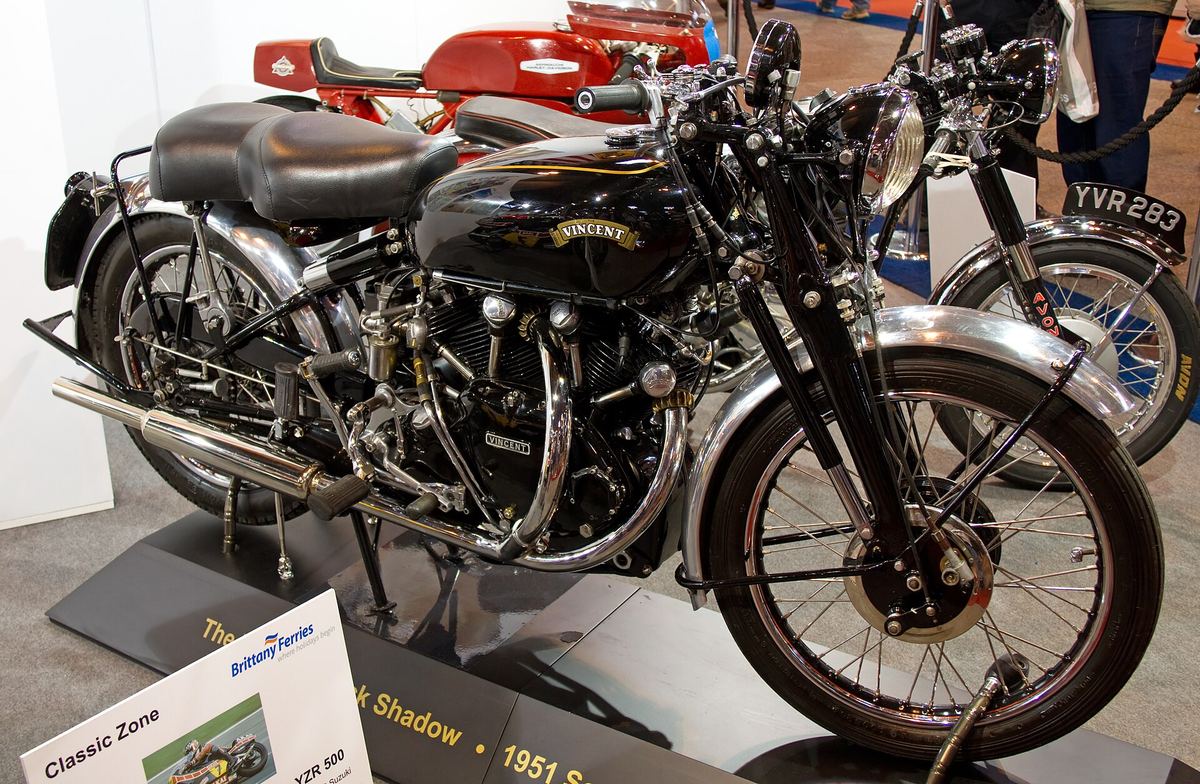
A Vincent Black Shadow, the 998cc British V-twin introduced in 1948.. Photo: Tony Hisgett / Wikimedia Commons, CC BY 2.0
Stevenage, February 1948. At the Vincent HRD factory on the Great North Road, the first Vincent Black Shadow was finished on 16 February, and the company announced the new model on 24 February. It looked like the Rapide twin Vincent already sold, except for two things: the engine was enamelled black, and the speedometer, a five-inch dial in front of the rider, read to 150 mph.
According to Motorcycle Classics, the prototype's speedometer housing was made from an aluminium saucepan. The catalogue called the Black Shadow "the world's fastest standard motorcycle".
It was a fair claim. Motor Cycling timed the prototype at 122 mph that May. Philip Vincent himself said it would do 125 mph, but only on machines in "tip-top condition". Vincent meant it to cruise comfortably at 100 mph, according to the National Motor Museum at Beaulieu.
Why Vincent built the Black Shadow
The Vincent Black Shadow grew out of the Rapide. Philip Vincent, who had bought the HRD name in 1928, and his Australian engineer Phil Irving had designed a 998cc V-twin before the war. After it, they redesigned it as the Series B Rapide, in production by September 1946, according to Shannons Club. Vincent enthusiasts still call the pair "the two Phils".
The Rapide was already fast. When Motor Cycling's tester tried one in May 1947, he could not find a road long enough for a two-way top speed, and the report read "maximum speed: not obtained", Motorcycle Classics says.
Vincent wanted a faster version, but his managing director, Frank Walker, said no, according to the historian Ian Falloon. So the factory's tester and racer, George Brown, worked with Irving on a tuned Rapide that a Motor Cycling journalist praised so warmly that it became known as "Gunga Din". Brown and Irving then quietly built a pair of sports twins and presented Walker with them as a finished fact.
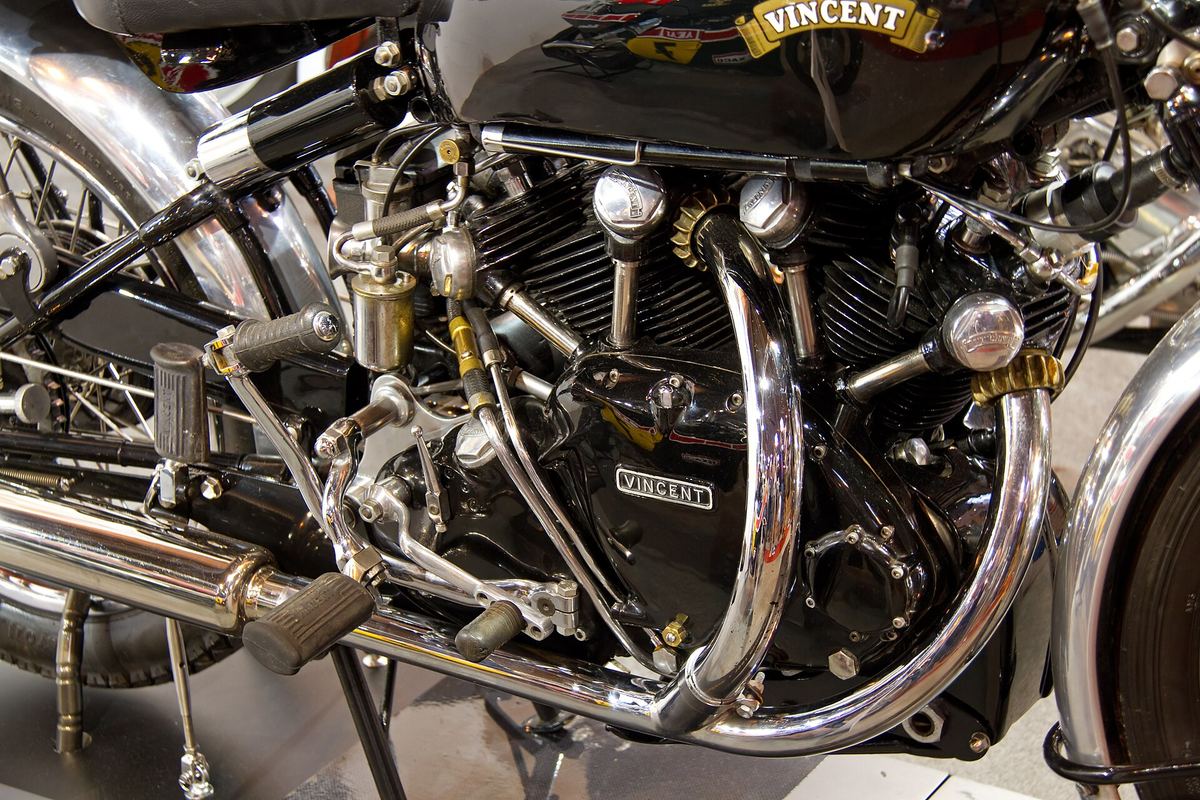
Vincent chose the black finish. Motorcycle Classics says he had the engine stove-enamelled black to give the bike a more dignified look. Falloon calls the result "sinister". Gunga Din itself stayed with the factory, and was among the machines Vincent took to Montlhéry in 1952, according to Wikipedia's account.
What made the Vincent Black Shadow different
The Vincent Black Shadow had no frame in the usual sense. The engine and gearbox, built as one unit, were the main structure, and a box-section top member that doubled as the oil tank joined the steering head to the rear suspension, Cycle World explained in 2007. As a Vincent history quoted by Shannons Club puts it, with a Vincent the frame is taken off the engine, not the engine out of the frame.
The engine was an all-alloy, 50-degree V-twin of 998cc, with a bore and stroke of 84 x 90mm. For the Black Shadow, Motorcycle Classics lists the changes: polished rockers, ports, combustion chambers and connecting rods; compression raised from 6.45:1 to 7.3:1; bigger 1-1/8in Amal carburettors; triple valve springs; and a taller first gear. Power rose from 45bhp to 55bhp, says the National Motorcycle Museum in Iowa, and claimed top speed from about 110 to 125 mph.
The brakes were upgraded to match. The Black Shadow had two 7in drums on the front wheel and ribbed cast-iron drums instead of pressed steel. It also had cantilever rear suspension, and from late 1948 the Series C added Vincent's own Girdraulic front fork.
Irving designed the speedometer dial. According to the National Motorcycle Museum, he "unthinkingly omitted the fabled 'ton'" from its markings, so 100 mph was not printed on it.
Some details were designed with the riders in mind. Sid Biberman, a friend of Irving's, told Cycle World in 1990 that the clutch was made light enough for hands burned when pilots bailed out of aircraft, and that the kickstart lever could go on either side for a rider with one bad leg.
It was not cheap. Old Bike Mart puts the price at £315 plus purchase tax, and the National Motor Museum at Beaulieu lists its 1955 Series D at £354 new.
In competition: Bonneville and Montlhéry
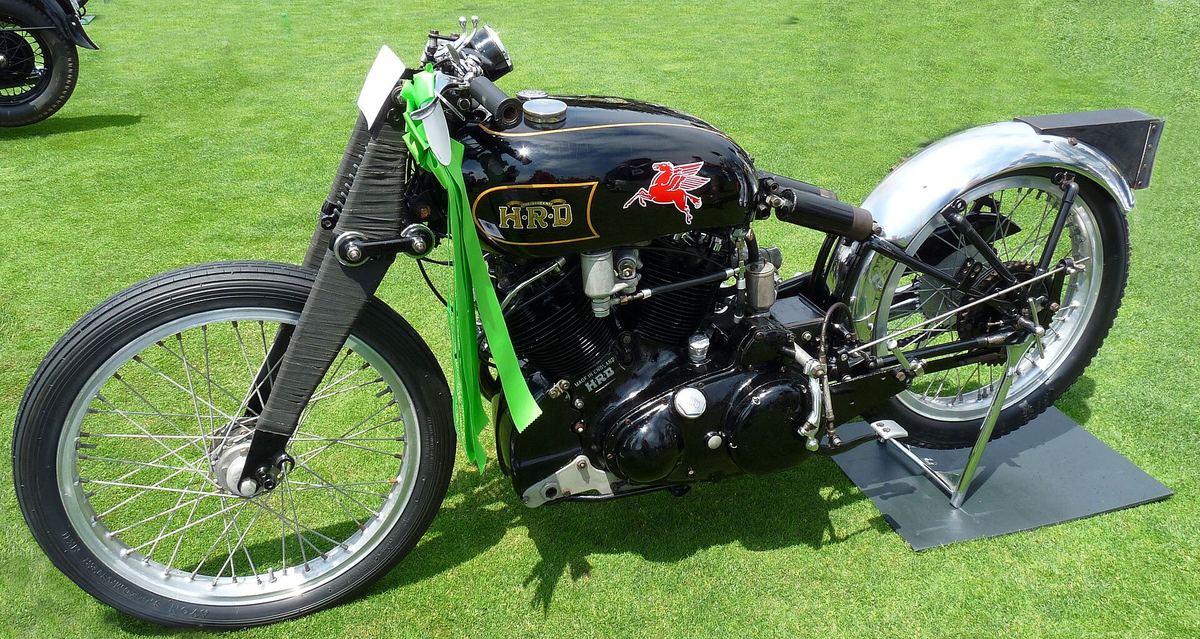
The Vincent Black Shadow's most famous run was made by a special one. An American enthusiast, John Edgar, ordered a specially prepared bike, serial number F10AB/1B/900, to beat the American flying-mile record of 136.183 mph held by Joe Petrali. On 13 September 1948, at the Bonneville Salt Flats in Utah, Rollie Free took it to 150.313 mph on his final run.
Free rode that run lying flat along the bike in swimming trunks to cut drag, and the photograph of it earned the machine the nickname "the bathing suit bike". Accounts differ on what it was. Phil Irving told the American Vincent specialist Sid Biberman that it was the first Black Lightning, the racing model, built after Vincent phoned him from the United States, Cycle World reported in 1990. Other accounts, summarised by Wikipedia, say it began as a Black Shadow and the factory renamed it later.
The road bike set records too. In May 1952, Vincent took four Black Shadows and a Black Lightning to the Montlhéry track near Paris, backed by Castrol. Unusually hot weather and big-end failures ended the attempt early, but a Black Shadow still took the 6-hour and 1,000km records. Falloon gives its average for 1,000km as 162km/h.
On the road
The British press of the late 1940s loved it. The Motor Cycle published its test on 11 August 1949 and gave the Black Shadow 99 out of 100 for engine performance, handling and braking. It reached 110 mph in third gear, and the tester wrote that it would also run in top gear at 29 to 30 mph. He called it "a connoisseur's machine".
It was also tough. In 1954 and 1955, Tony Rose and Jim Redman rode a Black Shadow 100,000 miles in 16 months, 16,000 of them with a sidecar, without decarbonising the engine, Old Bike Mart reports. It used 55 rear tyres and 25 rear chains along the way.
Not everyone agreed about the handling. When Cycle World tested a 1955 Black Lightning in 1965, Gordon Jennings called the handling "evil" and the brakes "simply awful", David Edwards recalled in 2008. The factory itself recommended a warm-up of about 20km before hard riding, according to Falloon.
The writer Hunter S. Thompson added to the legend. In a 1995 Cycle World road test of a Ducati, he wrote that the Black Shadow "would outrun an F-86 jet fighter on the take-off runway", but that "there was no point in trying to turn it". The Vincent, he wrote, "was like a bullet that went straight".
The Black Shadow today
Vincent built 1,774 Black Shadows, according to the factory records cited by Shannons Club, plus 15 White Shadows with polished rather than black engines. The early Series B bikes are rarest: the National Motorcycle Museum counts 78, Bonhams 76 and Falloon about 80. The last Black Shadow was built in December 1954, and Vincent stopped making motorcycles in 1955. Sid Biberman told Cycle World that the problem was not the bike but a weak post-war economy that put it beyond the reach of most buyers.
The bike has never been allowed to disappear. In 2007 the Vincent Owners Club's spares company built a brand-new 1952 Series C from reproduction parts, Cycle World reported; the parts alone cost about $55,000.
Values depend on history and condition. In October 2016, Bonhams sold a 1948 Series B Black Shadow for £113,500 at its Autumn Stafford sale. In April 2025, it offered a 1951 Series C that had been off the road since 1984 with an estimate of £30,000 to £40,000.
The Black Shadow was a fast Rapide with a black engine. That simple formula, and a speedometer that read to 150, made Vincent's name.
Quick answers
What is a Vincent Black Shadow?
The Vincent Black Shadow is a 998cc V-twin British motorcycle built by Vincent HRD of Stevenage from 1948 to 1955. A tuned version of the Rapide with a black-enamelled engine, it was advertised as the world's fastest standard motorcycle. Vincent built 1,774 of them.
How fast is a Vincent Black Shadow?
Motor Cycling magazine timed the prototype at 122 mph in May 1948, and Vincent claimed 125 mph. Its speedometer read to 150 mph. In 1948 Rollie Free reached 150.313 mph at Bonneville on a specially prepared Vincent, later called a Black Lightning.
How many Vincent Black Shadows were made?
Factory records show 1,774 Black Shadows were built between 1948 and 1955, plus 15 White Shadows with polished engines. Only about 80 were early Series B bikes; sources give 76, 78 or about 80.
What is the difference between a Vincent Rapide and a Black Shadow?
The Black Shadow was a tuned Rapide. It had higher compression, larger carburettors, polished internals, stronger valve springs, better brakes, a 150 mph speedometer and a black-enamelled engine. Power rose from about 45bhp to 55bhp, according to the National Motorcycle Museum.