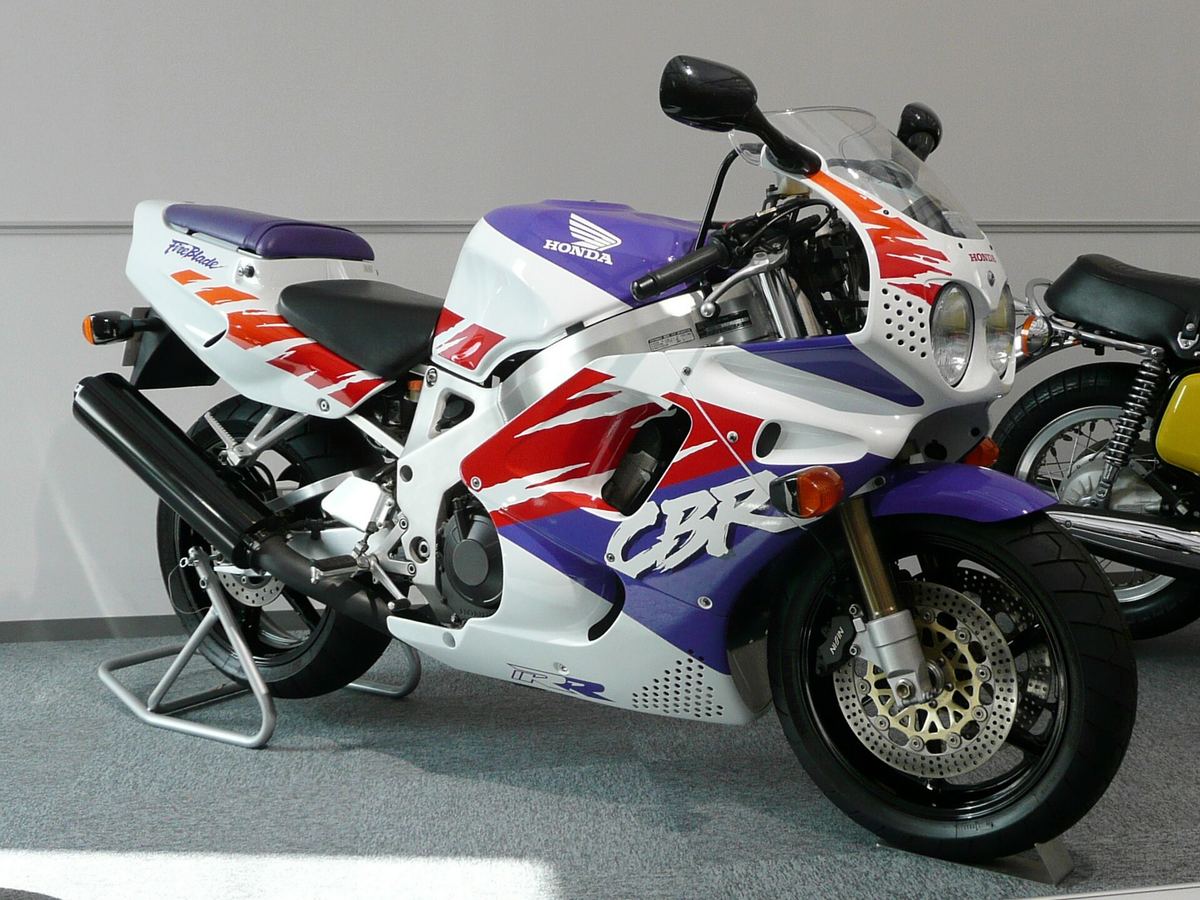
A 1992 CBR900RR Fireblade in its original white, blue and red.. Photo: PekePON / Wikimedia Commons, CC BY-SA 3.0
Brian Catterson had the first ride. In early 1992, Cycle World's managing editor took the magazine's new test bike out of the photo studio, rode it back to the office and skidded to a stop in the car park. His verdict, as the magazine reported it: "This thing is an 1100 in a 600 chassis."
The bike was the Honda CBR900RR, sold in Europe as the Honda Fireblade. Its 893cc four made less power than the big Suzuki and Yamaha superbikes of the day, and Cycle World's dynamometer proved it. But it weighed far less than either, and on the race track, the drag strip and the road it beat them both.
The man behind it was Tadao Baba, a former test rider who wanted a big sports bike that riders could actually control. He started on it in 1987, RideApart reports, and called the idea Total Control. His idea changed how Honda, and then its rivals, built superbikes through the rest of the 1990s.
Why Honda built the Fireblade
By the late 1980s, big sports bikes had become fast and heavy. "Bikes at the time in the 1980s were very fast. WHOOSSH," Baba told Honda UK. "But they never turned like a race bike." In another interview, with MCN in 2000, he went further: "Until then we called the current bikes super sports, but they didn't deserve this name."
The project began as a 750. Honda's racing arm, HRC, worked on it for six months before Baba took over, MCN reported, and the first goal was a road bike that could beat Honda's own RVF750 factory racer at the Suzuka 8 Hours, according to Honda. Baba had spent about 30 years as a test rider, Honda says, and he became the project's Large Project Leader. That was unusual: Cycle World noted that project leaders at Japanese factories usually came from engineering, while Baba had been R&D's chief test rider.
In 1989 Honda built prototypes of 749cc and 893cc, MCN says. Baba kept the 750's frame and chassis parts and found that the bigger engine fitted between the frame rails. A 1000cc bike at the target weight was not possible with the technology of the time, Honda says, and a conventional 750 could not match the dimensions of a 600. The 900 was the compromise: "a new class was born, the 900 class," as Baba later put it.
Honda set targets of 185kg dry and 200kg or less with fluids. The work took four years, about twice the usual time for a new model, Cycle World reported in December 1991. Honda showed the finished bike at the Milan show in November 1991.
What made the Honda Fireblade different
The Honda Fireblade was not built from exotic materials. When Cycle World visited Honda R&D in 1991, the engineers said its engine and aluminium frame were conventional; the difference was weight. They analysed almost every part, down to the nuts, bolts and washers, to see how light it could be made. An unnamed tester who had ridden a late prototype told the magazine to imagine a bike that "feels no bigger than a Honda CBR600F2, that accelerates much like a Kawasaki ZX-11, and that has the chassis composure of a Honda RC30".
Hirofumi Fukunaga, who led the chassis design, recalled his first instruction: "The first thing Baba told me was to manage even the weight of the graphic stripe decals." The habit lasted. Years later, when an engineer on a later Fireblade found that the assembled bike weighed 500g more than the sum of its parts, Baba told him that "0.5 percent is important", according to Honda.
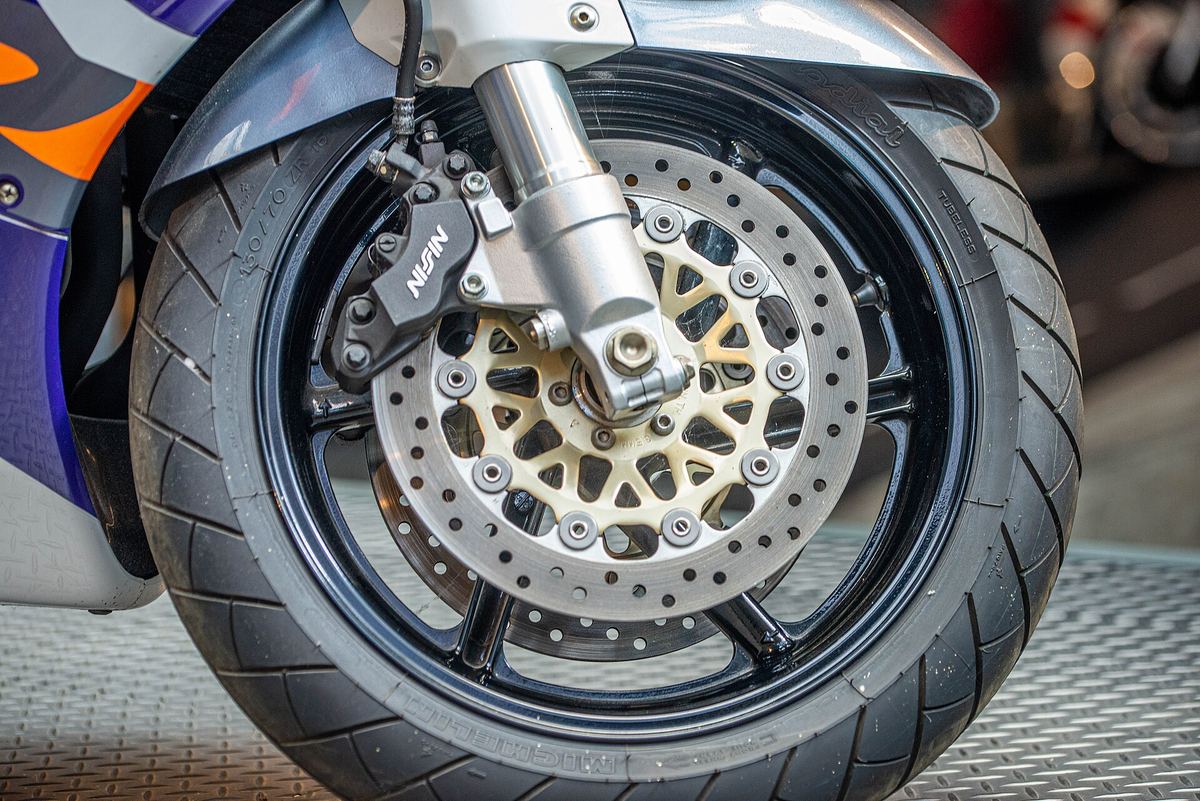
The savings came from everywhere. The engine had a side-mounted cam chain, cylinders cast with the upper crankcase and an alternator on the end of the crankshaft. The fairing was drilled with holes, a trick taken from the RVF750 racer. At the front, Baba chose a 16-inch wheel with a 130mm-wide tyre and a conventional 45mm fork rather than an upside-down one; forged aluminium fork bases saved 700 to 800g on each leg, Honda says.
The name caused trouble of its own. Honda expected buyers to hesitate over a bike that was neither a 750 nor a 1000, so its European companies sold it as the FireBlade with no capacity in the name. American Honda kept the alphanumeric CBR900RR, and Cycle World told its readers to "be glad" the American bike did not wear the "garish" European paint.
On the road
Cycle World tested the Honda Fireblade against Suzuki's GSX-R1100 and Yamaha's FZR1000 for its May 1992 issue. On the dynamometer the Honda made 114bhp at the rear wheel, against 123bhp for the Yamaha and 124bhp for the Suzuki. On the magazine's scales it weighed 432lb dry, 76lb less than the FZR and 94lb less than the GSX-R.
Weight decided the contest. At Willow Springs, road test editor Don Canet lapped the Honda in 1min 31.9sec, more than a second faster than either rival. At the drag strip it covered the quarter-mile in 10.59sec at 132.74mph, quicker than both. Only at top speed did it lose: the Honda and Suzuki both reached 159mph, while the Yamaha managed 165mph.
The testers found the Honda flicked into corners "with the nimbleness of a 250cc GP bike". It sometimes shook its head and wagged its tail, they wrote, but never weaved or ran wide, and at top speed it felt the most nervous of the three. Their complaints were small: a wide fuel tank, little room for a passenger and a price of $8,299, the same as the Yamaha but $800 higher than the Suzuki. "It really is that good," they concluded.
The verdict held. When Cycle World repeated the comparison a year later, the unchanged Honda won again, and the magazine named the CBR900RR its Best Superbike of 1993 in its Ten Best Bikes awards. Honda held the world press launch at Phillip Island in Australia, MCN says, and in Britain the bike went on sale in the spring of 1992 at £7,390.
The Fireblade today
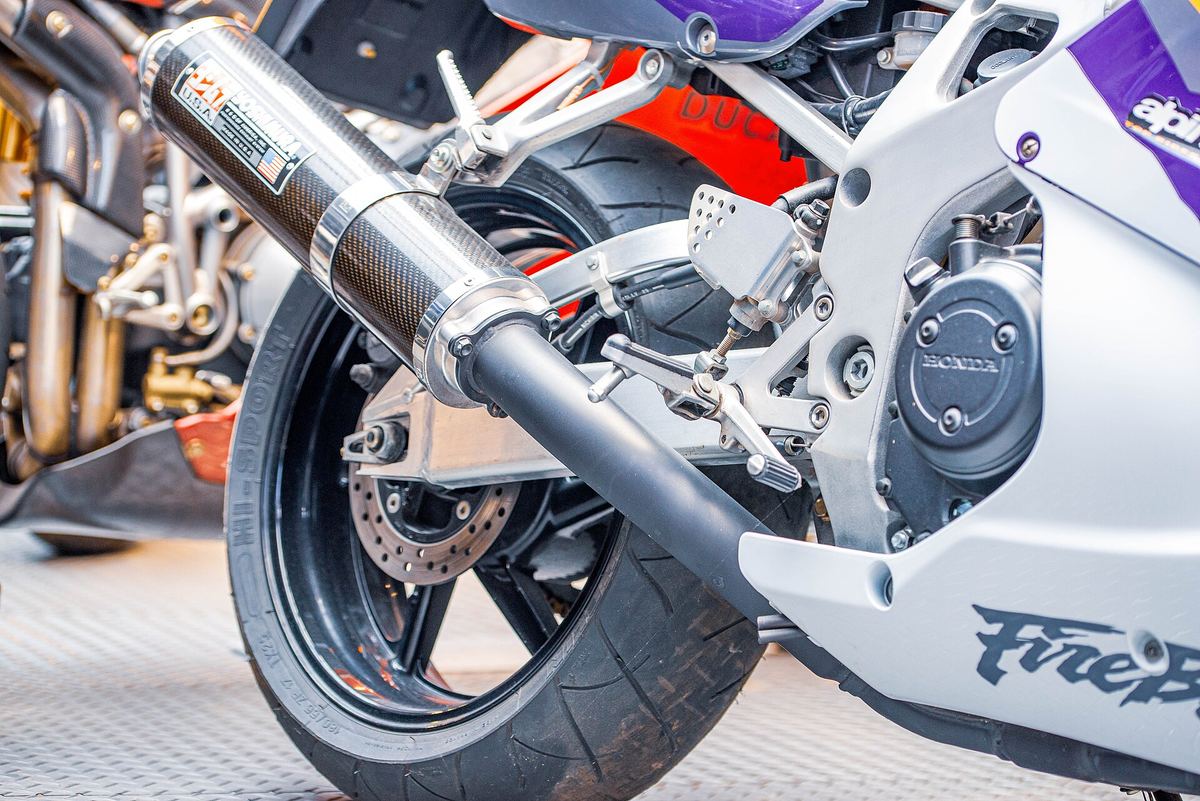
Honda kept developing the Honda Fireblade under Baba for ten years. The 1994 model brought the "foxeye" headlights, the engine grew to 918.5cc in 1996, and the 2000 model had a 929cc fuel-injected engine, Honda UK says. The 954cc bike of 2002 was Baba's last. In 2004 the all-new CBR1000RR became the first full litre-class Fireblade. Baba retired from Honda that year, after 42 years with the company. Since then Honda has written the name Fireblade, with a small b; the capital B of the FireBlade went with Baba, Motofomo notes.
The weight-cutting never stopped. The 2000 model was about 15kg lighter than the first, Honda says. Sales stayed strong too: Honda UK sold nearly 4,000 Fireblades in 1998, its best year for the model.
Rivals did follow. "Our rivals recognised the CBR900RR was special," Baba told MCN in 2000. "Without us there would never be a Yamaha YZF-R1."
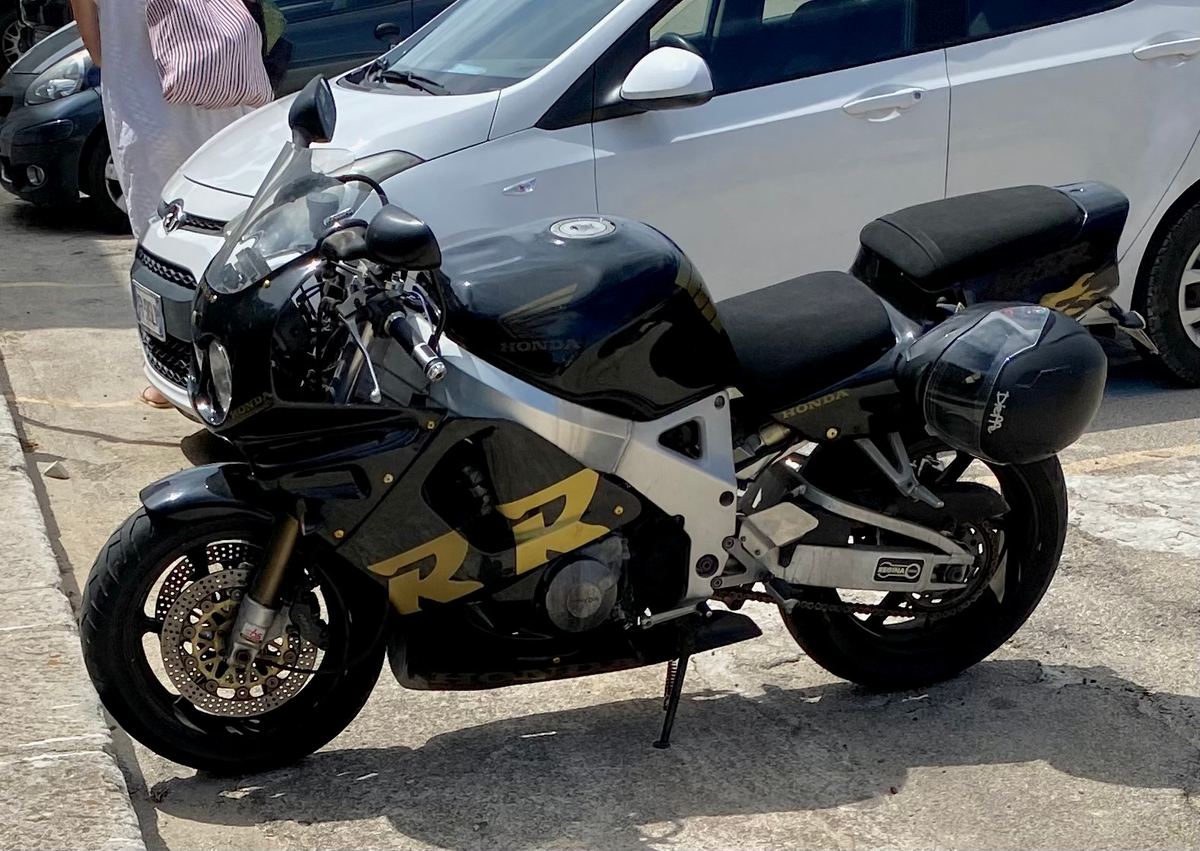
The first bikes are now collected. In the United States, where the first model was sold as a 1993 CBR900RR, Iconic Motorbike Auctions sold one with 15,347 miles for $7,597 in October 2025, and another with 9,890 miles for $19,795 the month before.
In 2022, Honda invited the retired Baba to the Honda Collection Hall in Motegi, where its 30th anniversary Fireblade was shown beside the 1992 original, Pirelli reported. Baba once recalled that the first bike carried a sticker with two words on it, the words that summed up his brief: Total Control.
Quick answers
What is the Honda CBR900RR Fireblade?
The Honda CBR900RR Fireblade is an 893cc inline-four sports motorcycle launched in 1992. Designed by Tadao Baba, it combined near-open-class power with the weight and size of a 600, at a claimed 185kg dry, and set the pattern for the modern superbike.
Who designed the Honda Fireblade?
Tadao Baba, a former Honda test rider, led the Fireblade project as Large Project Leader. He oversaw every generation from the 1992 CBR900RR to the 954cc model of 2002, built around his idea of Total Control.
How fast is the original Honda Fireblade?
Cycle World measured a 1992 CBR900RR at 159mph and recorded a quarter-mile of 10.59 seconds at 132.74mph. Its dynamometer showed 114bhp at the rear wheel, against Honda's claim of about 122bhp.
Why does the Honda Fireblade have a 16-inch front wheel?
Tadao Baba chose a 16-inch front wheel with a conventional 45mm fork because he considered a 17-inch wheel with upside-down forks too heavy. A 130mm-wide tyre gave the grip he needed while keeping the overall diameter of a 17-inch front tyre.