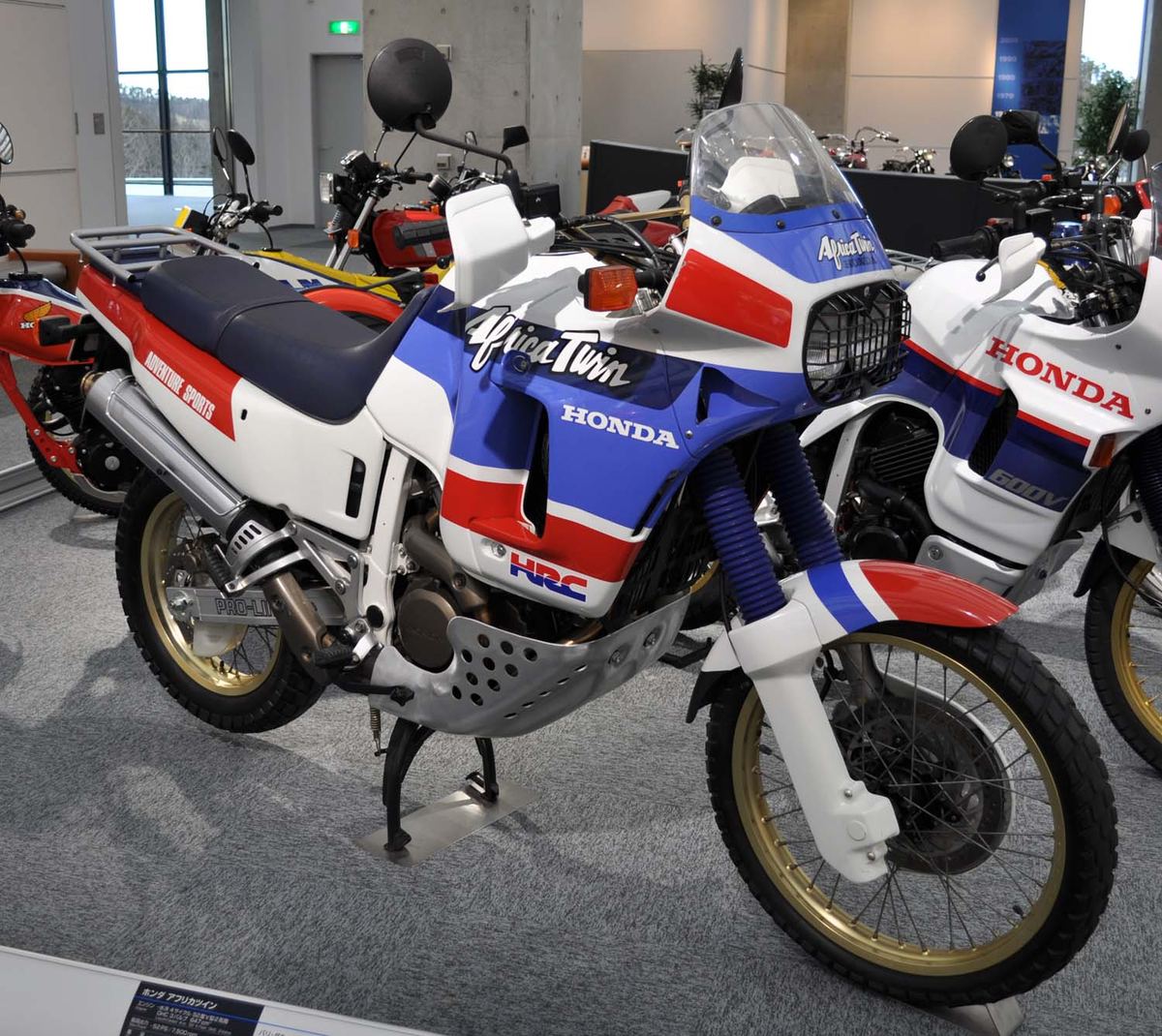
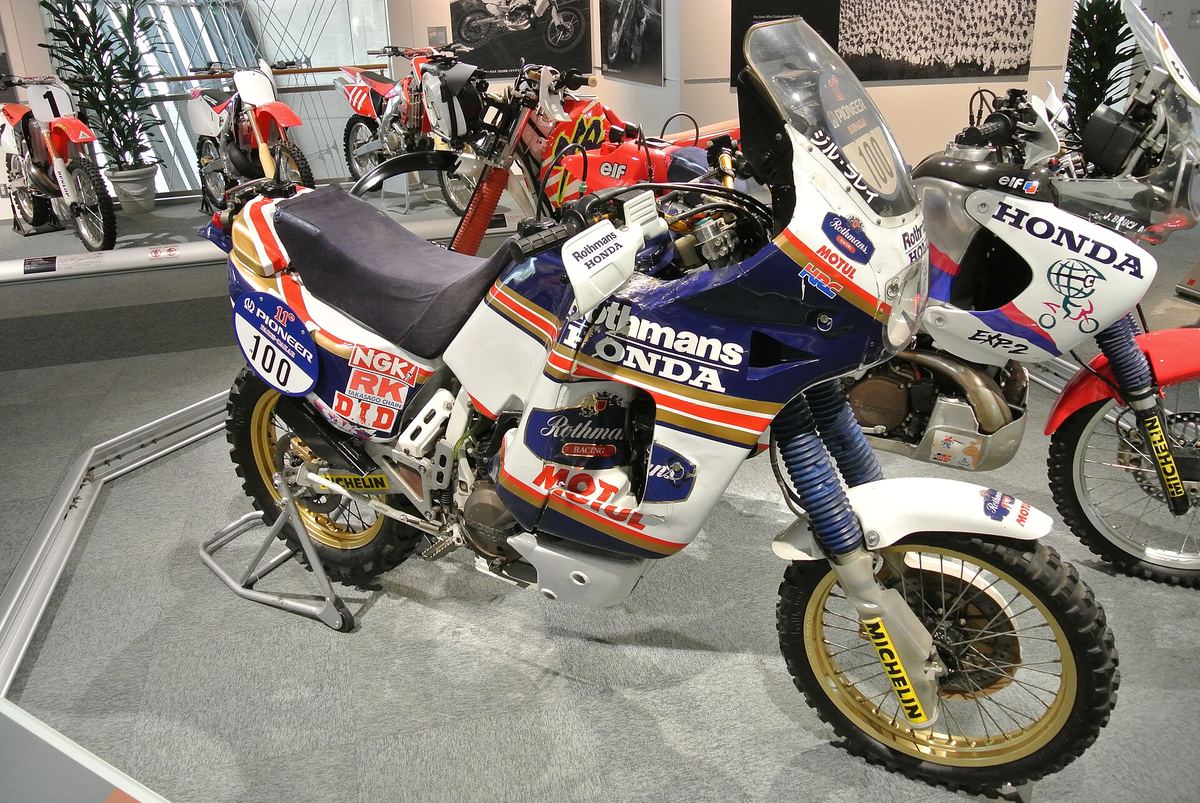
A 1988 XRV650 Africa Twin at the Honda Collection Hall, Motegi.. Photo: Rikita / Wikimedia Commons, CC BY-SA 3.0
Honda spent the second half of the 1980s winning the Paris-Dakar Rally on a motorcycle nobody could buy. Its NXR750, a V-twin built by Honda Racing Corporation (HRC), won the desert race four times in a row, from 1986 to 1989. In May 1988, in the middle of that run, Honda put a road-going version on sale: the Honda Africa Twin XRV650.
It was a replica in the plainest sense. The production bike had a smaller engine borrowed from the Transalp and weighed far more than the racer, but it wore the same white, red and blue HRC colours, with twin radiators and a big rally fairing. Project leader Tomonori Mogi told MSL magazine that copying the NXR "was the whole point".
The Africa Twin was never officially imported into Britain. In Germany, Motorrad later called it the best companion for a really big journey, and MSL argues that modern adventure bikes "simply wouldn't be what they are today without it".
Why Honda built the Africa Twin
Honda first won the Paris-Dakar in 1982, when Cyril Neveu of Honda France took a modified XR500R single to victory, according to Honda. That bike was built from a production enduro. For the rest of the 1980s, Honda wanted a machine designed for the desert from the start.
In October 1984, Honda ordered HRC to build "a factory machine that can win the Paris-Dakar", according to the company's racing history. HRC engineers went to the 1985 rally to watch, then set their priorities: the bike had to be light, small, tough, easy to maintain and stable at speed, and above all dependable. "It must reach the goal line or victory will be far ahead," Honda.Racing quotes from the brief.
The answer was the NXR750, a liquid-cooled V-twin with its cylinders at 45 degrees. MSL lists it at 780cc with eight valves, 72bhp at 7,000rpm, 125kg dry and a 59-litre fuel load, though the same article gives 75bhp elsewhere.
Once the NXR was winning, Honda wanted a showroom version. It already had a suitable engine in the Transalp, a road V-twin built for rough roads. Mogi told MSL: "What was clear was that we would be making a replica of the NXR – it was the whole point." He added that "it had to have the same colour as the factory-built machine". The name came from Honda's European sales staff, who reasoned, in MSL's account: "It must be a real Africa Twin if it has the V-twin engine that raced through Africa."
What made the Honda Africa Twin different
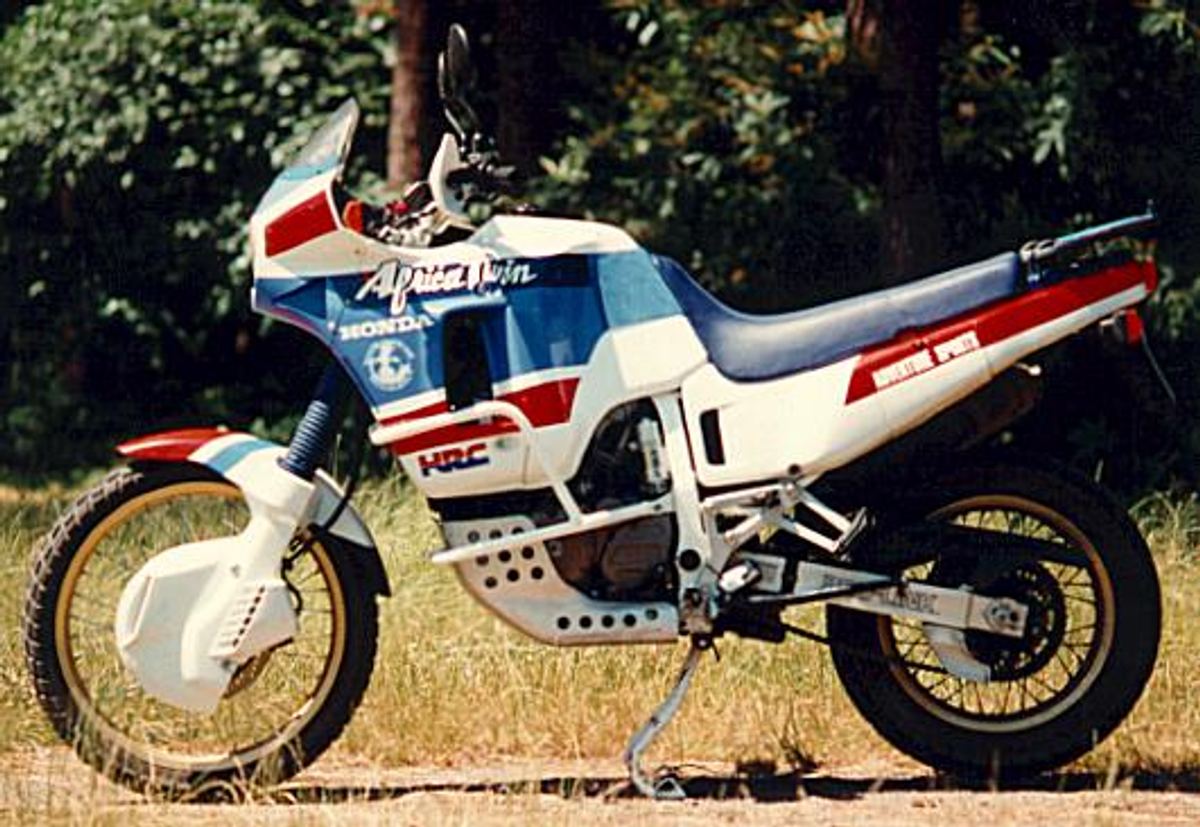
The Honda Africa Twin's engine was a stretched Transalp unit. Honda took the 583cc, liquid-cooled, 52-degree V-twin, with a single overhead camshaft and three valves per cylinder, and bored it out by 4mm to 647cc, according to MSL. Unlike the racer's 45-degree engine, it kept the road bike's wider vee. It had twin aluminium radiators, as on the NXR, and a stainless steel exhaust.
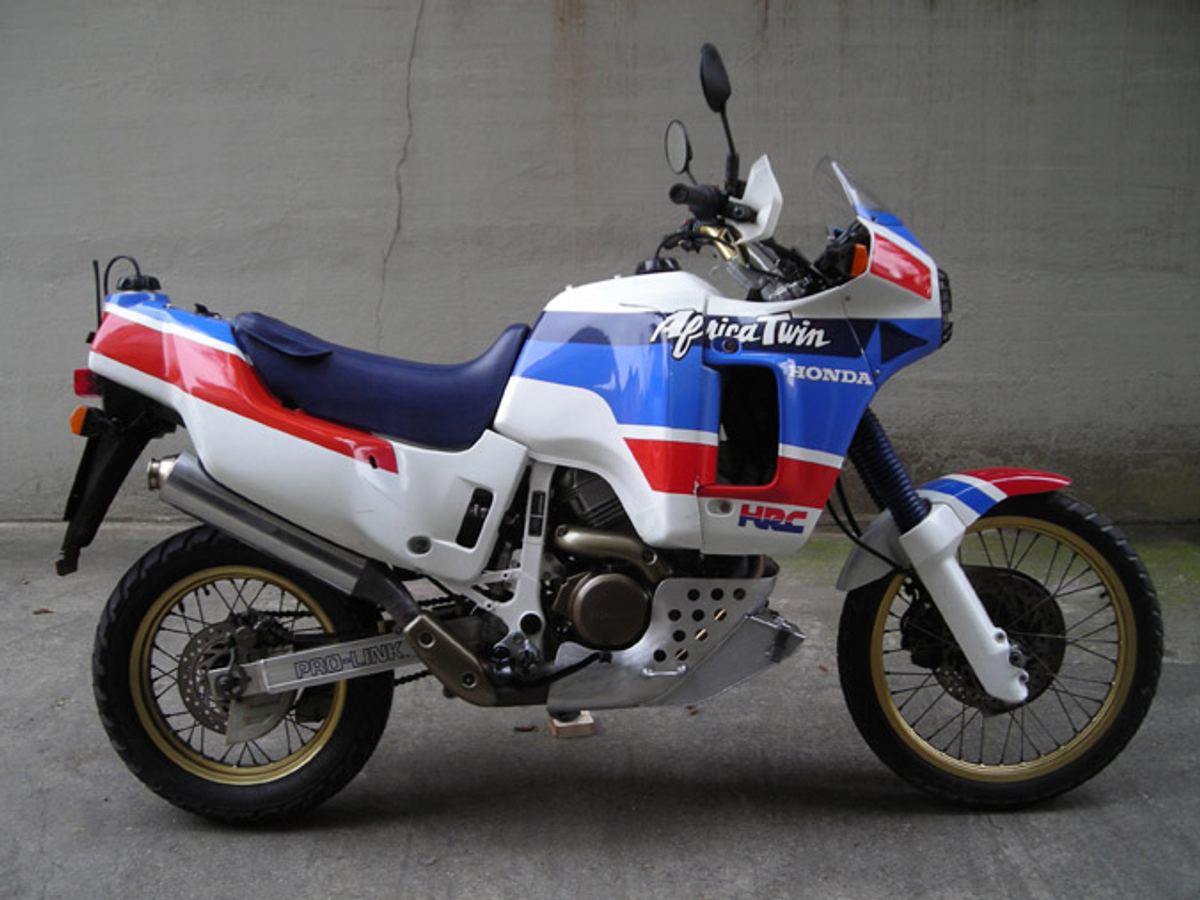
The bodywork did most of the imitating. The fairing and screen came straight from the rally look, and Honda says the fairing was there to cut rider fatigue on long days. MSL describes "a giant, saddle-type fuel tank extended down each side of the engine". Honda gives its capacity as 24 litres; MSL and the German magazine Motorrad both say 25. European bikes got a steel mesh headlight guard and off-road tyres, according to Honda.
The chassis was built for distance. Motorrad lists 220mm of travel at the front and 210mm at the rear, wire-spoked wheels with aluminium rims in 21-inch front and 17-inch rear sizes, and a 1,555mm wheelbase.
The figures depend on who you ask. MSL quotes 57bhp at 8,000rpm and 185kg dry. Japan's Young Machine gives 52PS at 7,500rpm and 195kg, and Motorrad lists the German-market bike at 50PS at 7,000rpm and 220kg with a full tank. Honda's design target, MSL says, was 180km/h flat out and a 150km/h cruise; Motorrad records a top speed of 168km/h.
It was not cheap. Motorrad puts the 1988 German price at 10,750 marks. In Japan, Young Machine reports, it was sold as a limited model at ¥749,000.
In competition: the NXR750 and the Marathon class
The NXR750 won its first Paris-Dakar Rally in 1986. Neveu took the victory and his team-mate Gilles Lalay finished second, according to Honda.Racing.
The second win was closer. In 1987, Neveu crashed in deep sand and damaged his navigation equipment, and Hubert Auriol took the lead on a Cagiva. Neveu had cut the gap to 10 minutes by 19 January. On the 21st, the day before the finish, Auriol fell and was injured, and the NXR won by a narrow margin.
In 1988 Honda entered seven riders on NXRs, and Edi Orioli of the Italian Honda team won, partly by finding a checkpoint that many others missed. In 1989 Lalay won after falling 53 minutes behind the leader at one stage. He took the lead on day 16 and reached the finish about 30 minutes clear, Honda.Racing says. The insurer Carole Nash calls the 1988 and 1989 bikes the NXR800V.
The road bike went to Africa too. In 1989, the year after its launch, the production Africa Twin finished first and second in the Paris-Dakar's Marathon class for unmodified production motorcycles, according to Honda. That year Honda France also ran its "Objet Dakar" project: it chose 50 members of the public and supported them to ride Africa Twins to Dakar. Eighteen of them finished.
On the road
Motorrad's verdicts on the Honda Africa Twin are mostly warm. Werner Koch, looking back at the 1988 bike, found the engine smooth apart from what he called "slightly tingling" vibrations above 6,000rpm. It used between 4.5 and 6.5 litres per 100km depending on how it was ridden. With a 25-litre tank, that works out at roughly 385 to 555km between fill-ups, by our arithmetic.
He also listed its faults. Many engines burn oil through the exhaust, which Koch considered tolerable. The short, splined gearbox output shaft was a weak point, because the angled sprocket loads the splines only in places. And with a full touring load, which could push the total weight past 400kg, the 296mm single front disc got very hot.
The seat was the common complaint. In a separate Motorrad feature, written from the bike's own point of view, Thorsten Dentges admits it is "really not comfortable", and says XRV owners complain about it often.
None of it hurt the bike's reputation much. Koch quotes a KTM development chief, whom he does not name: "The Africa Twin was a real milestone; everything really fitted." It was generous praise from a rival manufacturer. On balance, Koch wrote, he still took his hat off to what Honda had built 25 years earlier.
The Africa Twin today
The Honda Africa Twin grew quickly. In 1990 the RD04 arrived, with a 742cc engine, 62bhp and a second front disc, according to MSL. Honda Japan announced a limited run of 500 XRV750s from 20 March 1990. The RD07 followed in 1993, with a revised version in 1996, and Honda ended production in 2003.
The name came back in 2016 with the CRF1000L, and again in 2020 with the CRF1100L. Honda's next Dakar win came in 2020, when Ricky Brabec won, 31 years after Lalay.
Honda's own history describes the 1988 machine as a "true adventure production model", and the company still gives the Africa Twin name to its largest adventure bike.
For collectors, the first bike is the one to have. MSL's Phil West writes that "the original RD03 650 is at last becoming an appreciating modern classic".
Honda built the Africa Twin to sell the story of the NXR750. Almost four decades later, the road bike has outlasted the racer's fame.
Quick answers
What is the Honda Africa Twin XRV650?
The Honda XRV650 Africa Twin is a 647cc V-twin adventure motorcycle launched in 1988. It was designed as a road-going replica of Honda's NXR750, which won the Paris-Dakar Rally four times in a row from 1986 to 1989, and wore the same HRC colours.
Did the Honda Africa Twin win the Dakar?
The NXR750 factory racer that inspired it won the Paris-Dakar in 1986, 1987, 1988 and 1989. The production Africa Twin finished first and second in the 1989 Marathon class for unmodified production motorcycles, according to Honda.
How powerful is the original Honda Africa Twin?
Sources disagree. MSL magazine quotes 57bhp at 8,000rpm for the 1988 XRV650, Japan's Young Machine gives 52PS at 7,500rpm, and Germany's Motorrad lists the German-market bike at 50PS at 7,000rpm.
When did Honda stop making the original Africa Twin?
Honda built the XRV650 from 1988, replaced it with the 742cc XRV750 in 1990 and updated that model in 1993 and 1996. Production ended in 2003. The name returned in 2016 on the CRF1000L.