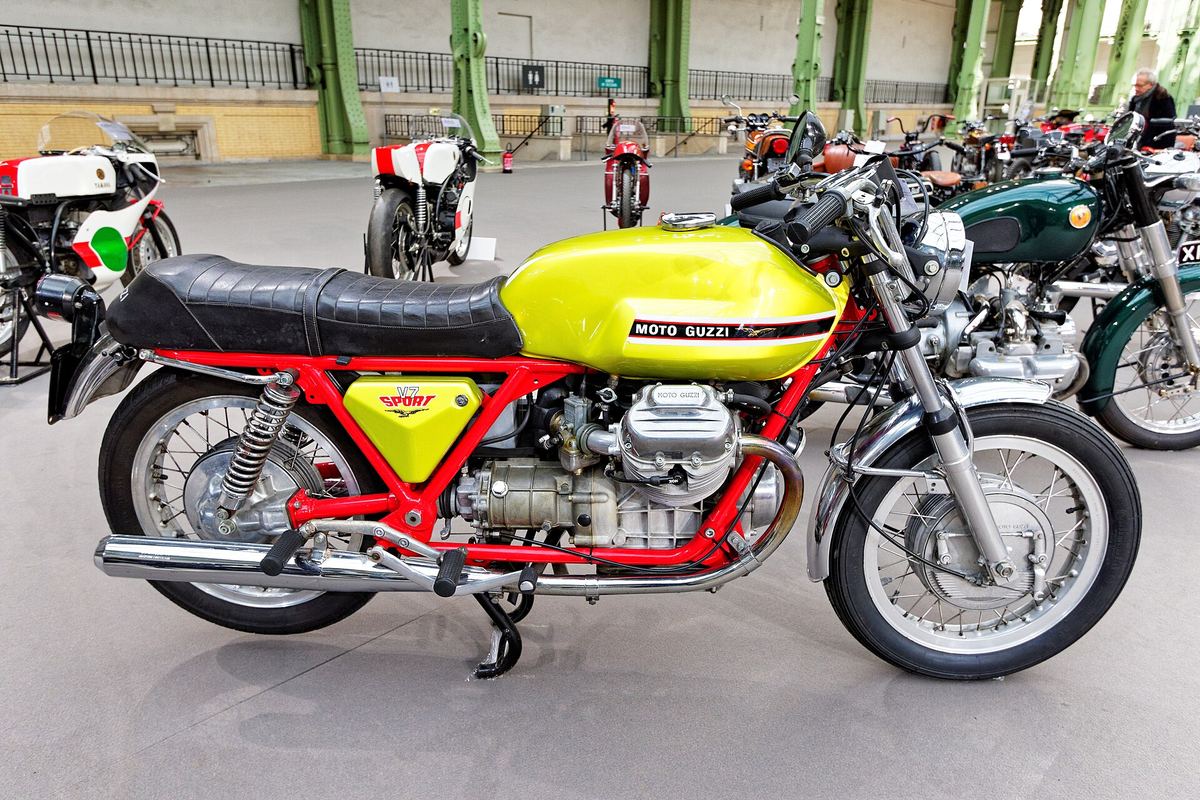
A 1971 V7 Sport at the Bonhams sale in the Grand Palais, Paris, 2016.. Photo: Thesupermat / Wikimedia Commons, CC BY-SA 4.0
Monza, 1971. At the 500 km production race, a motorcycle Moto Guzzi had not yet officially launched lined up on the grid. The Moto Guzzi V7 Sport finished third, behind a Triumph Trident and a Honda CB750, Cycle World's Italian correspondent Carlo Perelli reported. The factory still would not release any figures for it.
The engine came from a heavy police and touring bike that Cycle World's Phil Schilling later called "long, rugged, heavy, simple and exceedingly homely". The chief engineer, Lino Tonti, kept that engine and built a new motorcycle around it: lower, lighter and with a frame so tight that its bottom rails had to unbolt to let the engine out.
The result went on sale late in 1971. Moto Guzzi's owner, the Piaggio group, now describes it as the first mass-produced motorcycle able to exceed 200 km/h. Its frame became the base for Guzzi's sports bikes through the rest of the 1970s.
Why Moto Guzzi built the V7 Sport
Moto Guzzi was in trouble long before the V7 Sport. It left Grand Prix racing in 1957, and by 1966 it was in receivership, according to The Classic MotorCycle. Its V-twin engine had begun life as a design by chief engineer Giulio Cesare Carcano for Fiat, which turned it down; Guzzi put it into the V7, a shaft-drive tourer that the Italian police wanted. Carcano himself was forced out in 1966, Cycle World recalls.
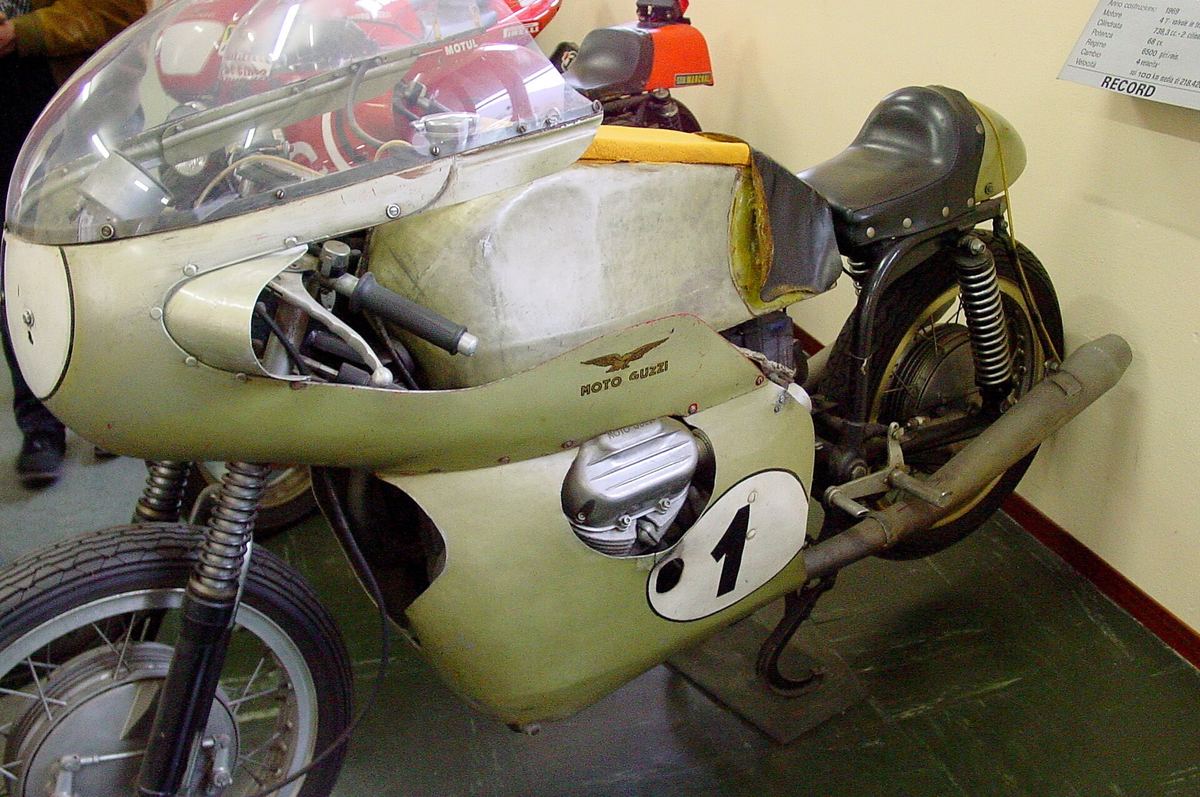
New management hired Lino Tonti in 1967. He had designed racing bikes for Aermacchi, Bianchi and Mondial, and he started by making the V7 go faster. In June and October 1969, faired V7s with engines of 739cc and 757cc set world records on the Monza banking, including 100km at an average of 218.426km/h, according to Piaggio. The Italian magazine inSella counts 19 world records in all, with riders including Vittorio Brambilla, Pagani, Raimondo Mandracci and the journalist Roberto Patrignani.
After the records, Tonti was briefed to build a road bike for both production and production-based racing, writes the historian Ian Falloon. The targets were 200km/h, less than 200kg and a five-speed gearbox. Strikes slowed work at the factory, so Tonti and two former Aermacchi colleagues, Francesco Botta and Alcide Biotti, built the first frames in his own workshop, Falloon says. inSella puts the work in Tonti's cellar.
Tonti unveiled the V7 Sport in June 1971, Falloon writes. Classic Bike Guide calls it the firm's first production sports bike.
What made the Moto Guzzi V7 Sport different
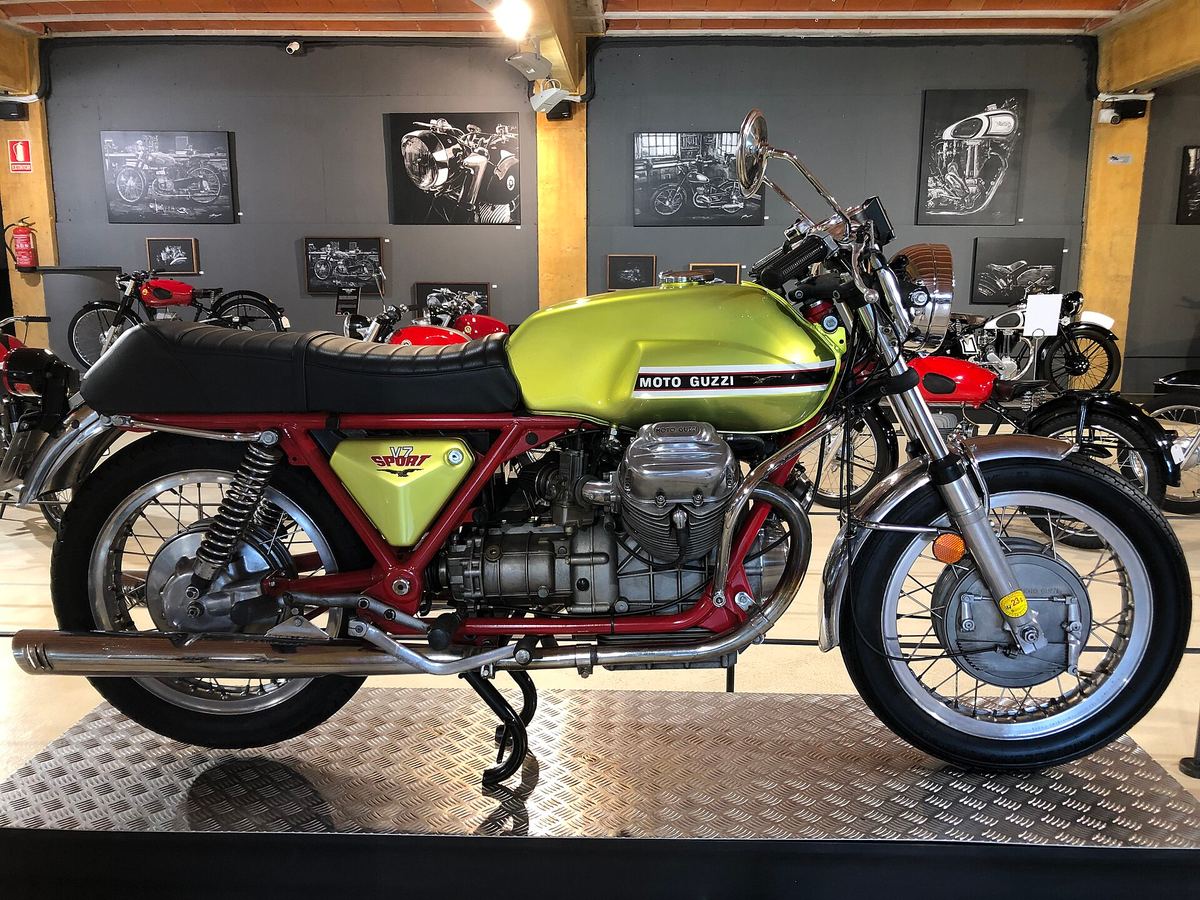
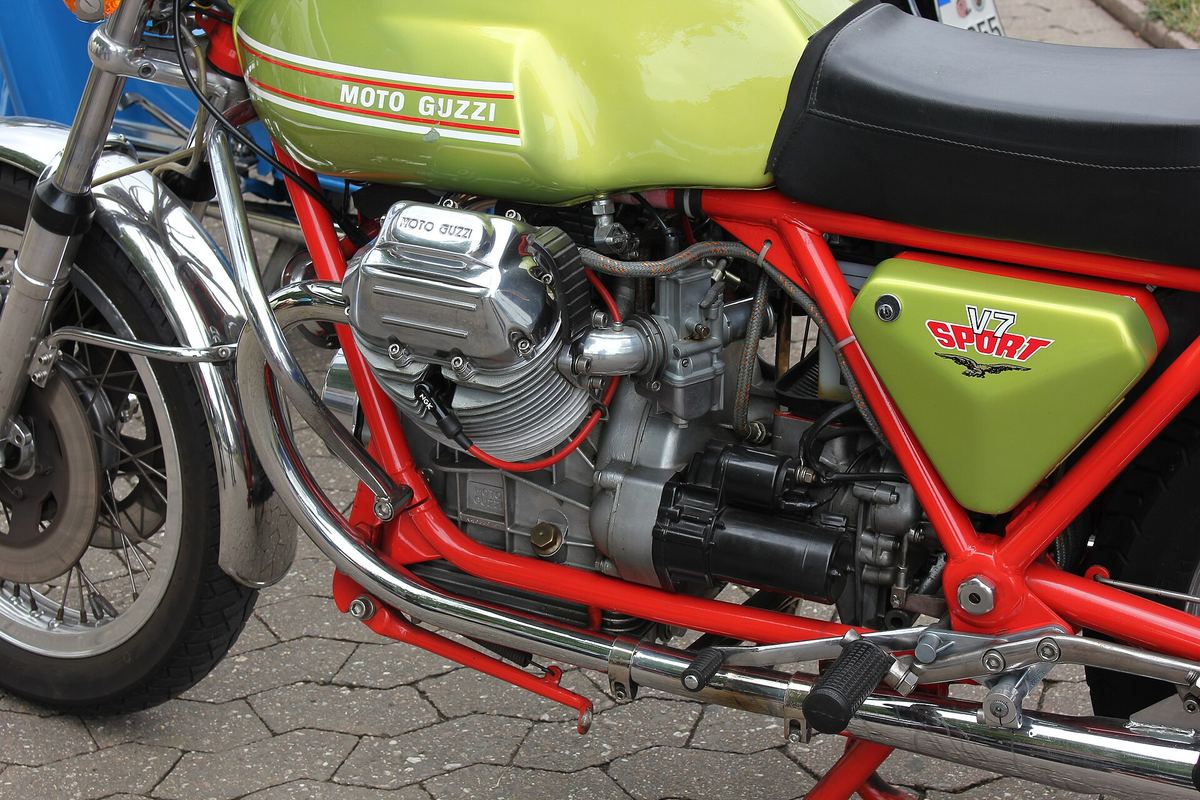
The Moto Guzzi V7 Sport's key change was small. The touring V7 carried a large generator on top of the engine, between the cylinders. Tonti replaced it with a compact alternator on the front of the crankshaft, which freed the space above the engine for a low frame backbone, Cycle World explained. The frame then wrapped the engine so tightly that its lower rails had to be removable. "With the Ambassador, the engine came out of the frame; with the V7 Sport, the frame came off the engine," Schilling wrote.
The engine was reduced from 757cc to 748cc to fit the 750cc racing class. Most sources give the bore and stroke as 82.5 x 70mm; The Classic MotorCycle lists 83 x 70mm. A five-speed gearbox replaced the four-speed, two 30mm Dell'Orto carburettors fed it, and final drive stayed by shaft. Moto Guzzi claimed 70bhp at 7,000rpm.
The first bikes were special. Built in the factory's experimental department, they had frames of chrome-molybdenum tube painted red, with lime green bodywork, according to Piaggio. Collectors call them the Telaio Rosso, or red frame. How many were made is disputed: Piaggio and inSella say 150, The Classic MotorCycle says 150 to 200, and Gooding & Company, citing factory records, says 104 were built in 1971. Regular production began in November 1971 with a steel frame, and later bikes had black frames, according to Piaggio.
It was expensive. inSella puts the Italian price at 1,480,000 lire, against 1,020,000 lire for a Laverda 750 SF. Perelli quoted the equivalent of about $2,500.
In competition: the V7 Sport at Monza
The Moto Guzzi V7 Sport was built to race in production classes, and it raced before it was sold. At the 1971 Monza 500km, scrutineering was so strict that 18 of the first 20 bikes inspected were excluded, Perelli reported, until the organisers told the officials to relax. The race went to Triumph's Trident; the V7 Sport took third.
Perelli also wrote that "a group of famous riders" had met secretly at Monza to test the machine. Falloon writes that Mike Hailwood tested the V7 Sport at Monza and called it the best-handling road bike he had ridden.
The bike's endurance record was close but not quite successful. In September 1971, Brambilla and Mandracci led the Bol d'Or 24-hour race until the engine failed in the tenth hour, the journalist Nico Cereghini recalls. In 1973 Perelli wrote that the racing Guzzis behind the new 850 Le Mans had shown "brilliant qualities" in the Bol d'Or two years running, "although never winning due to sheer bad luck".
At the first Imola 200 in 1972, the works Guzzis of Brambilla, Jack Findlay and Mandracci were "clearly underpowered", Perelli reported, but all three finished, in eighth, tenth and eleventh places.
On the road
Perelli rode one of the first V7 Sports to reach an Italian showroom. Below 3,000rpm, he wrote, the engine "isn't happy, but it pulls like a turbine from there up to a little over 7000 without annoying vibration". Shaft-drive torque reaction was noticeable on every gear change, and he advised a long, soft use of the clutch. His verdict was that Guzzi had turned "the elephantine Ambassador into a good sports model".
Speed was its strongest card. In June 1972 the Italian magazine Motociclismo tested it against its rivals, and it was the only bike to pass 200km/h, inSella reports. In the 1972 Premio Varrone, Italy's prize for the best big bike of the year, it got the most votes from the jury, though the trophy was not awarded because Guzzi had already won it, Cycle World noted.
Schilling, writing almost 30 years later, praised its long-distance manners: the engine fires its cylinders 270 degrees apart, then waits 450 degrees, and "lopes" even at 7,500rpm. He thought it was not the quickest bike of its day, at roughly 13.5 seconds for the standing quarter-mile, and he criticised the four-shoe front drum at a time when discs were arriving. By his account, at the end of a long ride an experienced rider would choose the Guzzi over a Laverda triple or a Ducati twin.
The V7 Sport today
The Moto Guzzi V7 Sport lasted only until 1974. Alejandro De Tomaso took control of Moto Guzzi in 1973, and Schilling says cost cutting soon reached the V7, from cheaper front disc brakes to simpler gearshift linkage. The 750 S with twin discs followed in 1974 and the 750 S3 in 1975, according to inSella. Tonti's frame went on into the 850 Le Mans, which appeared in 1975.
inSella puts production at 3,541 bikes over three years, plus the red-frame pre-series. The gap between early and later bikes is wide. Gooding & Company sold a 1971 Telaio Rosso for $87,000 in December 2023, against an estimate of $30,000 to $50,000. In March 2026, a 1972 V7 Sport sold for $8,560 on Iconic Motorbike Auctions.
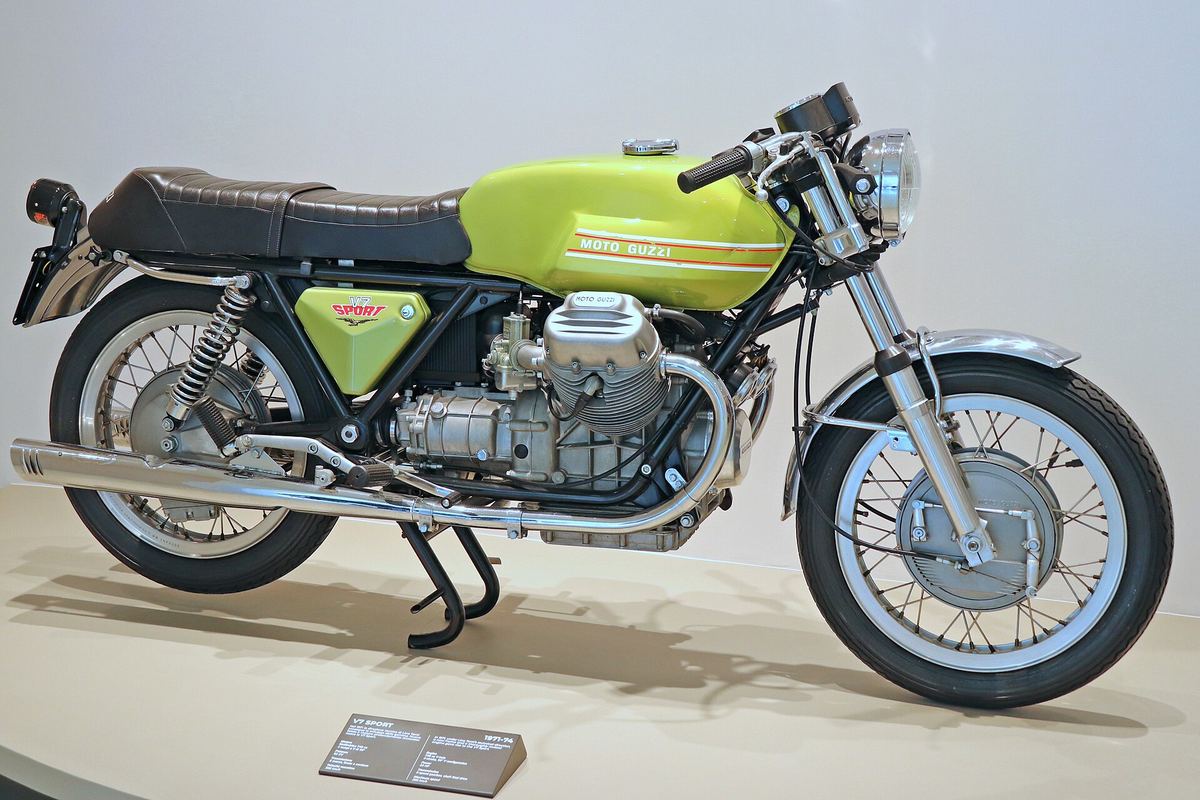
One V7 Sport now stands in the new Moto Guzzi museum in Mandello del Lario, and the company still sells a modern V7 Sport that borrows the name. The original showed that a factory short of money could make a fast, good-handling sports bike from the engine it already had.
Quick answers
What is a Moto Guzzi V7 Sport?
The Moto Guzzi V7 Sport is a 748cc shaft-drive V-twin sports motorcycle built from 1971 to 1974. Designed by Lino Tonti, it used the engine of the touring V7 in a new, lower frame and was one of the fastest production motorcycles of its time.
What is a Moto Guzzi Telaio Rosso?
Telaio Rosso, Italian for red frame, is the name for the first V7 Sports of 1971, built in Moto Guzzi's experimental department with red chrome-molybdenum frames. Sources disagree on the number: Piaggio says 150, while Gooding & Company cites factory records of 104 built in 1971.
How fast is a Moto Guzzi V7 Sport?
Moto Guzzi claimed about 200km/h. In a June 1972 comparison test by the Italian magazine Motociclismo, it was the only bike to exceed 200km/h, according to inSella. Cycle World's 1971 report gave a top speed of over 124mph.
What replaced the Moto Guzzi V7 Sport?
The V7 Sport was replaced in 1974 by the 750 S, which had twin front disc brakes, and then by the 750 S3 in 1975. Lino Tonti's frame design continued in the 850 Le Mans, launched in 1975.