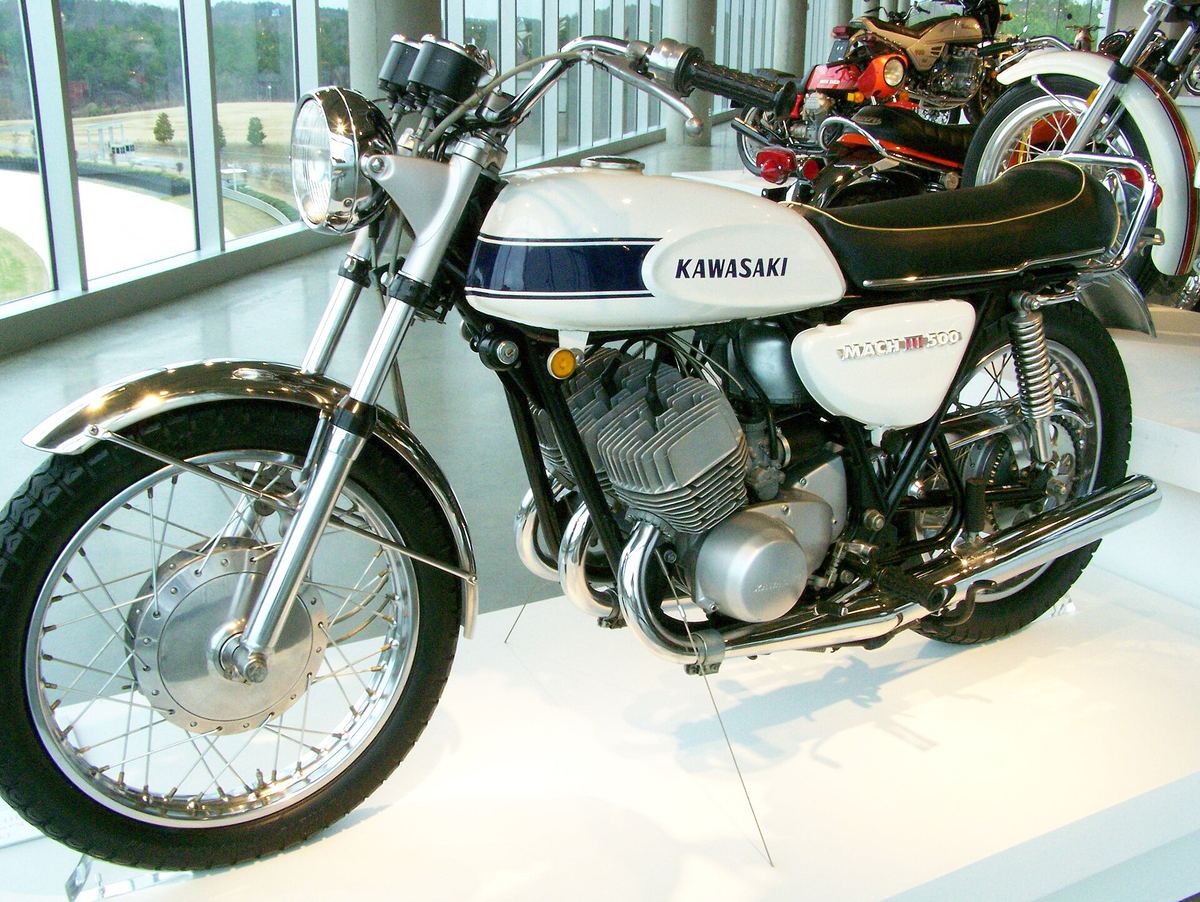
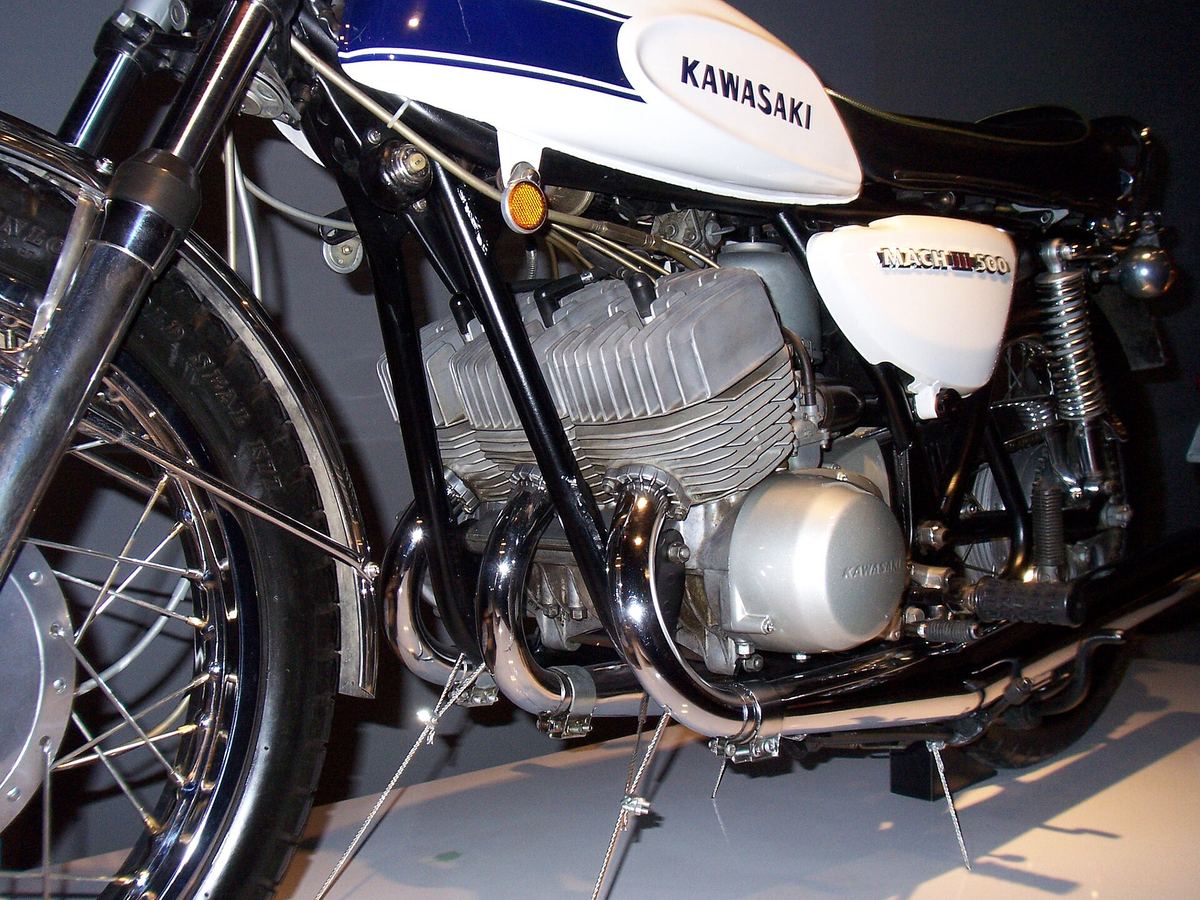
An early H1 Mach III in its original white and blue, Barber Vintage Motorsports Museum, Alabama.. Photo: Chuck Schultz / Wikimedia Commons, CC BY-SA 2.0
Ivan Wagar, editor of Cycle World, flew to Japan to see the bike before it arrived. When the Kawasaki H1 Mach III reached the magazine's offices in early 1969, the staff joked about drawing lots to decide who would not have to ride it down the drag strip. The road test called it "the kinkiest street bike ever".
The fear was misplaced. The testers found it started easily, behaved in traffic and stopped well. But it made 60bhp from 500cc, lifted its front wheel "if the throttle is jerked on in the first three gears", and cost $999.
In the same issue, Wagar asked American dealers to take responsibility for what they were selling. The Mach III, he wrote, had "the weight and balance of a 350, with the power of a 750, not to mention the brakes of a 1000". It was the bike that made Kawasaki a name in America at the end of the 1960s.
Why Kawasaki built the Mach III
In the mid-1960s Kawasaki was a newcomer to motorcycles, and the United States was the market that mattered. The company's plan to take over the American performance market, the N100 Plan, was drawn up in 1966 and 1967, Cycle World's Kevin Cameron wrote in 2019. Kawasaki looked at the Harley-Davidson Sportster, the Triumph Bonneville, the BSA Super Rocket and Honda's CB450, and set a target of 500cc, 60hp and a 13-second quarter-mile.
Kawasaki's own four-stroke twins, based on a BSA design, could not reach those numbers, Cameron writes. Its two-stroke twins used rotary disc valves, which were expensive to make, and a bigger twin meant bigger pistons that were more likely to seize. The answer was three smaller cylinders with piston-port induction. Cycle World added another reason in 1969: Kawasaki had used rotary valves on every two-stroke until then, but on a triple they would have made the engine too wide, and a rotary valve for the middle cylinder was almost impossible.
Classic Bike Guide dates the start of the N100 Plan to February 1967 and the start of engine work to July. Kawasaki asked Osaka University to study whether the middle cylinder of an inline three would run too hot; the result was wide cylinder spacing, at 115mm, and longer fins on the middle barrel, according to Cameron.
Kawasaki announced the bike in September 1968 and it reached American dealers in early 1969, Classic Bike Guide says.
What made the Kawasaki H1 Mach III different
The Kawasaki H1 Mach III's engine was all new. Cycle World reported that none of its parts were shared with other Kawasakis and credited a young engineer, Otsuki, and his team with the design. Three air-cooled cylinders of about 166cc each sat across the frame, each with its own 28mm Mikuni carburettor, and the crankcases were split horizontally, which the magazine considered a difficult piece of machining for a two-stroke triple.
The ignition was new too. At 10,000rpm the engine needed 500 sparks a second, more than conventional points could manage, so Kawasaki fitted capacitor discharge ignition delivering 25,000 volts, Cycle World explained. Normal spark plugs would not last at that voltage, so it used surface-gap plugs borrowed from American outboard motors.
The layout was audacious. Cycle World noted that a three had more cylinder wall area, and so more potential port area, than a twin of the same size, which it reckoned was worth about 22 percent more power. There were three exhausts, two on the right and one on the left, and an oil pump linked to the throttle. The weight sat 57 percent over the rear wheel, which helped explain the wheelies.
The engine was compact for a triple. Cycle World found it less than an inch wider than Kawasaki's A7 350 twin, and noted that the first prototype had rubber engine mounts that caused strange harmonics, so the production engine was bolted solidly into the frame. The magazine also admired the styling, from the long white tank with its broad blue stripe to the three slim silencers, and compared its restrained look to a $14,000 sports car.
In competition: drag strips and Grands Prix
The Kawasaki Mach III's first battleground was the drag strip. Kawasaki hired the drag racer Tony Nicosia to help develop and promote it. At Lions Drag Strip in California he ran an uncrated bike with no miles on it through the quarter-mile in 13.01sec at 99mph, then 12.70sec at 107mph after seven miles, RevZilla's Common Tread reports. Some magazines at first refused to publish times that quick. On the street the bikes did the same thing. Kevin Cameron, then working in a Boston-area dealership, remembers customers coming in to describe how they had beaten Sportsters and Bonnevilles away from the lights.
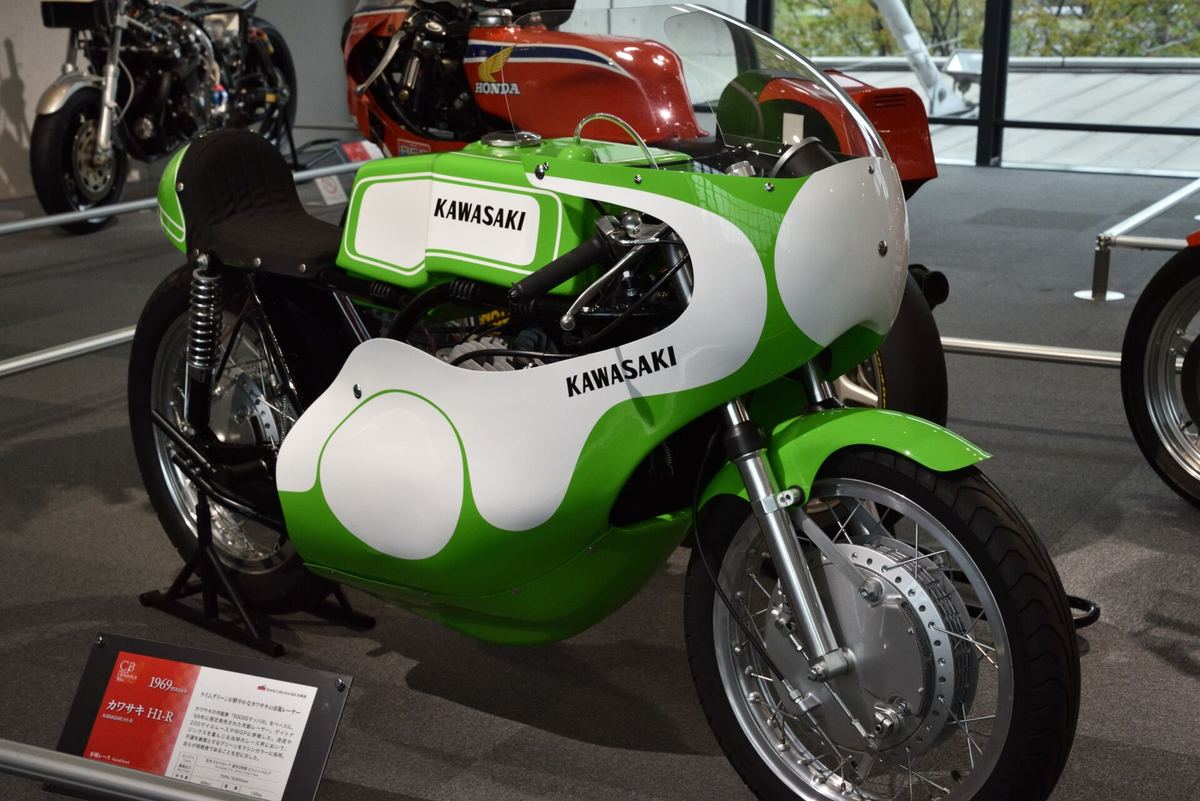
The road racers came next. Kawasaki built a racing version, the H1R, and in 1970 Ginger Molloy rode one to second place in the 500cc world championship behind Giacomo Agostini's MV Agusta. In 1971 Dave Simmonds won the Spanish Grand Prix at Jarama on an H1R, Kawasaki's first win in the premier class, after Agostini had sat out the race with the title already won, according to Wikipedia's account, which cites Classic Racer.
The road bike won too. In 1974 Keith Martin took the 500cc class of the Isle of Man Production TT on a standard H1, according to Wikipedia, citing the TT's official results.
On the road
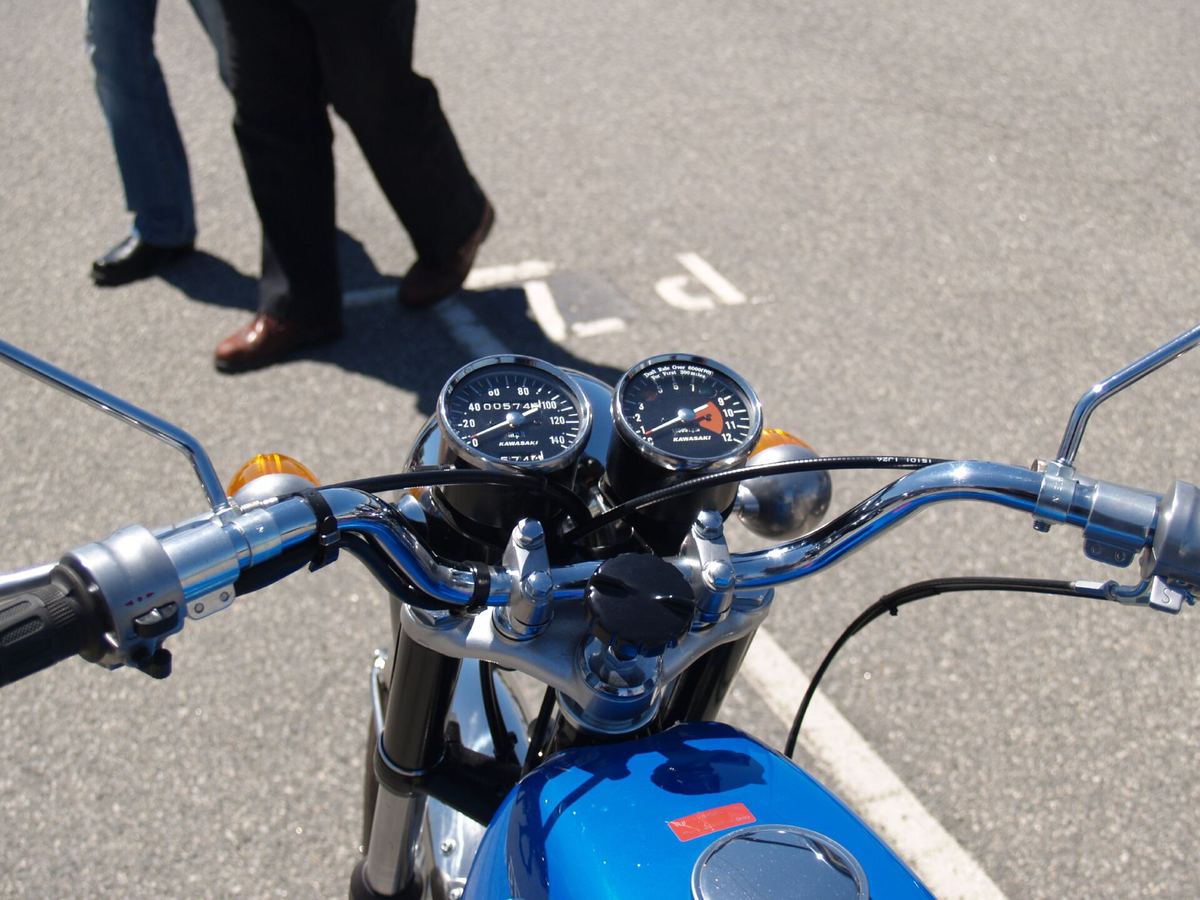
The Mach III was easy to ride slowly. Cycle World's testers praised the comfortable seat and handlebars and found the engine free of vibration. It was "slightly peaky", they wrote, with a strong surge around 6,000rpm, and once moving it was best to change into second as soon as possible.
The handling drew more argument. Cycle World found the frame strong, but noted a slight waggle above 110mph when banked over, and the centre stand grounded on left-hand bends. Cameron later traced the handling criticism to two factory faults he had seen himself: frames welded on one side and then the other, which allowed distortion, and rear dampers that could lose their oil in a few strokes.
Not everyone agreed it was dangerous. Writing for Hagerty in 2024, John L. Stein, who owned and serviced Mach IIIs, said the triples "handled fine" in normal riding, though early bikes ran out of ground clearance and their rear suspension pogoed when pushed. The "widowmaker" name, he argued, should describe the rider rather than the bike.
Kawasaki refined it year by year. A front disc brake replaced the drum in 1972, and frame and suspension changes followed in 1973, Classic Bike Guide says.
The Mach III today
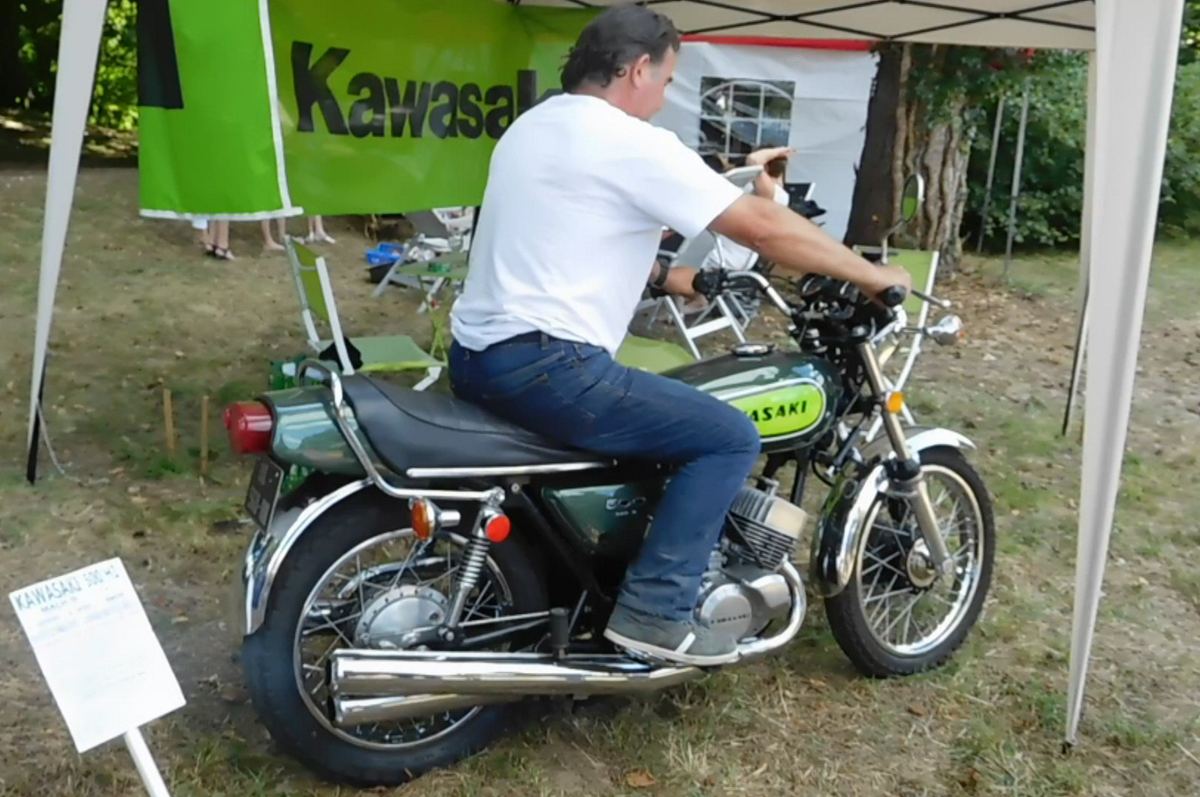
The Kawasaki Mach III started a family. Kawasaki added the 350cc S2 and 250cc S1 triples, and the 750cc H2 Mach IV arrived in 1972. Cameron argues that the triples forced four-stroke makers to build bigger, more advanced engines, including Kawasaki's own 903cc Z1 of 1973. Tighter emissions laws then ended the two-strokes: the 500 was renamed the KH500 and sold in America until 1976. Cameron puts total H1 production at 110,000.
Prices are still modest. Classic Bike Guide put a project needing a full rebuild at £4,000 to £5,000 in April 2026, a good running H1 at £7,000 to £9,000 and a show-quality bike at £9,000 to £12,000. In March 2026, H&H sold a renovated 1975 H1F for £6,210.
Cameron remembers the sound best. In 1977, he wrote, he could tell when the bars two miles away had closed, because he could hear the three-cylinder Kawasakis "upshifting away into the night".
Quick answers
What is the Kawasaki H1 Mach III?
The Kawasaki H1 Mach III is a 498cc air-cooled two-stroke triple sports motorcycle launched in 1969. It made a claimed 60bhp, ran the quarter-mile in about 13 seconds and sold in America for $999, making Kawasaki's name as a performance brand.
How fast is the Kawasaki H1 Mach III?
Cycle World's 1969 road test is credited with a quarter-mile of 13.20 seconds and a top speed of 119.14mph. Drag racer Tony Nicosia ran a new bike through the quarter-mile in 12.70 seconds at 107mph.
Why is the Kawasaki Mach III called the widowmaker?
The nickname comes from its sudden power, front-wheel lifting and criticised handling. Some writers say it belonged first to the 750cc H2. Hagerty's John L. Stein, who serviced the bikes, argued the H1 handled fine in normal riding and that the name describes the rider rather than the bike.
When was the Kawasaki H1 Mach III made?
Kawasaki announced the H1 in September 1968 and sold it from early 1969. It received a front disc brake in 1972, became the KH500 in 1976 and ended production that year as emissions laws tightened.