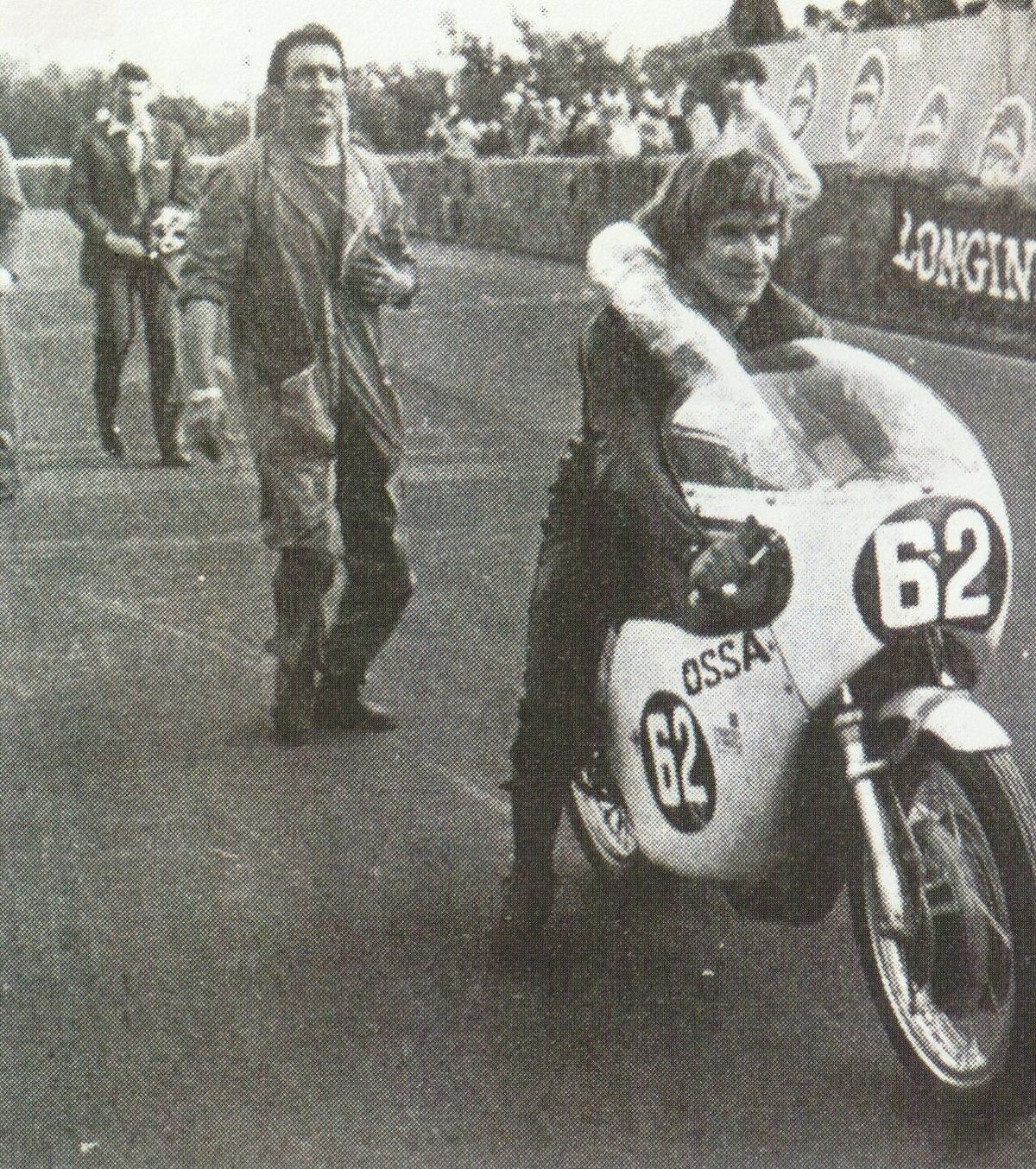
Santi Herrero after winning at Opatija in May 1970, eight months after losing the 1969 title there. Behind him is his mechanic, Esteban Oliveras.. Photo: Wikimedia Commons, CC0
The last round of the 1969 250cc world championship was run on 14 September at Opatija, a road circuit cut into the hillside above the Adriatic. Santiago Herrero started the Yugoslavian Grand Prix leading the series by a single point, on a Spanish single-cylinder two-stroke that was giving away more than 20 hp to the bike he had to beat.
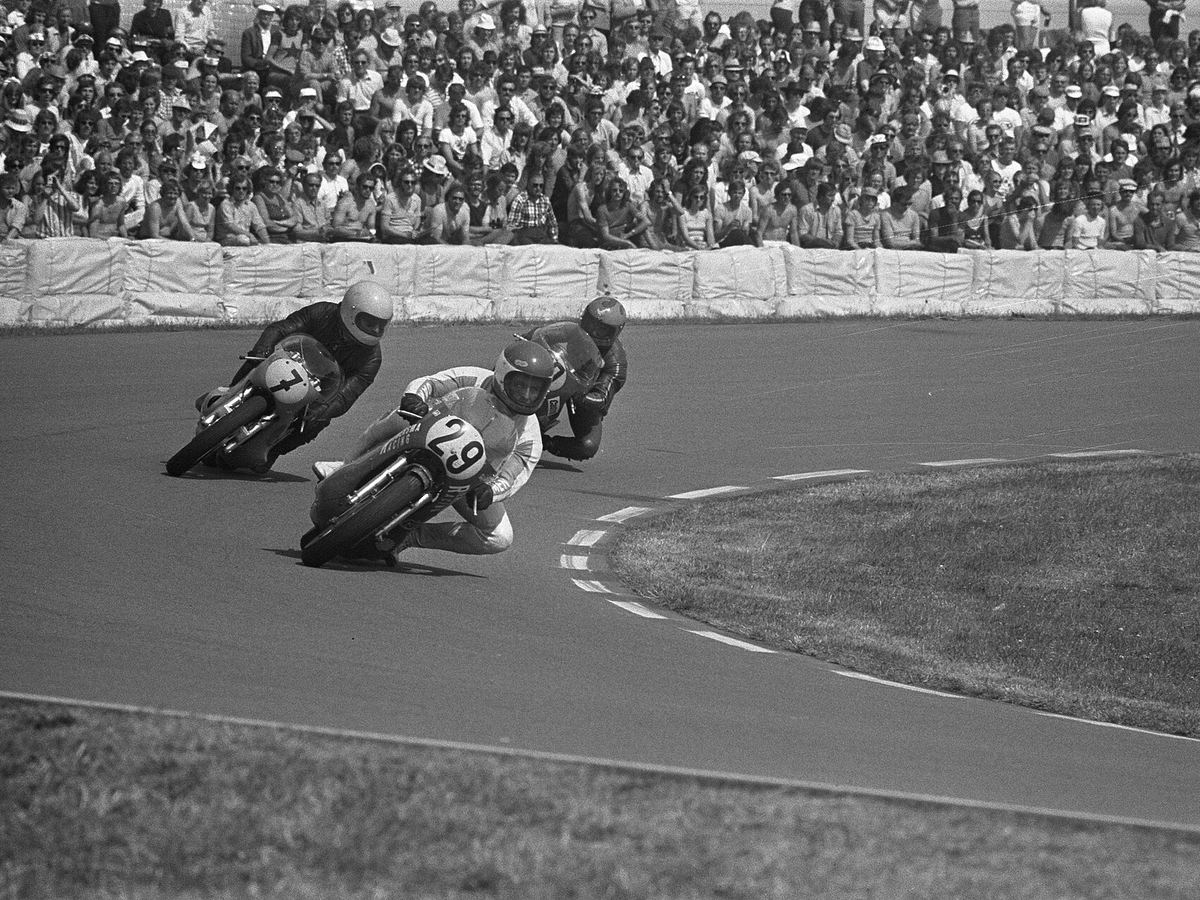
That bike was Kel Carruthers' four-cylinder Benelli, a four-stroke that made 64 hp. Kent Andersson, the third man in the fight, rode a Yamaha twin. Herrero's Ossa made 42. He took the lead anyway. Then, according to Spanish accounts of the race, a light rain began to fall, and on a painted white line the Ossa went from under him.
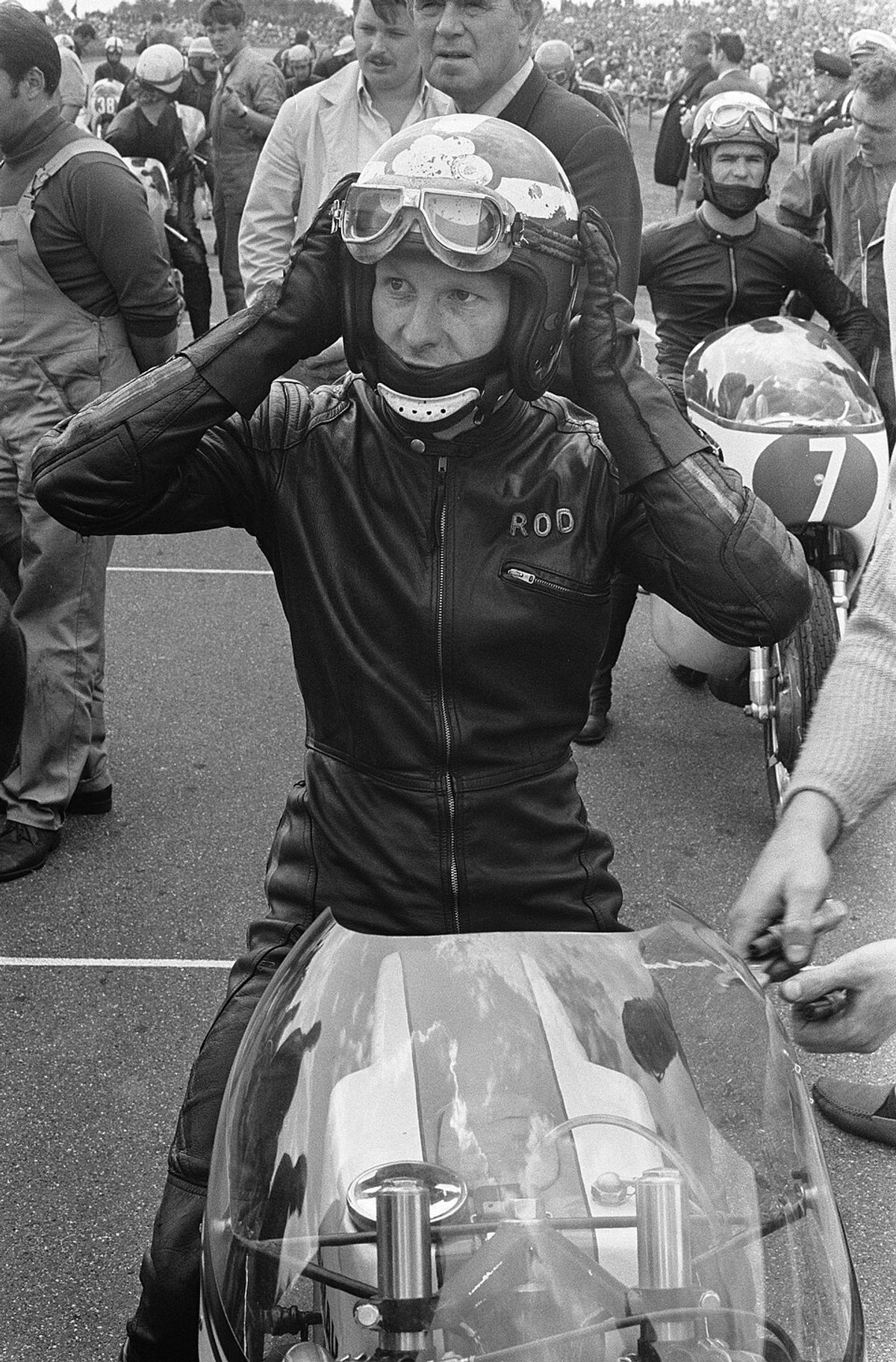
Carruthers won the race and the title. Andersson finished third and took second in the championship. Herrero, who had led the standings since Spa in July, ended the year third: 83 points to Andersson's 84 and Carruthers' 89.
Santi Herrero and a magnesium Ossa
Ossa built cinema projectors in Barcelona before it built motorcycles. In the 1960s Eduardo Giró, son of the founder, Manuel Giró, wanted a 250cc world championship challenger. According to MotoVue, he considered a two-stroke V4 to match Yamaha's, found it was beyond Ossa's budget, and chose a single instead.
The engine was a 249cc two-stroke with rotary disc valve induction, air cooling and a six-speed gearbox. It was strong. The steel-tube frame around it was not, so Giró replaced the frame with a monocoque: a welded shell of magnesium sheet that also served as the fuel tank. Corsedimoto reports that the magnesium was American aviation material brought in through France, and that Ossa had to build its own welding machine because no European firm could weld it.
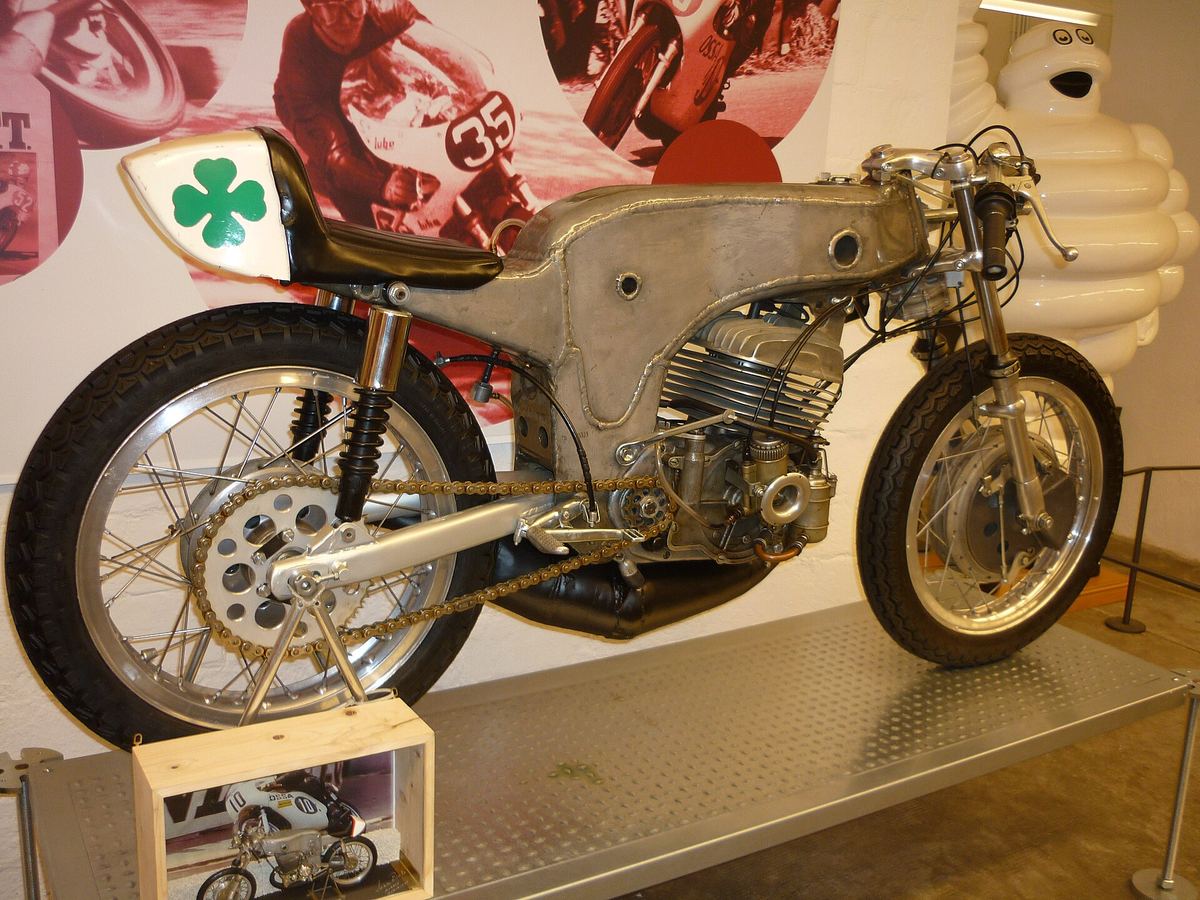
The rider Giró signed at the end of 1966 was a mechanic from Madrid. Herrero had bought his first motorcycle at 12, raced a Derbi he maintained himself, and worked in the competition department of the small Lube factory until it went out of business. He was running a repair shop in Bilbao and racing a Bultaco as a privateer when Ossa called. With the factory mechanic Esteban Oliveras, he developed the monocoque, and he won the Spanish 250cc championship for Ossa in 1967 and 1968.
In 1968 Herrero entered the world championship and finished seventh overall, with third place at Monza behind the Yamahas of Phil Read and Bill Ivy.
Then Yamaha and Suzuki withdrew their factory teams. New FIM rules would restrict the 250cc class to two cylinders and six gears, but the restriction did not apply until 1970. For one more season, Benelli's four-cylinder four-strokes were allowed to race.
1969: Jarama, Le Mans and Spa
The season opened at Jarama, near Madrid, on 4 May. Herrero won in front of his home crowd, about 25 seconds ahead of Andersson. It was Ossa's first Grand Prix win and the first 250cc Grand Prix win by a Spaniard, and Herrero became only the second Spaniard to win a Grand Prix of any class.
His ignition failed at Hockenheim, where Andersson won. At Le Mans on 18 May Herrero won again, almost 42 seconds ahead of Rod Gould. He was third at the Isle of Man, his second visit, and third again at Assen, where he tried a water-cooled engine and decided he preferred the air-cooled one. At Spa on 6 July he beat Gould by half a second and took the championship lead.
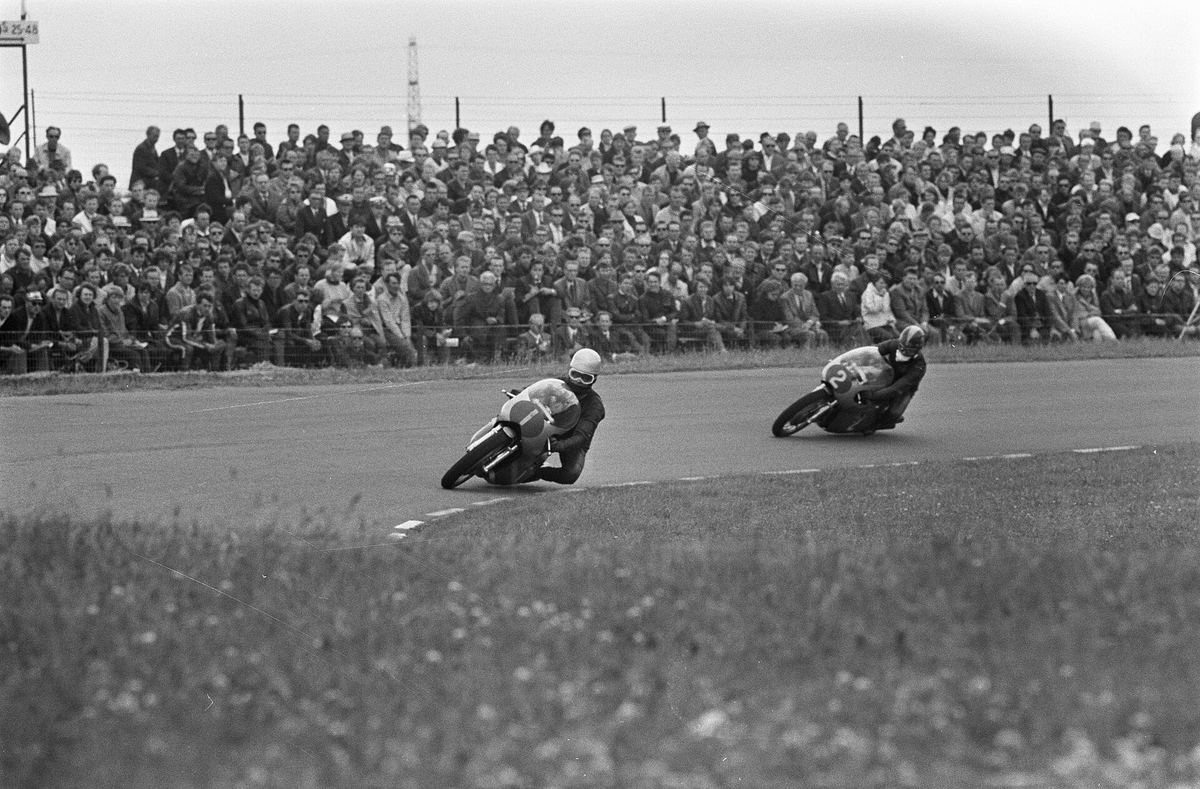
Carruthers had not planned to race a 250 at all. Benelli asked him to ride a spare bike at the TT to back up Renzo Pasolini, who had not scored in the first three rounds. He led, slowed to let Pasolini catch up, and was signed as support rider. "It was a bit embarrassing because the wrong guy was getting all the points," he told AMCN. Pasolini crashed at Imatra and was told not to race again that season. From then on, Benelli gave Carruthers two bikes and full support.
Herrero was second at the Sachsenring, 0.03 seconds behind Pasolini. His engine failed at Brno and he was sixth at Imatra, where Andersson won. At the Ulster Grand Prix he crashed on the second lap while running third and broke two bones in his hand. Cycle World's reporter wrote: "He cannot afford to miss either of the remaining rounds." Carruthers won, with Andersson second.
Herrero raced at Imola three weeks later with the hand still damaged and finished fifth. That left the decider at Opatija, with three riders still in contention and Herrero one point ahead. Carruthers' summary, years later, was short: "I got the title at the last race at Opatija."
It was the last 250cc world title won by a four-stroke, and the only one won by an Australian. On the same afternoon at Opatija, Ángel Nieto clinched the 50cc title, Spain's first world championship. Herrero had played a part. He rode three 50cc Grands Prix for Derbi that year, finishing seventh, second and second, and MotoVue credits those results with helping Nieto to the title.
After the flag
For 1970 the 250s were limited to twins, and Benelli dropped Carruthers from its plans. Herrero started the season as one of the favourites. He retired at the Nürburgring, crashed and recovered to second at Le Mans with the fastest lap, and on 24 May went back to Opatija and won, four seconds ahead of Andersson. It put him at the top of the championship again. Three years later the same circuit saw Kim Newcombe win the 500cc race on his König.
At the Isle of Man TT, Herrero ran in the 250cc Lightweight race. Early on he went up the slip road at Braddan Bridge and broke his screen, but carried on and climbed back to third. On the last lap he crashed on the fast downhill left-hander at the 13th milestone. Stan Woods, following him, fell while trying to avoid the crash. Herrero died of his injuries two days later, on 10 June 1970. He was 27.
Six competitors were killed at the TT that year, the most in the event's history. Ossa withdrew from road racing immediately and never came back. According to MotoVue, Spanish riders and their federation then stayed away from the TT for 20 years.
Why it still matters
Herrero started 17 Grands Prix and won four of them, with 11 podiums. He did it on a single-cylinder bike from a company that had started out making film projectors, against Benelli's four-cylinder four-strokes with eight-speed gearboxes. The Ossa was lighter and handled better, especially on tight circuits, and for most of 1969 that was enough.
Corsedimoto calls it the first Grand Prix motorcycle with a monocoque frame, and says its engine began as Eduardo Giró's graduation project. It came from a small factory in Barcelona, and it was developed by a rider who did his own mechanical work.
Spain got its first world champion at Opatija that afternoon. It very nearly got two.
Quick answers
Who was Santiago Herrero?
Santiago "Santi" Herrero was a Spanish motorcycle racer from Madrid who rode for the Ossa factory from 1968 to 1970. He won four 250cc Grands Prix and finished third in the 1969 250cc world championship, one point behind Kent Andersson and six behind champion Kel Carruthers.
What was the Ossa monocoque?
The Ossa 250 monocoque was a Grand Prix racer designed by Eduardo Giró in Barcelona. A 249cc single-cylinder rotary-valve two-stroke making about 42 bhp sat in a welded magnesium shell that served as both chassis and fuel tank. It won four Grands Prix between 1969 and 1970.
Who won the 1969 250cc world championship?
Kel Carruthers of Australia won the 1969 250cc world championship on a four-cylinder Benelli with 89 points, clinching it by winning the final race at Opatija. Kent Andersson was second on 84 and Santiago Herrero third on 83, after crashing out of that last race while leading.
How did Santiago Herrero die?
Santiago Herrero crashed on the final lap of the 250cc Lightweight race at the 1970 Isle of Man TT, at the 13th milestone, while running third. He died of his injuries two days later, on 10 June 1970, aged 27. Ossa withdrew from road racing immediately afterwards.