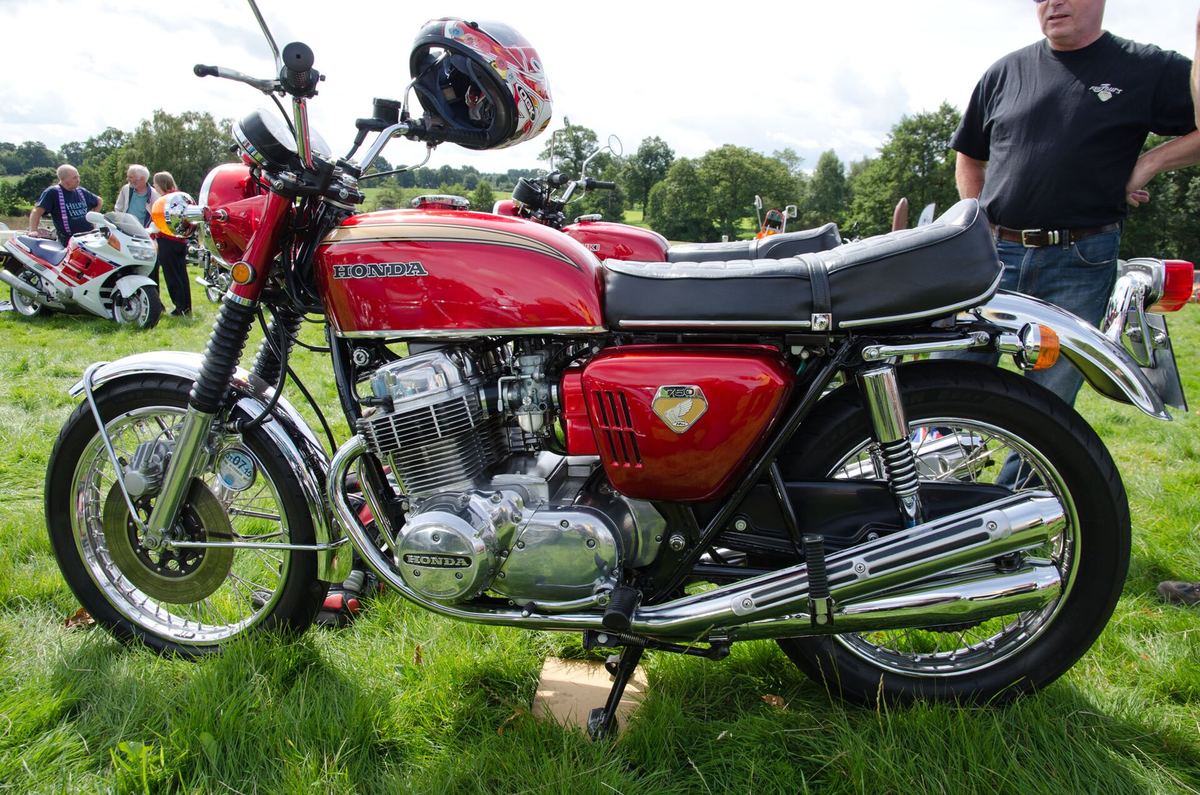
An early Honda CB750 Four at the Capesthorne Hall classic show in Cheshire.. Photo: SG2012 / Wikimedia Commons, CC BY 2.0
Las Vegas, January 1969. American Honda gathered its dealers to show them the new Honda CB750 Four, and its president, Kihachiro Kawashima, announced the price: $1,495. The bike's project leader, Yoshiro Harada, later recalled that "all 2000 dealers burst into thunderous applause when they heard its price", as Motorcycle News reported.
The bike had already been unveiled at the Tokyo Motor Show in October 1968. British riders got their first look on 5 April 1969, when two pre-production bikes went on show at the Metropole Hotel in Brighton, according to Motorcycle News.
The dealers had reason to clap. The CB750 had four cylinders, four exhaust pipes, a five-speed gearbox, an electric starter and a hydraulic disc brake at the front. Honda had planned to build 1,500 a year. According to Honda's own history, that figure soon became the monthly target, and then rose to 3,000 a month.
Motorcycle News now calls it the world's first superbike. The brief Honda's engineers started from was more modest: American Honda simply wanted a bigger bike to sell.
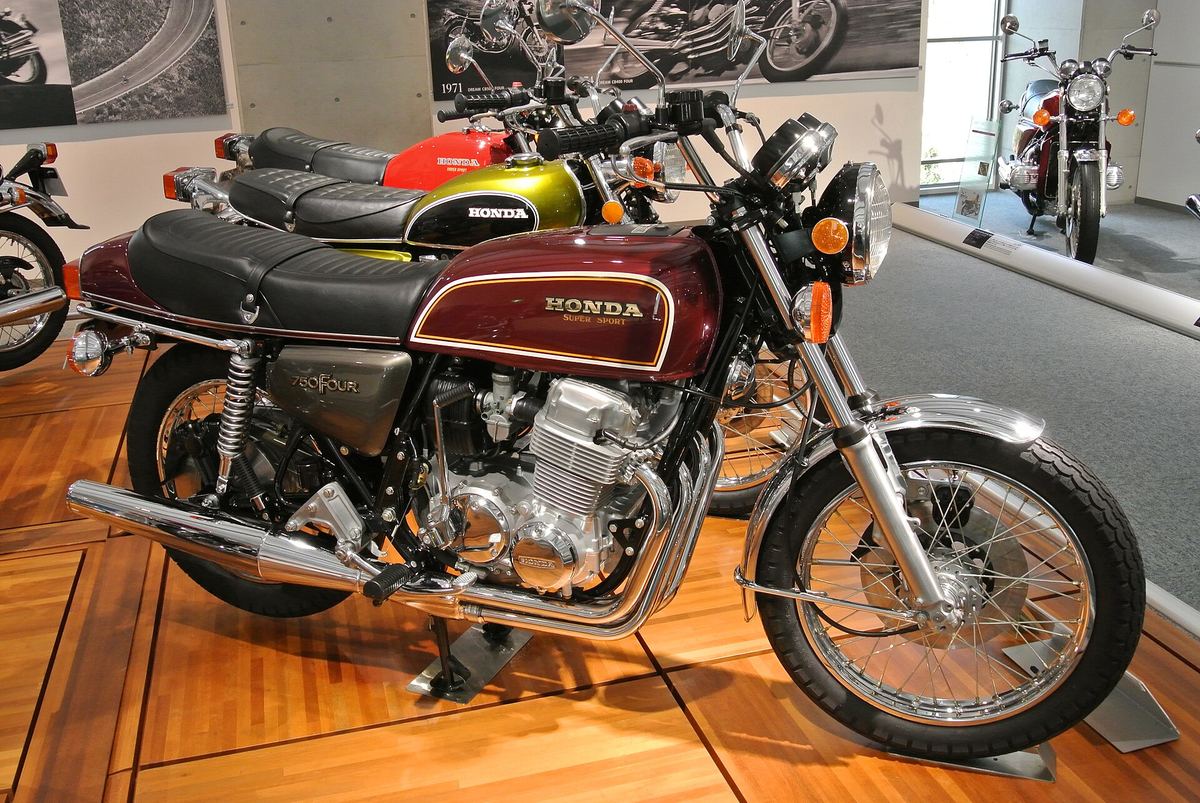
Why Honda built the CB750 Four
The Honda CB750 Four was built because Honda's American customers wanted something bigger. Honda had left Grand Prix racing after the 1966 season and turned its engineers to road bikes. Its biggest road bike was the CB450, a 444cc twin that Harada had also developed. When Harada visited the United States around the summer of 1967, Honda's archive says, American Honda's staff told him plainly that bigger was better.
The size came from a rival. On the same trip, Harada learned that Triumph was developing a 750cc three-cylinder engine. By October 1967, Honda says, the outline was set: 750cc and 67 hp, one more horsepower than Harley-Davidson's 1300cc twin of the time. A team of about 20 engineers began the design in February 1968.
Not every account agrees on how fast it all happened. Cycle World, testing the bike in August 1969, wrote that Honda had not even decided the engine layout by the summer of 1968, and that the complete motorcycle took less than a year to develop. Honda's own account puts the key decisions earlier.
Four cylinders were a statement as much as a choice. Honda says the inline four with four silencers was meant to link the road bike to its multi-cylinder Grand Prix racers. The tall handlebar was there for American riders. Honda also set its engineers six targets, from stable cruising at 140 to 160 km/h (87 to 99 mph) to a long service life and a design suited to mass production.
The brake was Harada's call. During a trip to America he found aftermarket disc brakes made by Lockhart and tried them on a CB450. He then took both options, drum and disc, to Soichiro Honda. Honda chose the disc.
What made the CB750 different
The CB750's engine was a 736cc air-cooled inline four with a single overhead camshaft. An overhead camshaft opens the valves directly from above, instead of through long pushrods. Cycle World noted that Honda chose one camshaft instead of two to keep the cylinder head small and light.
The lubrication was borrowed from racing practice. The CB750 used a dry sump, with its oil kept in a separate tank and pumped around the engine at 60 psi. That let Honda use plain bearings throughout the crankshaft and connecting rods, which are smaller, lighter and quieter than ball or roller bearings. The engine was in what Cycle World called "an extremely mild state of tune", so it could potter through town at 2,000 to 3,000 rpm.
The front brake was the headline. Motorcycle Classics credits the CB750 with the first hydraulic front disc brake on a production motorcycle. In a disc brake, pads squeeze a metal disc fixed to the wheel, which resists fading far better than the drum brakes of the day. Cycle World found it strong enough to lock the front wheel at any speed, yet progressive and not at all touchy. Honda made the disc from stainless steel so it would not rust.
Then there was the simple stuff that dealers loved. The CB750 started with a button. Many big bikes of 1969 still had to be kicked into life, and Honda dealers interviewed by Cycle World in 1994 remembered the electric starter as one of the bike's biggest selling points.
Production changed too. The first engines had crankcases cast in sand moulds. Honda soon moved to faster metal die-casting, but not before about 7,414 "sandcast" engines were built, according to Motorcycle Classics and Motorrad.
On the road: how the CB750 rode in 1969
The Honda CB750 Four was fast and, more surprisingly, easy to ride fast. Cycle World's August 1969 road test recorded more than 120 mph and a standing quarter-mile finishing at 100 mph. The magazine called it the finest production road machine in the world.
Weight was the obvious worry. At around 500 lb, the CB750 was heavy for 1969, yet Cycle World found it "nearly impossible to ground". Its silencers were tucked up, its crankcases were narrow, and one tester reported scraping his boot sole before anything else touched the road. The suspension was firm, and the testers reported a slight fork oscillation over regular road joints, a minor complaint.
It was frugal for its speed. Over a six-hour run mixing fast touring with bursts to 110 mph, Cycle World recorded 29.9 mpg.
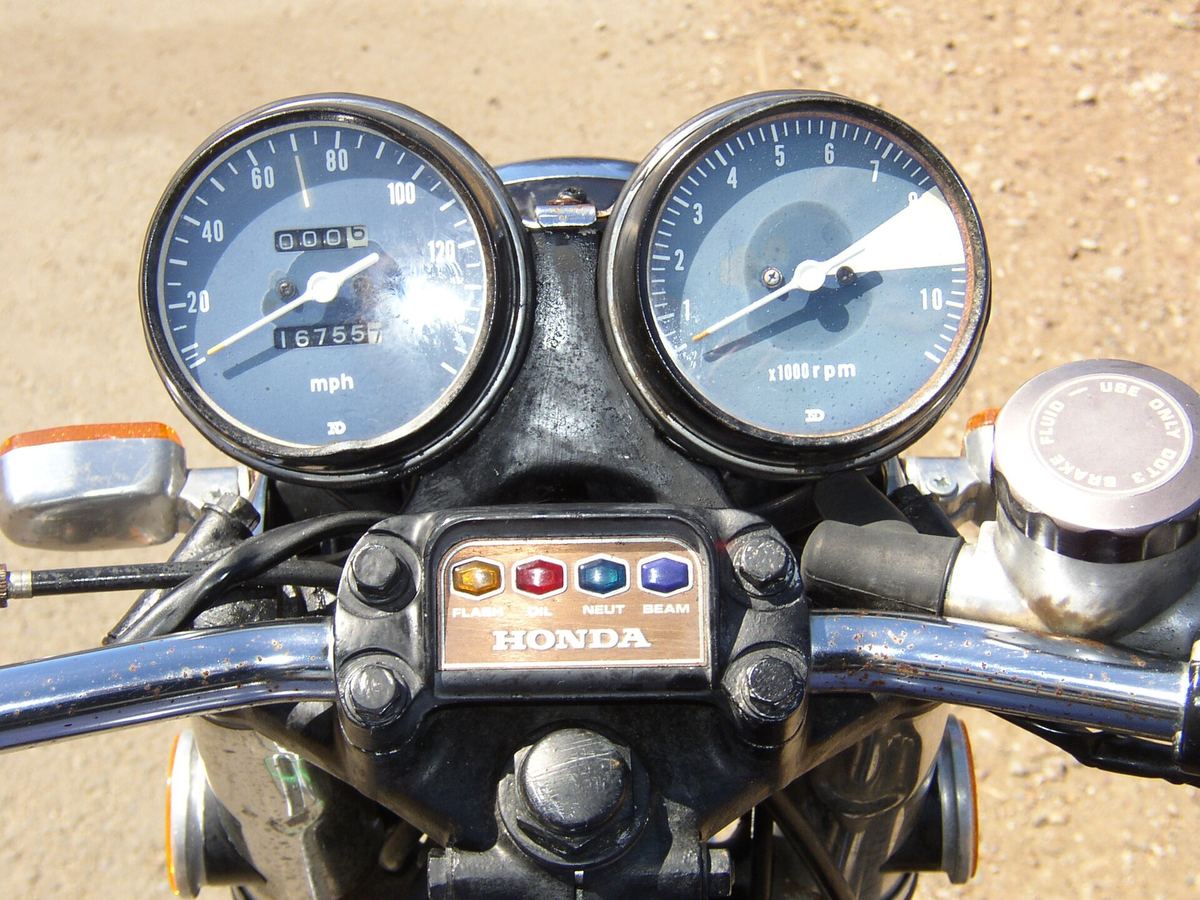
Cycle World also liked the instruments: a 150 mph speedometer and an 11,000 rpm tachometer, set upright so they could be read from a racing crouch. Its one real worry was the rear tyre, which it doubted would last long under that much power.
Other magazines agreed. Motorcyclist called it, in July 1969, "the wildest engine to come along in many a moon". A month earlier, the same magazine had written that Honda had "dared to do something that no one else would do". Dealers struggled to keep up: one New Orleans dealer told Cycle World he once sold about 20 in a single week.
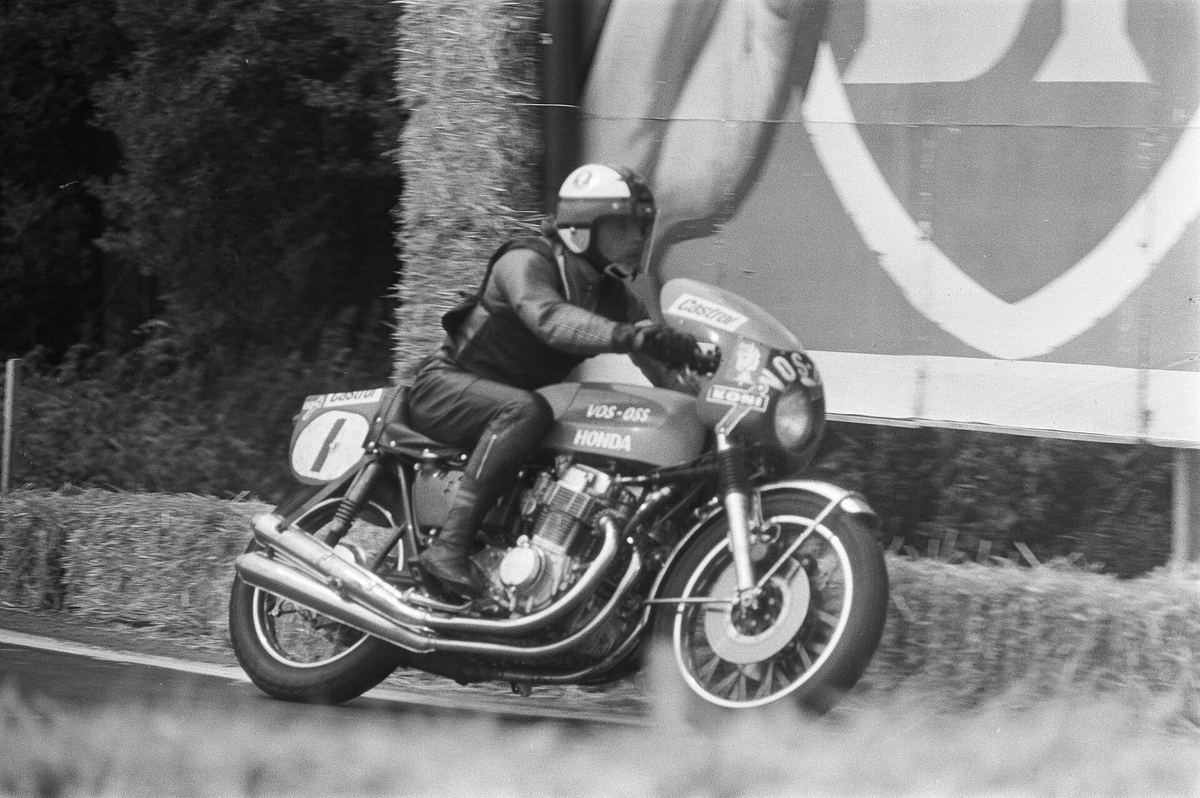
The CB750 also won races quickly. Honda says CB750s finished first and second in the Suzuka 10 Hours in August 1969, and in March 1970 Dick Mann won the Daytona 200 on a race-prepared CB750, Honda's first Daytona 200 win.
The Honda CB750 Four today
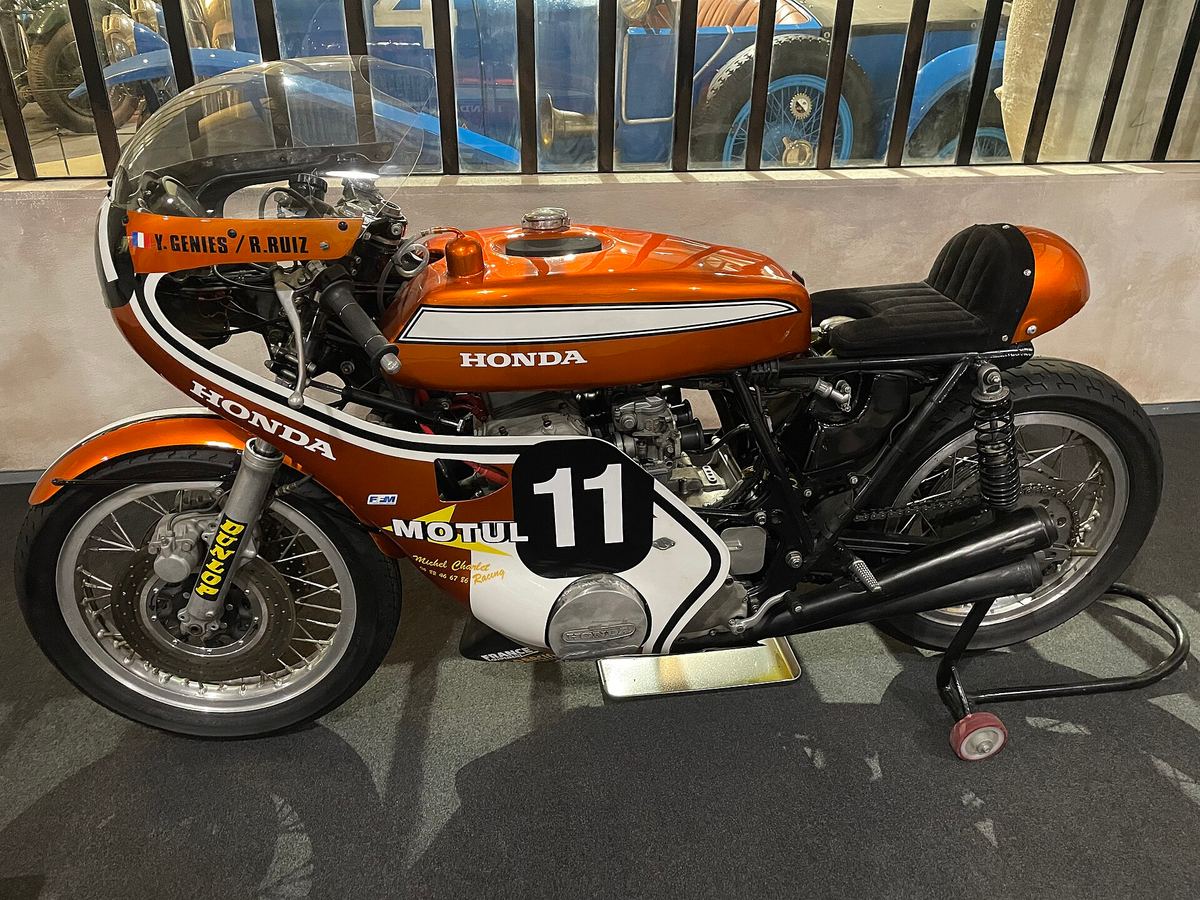
The Honda CB750 Four changed what a big motorcycle was expected to be. In Japan it created a whole category, the "nanahan", from the Japanese for 750; Honda says the word started as internal development jargon. Kawasaki answered in 1972 with the 900cc Z1, and Honda answered back with the GL1000.
Honda kept refining it. The K1 of September 1970 brought a two-cable throttle, according to Motorcycle Classics, and the yearly K-series updates that followed were mostly cosmetic. The original single-cam CB750 stayed in production for ten years, until a 16-valve twin-cam engine replaced it in 1979. Honda built the first bikes in Saitama and Hamamatsu, starting at about five a day, and later raised output to more than 100 a day. By the end of 1971 production had moved to the Suzuka factory.
Collectors pay most for the earliest bikes. The roughly 7,414 sandcast machines are the ones to find, recognisable by their rougher crankcase finish; Motorcycle News adds that their clutch covers are held by 10 screws, not 11. In January 2026, a 1968 development CB750 that American Honda had used for press photos before launch sold at Mecum's Las Vegas auction for $313,500, according to Motorrad.
Before the CB750, most fast motorcycles of the 1960s needed a kickstart and a strong right leg. Afterwards, all you needed was $1,495 and a thumb.
Quick answers
When did the Honda CB750 Four come out?
The Honda CB750 Four was unveiled at the Tokyo Motor Show in October 1968 and shown to American dealers in Las Vegas in January 1969. The first production bike was built on 15 March 1969, according to Motorcycle News, and sales began that year.
Was the Honda CB750 the first superbike?
The Honda CB750 Four is widely called the first superbike, including by Motorcycle News. Launched in 1969, it combined an inline four-cylinder engine, a front disc brake, five gears and an electric starter at a US price of $1,495, setting a new standard for big road bikes.
How fast is a 1969 Honda CB750?
Cycle World's August 1969 road test recorded a top speed of more than 120 mph (193 km/h) and a standing quarter-mile finishing at 100 mph. The 736cc four-cylinder engine was rated at 67 hp at 8,000 rpm.
What is a sandcast Honda CB750?
A sandcast Honda CB750 is one of the earliest bikes, built with crankcases cast in sand moulds before Honda switched to die-casting. About 7,414 sandcast engines were made, according to Motorcycle Classics, and they are the most valuable early CB750s.