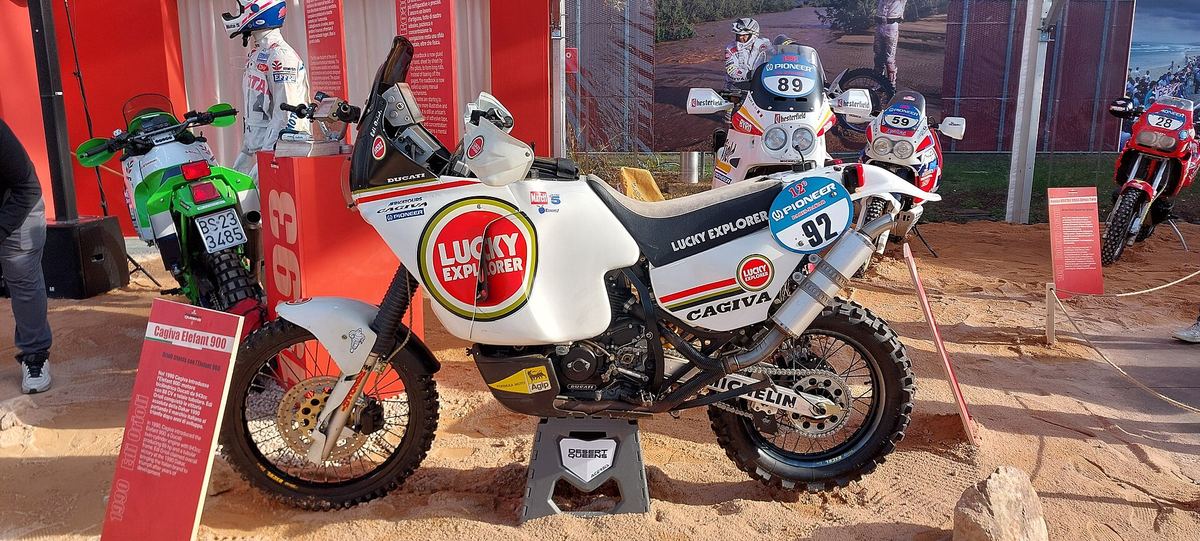
The Cagiva Elefant 900 shown as Orioli's 1990 winner at EICMA's Desert Queens exhibition, Milan, 2025.. Photo: MotorideSA / Wikimedia Commons (CC BY-SA 4.0)
On 6 January 1990, the ninth stage of Dakar 1990 sent the motorcycles 780 km across the Ténéré, from N'Guigmi to Agadez. Edi Orioli, leading the rally on a Cagiva Elefant, had done his homework: according to Australian Motorcycle News, the start flags that morning were planted on the wrong track, and Orioli, who had studied military maps of the area, didn't follow them.
By Agadez the motorcycle race had a different shape. Stéphane Peterhansel (Yamaha) was out; French accounts say he got lost and ran out of fuel. Cyril Neveu's Honda had mechanical trouble before he too was put out of the race. Gilles Lalay, the 1989 winner, had crashed and dislocated a wrist.
Orioli won the stage. The rally's own summary put it plainly: the road was now clear for the Cagivas. Ten days later Orioli reached Dakar first, and Cagiva had the win it had been chasing since 1985.
Dakar 1990: the rally Honda had owned
Dakar 1990, the 12th Paris–Dakar, was a long way from the trail-bike adventure of 1979. After short prologues in France on 25 and 26 December 1989, it crossed to Tripoli and ran through Libya, Niger, Chad, Mali and Mauritania to Dakar: 11,420 km in all, 8,564 km of them timed specials. The specials are the racing; the rest are road sections between them. Of 465 starters, 136 were on motorcycles.
Honda had won the motorcycle class four years running, from 1986 to 1989, with its NXR works twins. Orioli had won on one himself in 1988. His first Dakar for Cagiva, in 1989, went badly: he arrived still hurt from a crash at the Rally of the Pharaohs and finished sixth, according to l'Unità, on a bike Moto.it later described as heavy and unbalanced.
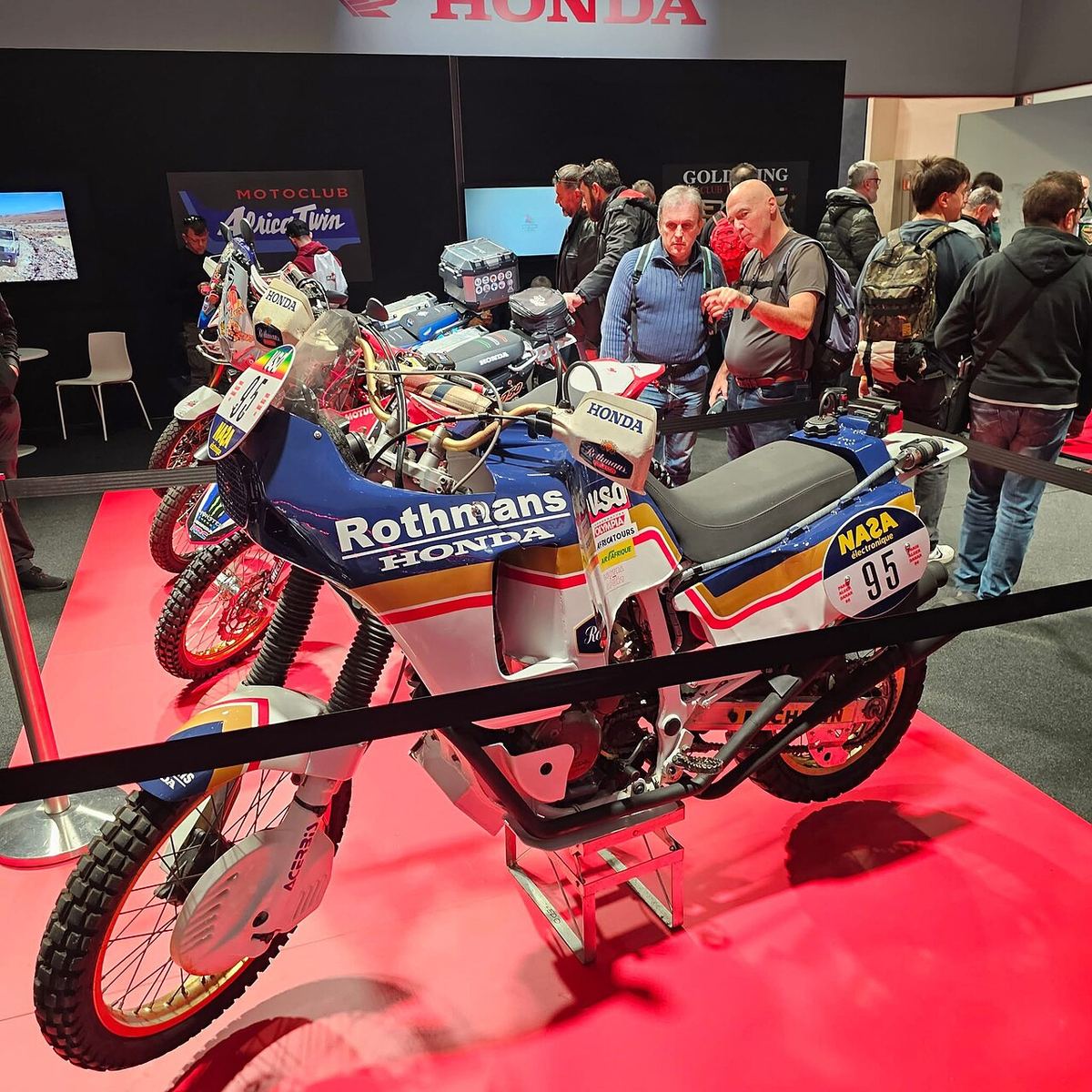
Cagiva, the Castiglioni brothers' company from Varese, had been trying since 1985 with Ducati engines. It bought Ducati that same year. Its closest call came in 1987, when Hubert Auriol led until he broke both ankles near the end. In 1986 its rider Giampaolo Marinoni fell in the closing stages and died days later in hospital in Dakar.
For 1990 the team, run by Roberto Azzalin and funded by Lucky Strike under the Lucky Explorer name, fielded three Elefants: Orioli, Alessandro "Ciro" De Petri and Jordi Arcarons.
From Tripoli to the Ténéré
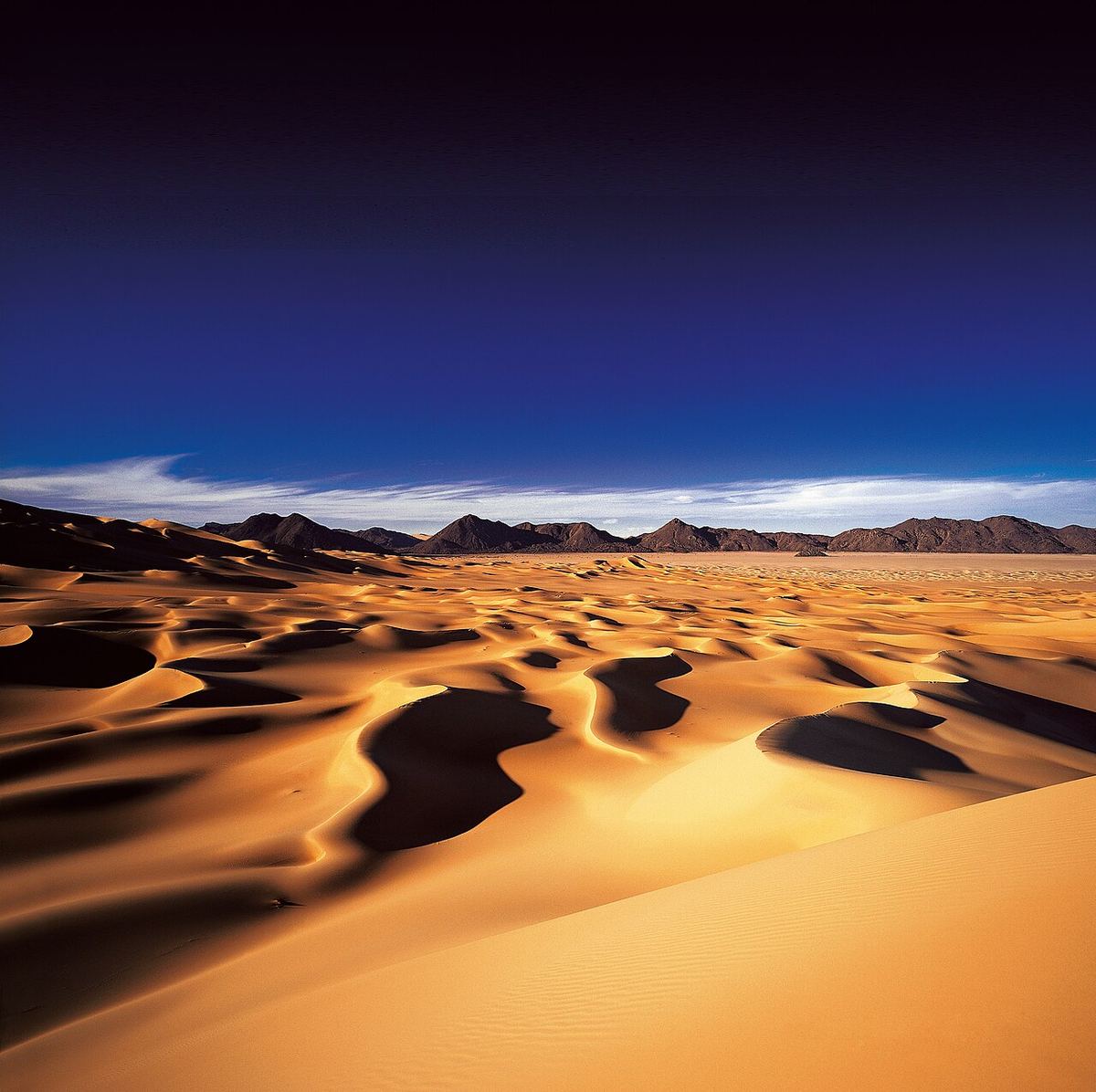
Laurent Charbonnel (Husqvarna) won both short prologues in France, but once the rally reached Africa the Cagivas were quick from the first day. Arcarons won the opening special out of Tripoli, and Orioli won the second, 609 km to Ghat, where the route turned into giant dunes after skirting the Algerian border. The rally's history calls the canyons on the next leg, to Sabha, some of the most beautiful landscapes in Africa. Yamaha answered there, with Gilles Picard winning the stage for the Japanese factory.
De Petri was the fastest man in the field. He won four specials in a row through Libya, Niger and Chad, and six in all. But it was Orioli who led, and he held on along the shore of Lake Chad as Peterhansel closed in, winning the stage to N'Guigmi. Then came the Ténéré, the sand sea where the rally's founder, Thierry Sabine, had got lost in 1977, according to the Dakar's own telling. The stage into Agadez took Peterhansel, Neveu and Lalay out of contention.
Leading all the way to the Lac Rose
After a rest day in Agadez, the rally ran on through Niger and Mali. The navigation stage from Niamey to Gao, won by Arcarons, livened up the race a little, in the organisers' words, and De Petri took the 674 km special from Timbuktu to Néma. In Mauritania, soft sand bogged down much of the field. Orioli didn't win another stage, and he never lost the lead.
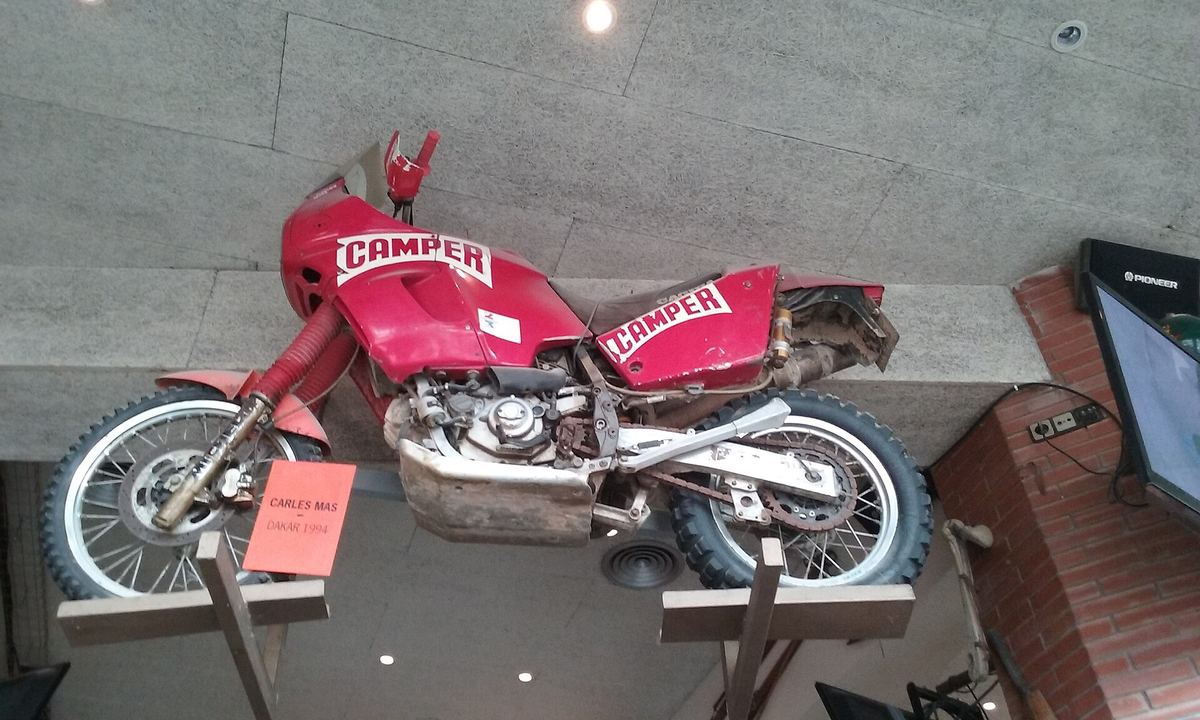
The last special, 40 km from M'Boro to the Lac Rose, started as a mass start and went to Franco Picco on a Yamaha. Orioli's total was 87 hours, 58 minutes and 25 seconds, according to the results printed by the Italian daily l'Unità. Carlos Mas (Yamaha) was second, 54 minutes behind, De Petri third, Thierry Magnaldi (Yamaha) fourth and Picco fifth. Only 46 of the 136 motorcycles reached Dakar, as the official classification shows.
It was Orioli's second Dakar win and Cagiva's first. One other rider deserves a line: Patricia Schek, the only woman entered on a motorcycle, rode the same BMW as her father Herbert, who at 57 was the oldest man in the rally.
The Cagiva Elefant 900: a Ducati twin built for the dunes
The Cagiva Elefant 900 that won Dakar 1990 put a Ducati V-twin in a rally frame, with a long-travel Marzocchi fork and an Öhlins shock. It ran fuel injection, which meters petrol electronically instead of through carburettors.
Beyond that, the numbers depend on who you ask. The plaque beside it at the 2025 Desert Queens exhibition says 943cc and 88 hp. Australian Motorcycle News describes a Ducati 900SS engine bored out to 944cc, about 65 litres of fuel and 180 kg. Marzocchi's history of the bike says 904cc. The photographer Phil Aynsley, who shot the bike in Azzalin's collection, recorded 904cc, 50 litres and 187 kg dry, a 180 km/h (112 mph) top speed and a 1,000 mm seat height.
The details tell you how seriously Cagiva took it: magnesium engine covers, carbon-fibre bodywork, a Termignoni exhaust and navigation equipment borrowed from aviation, which went back to its owners after the rally.
What the sources agree on is the character. The Elefant was not the most agile bike in the field, but it was stable at speed and its twin kept going. According to Australian Motorcycle News, three were built for 1990 and two survive: one in Ducati's museum and one in private hands. Azzalin has kept his since 1990. According to Aynsley, he owns a complete set of the team's bikes, one from every year he ran it, from 1984 to 1995.
Why it still matters
Before 1990, the Dakar motorcycle class had only been won by Yamaha, BMW and Honda. Cagiva's win was the first for an Italian factory, from a company that had set out to take on much larger manufacturers.
Yamaha struck back straight away: Peterhansel won in 1991, the first of his six motorcycle wins. But Cagiva's win was not a one-off. Orioli won again on an Elefant in 1994, after the rules moved the bikes closer to production machines, and again in 1996 on a Yamaha. That made four Dakar wins on three different makes. In November 2025 the 1990 Elefant stood in the sand of the Desert Queens exhibition at EICMA in Milan, 35 years on.
Honda had the factory. Yamaha had Peterhansel. Cagiva had a rider who read the map before he read the flags.
Quick answers
Who won the 1990 Dakar Rally on a motorcycle?
Edi Orioli of Italy won the motorcycle class of the 1990 Paris–Dakar Rally on a Cagiva Elefant 900, finishing on 16 January 1990. Carlos Mas (Yamaha) was second and Alessandro De Petri (Cagiva) third. It was Orioli's second Dakar win and the first for Cagiva.
What motorcycle won the 1990 Dakar Rally?
A Cagiva Elefant 900 won the 1990 Dakar Rally, ridden by Edi Orioli for the Lucky Explorer team. It used a fuel-injected Ducati V-twin of about 900cc in a rally frame. Sources disagree on the exact capacity, giving figures between 904cc and 944cc.
How many times did Cagiva win the Dakar Rally?
Cagiva won the Dakar Rally motorcycle class twice, in 1990 and 1994, both times with Edi Orioli riding a Ducati-powered Elefant. The 1990 win ended Honda's run of four straight victories from 1986 to 1989.
How many Dakar Rallies did Edi Orioli win?
Edi Orioli won the Dakar Rally motorcycle class four times: in 1988 on a Honda, in 1990 and 1994 on a Cagiva, and in 1996 on a Yamaha.