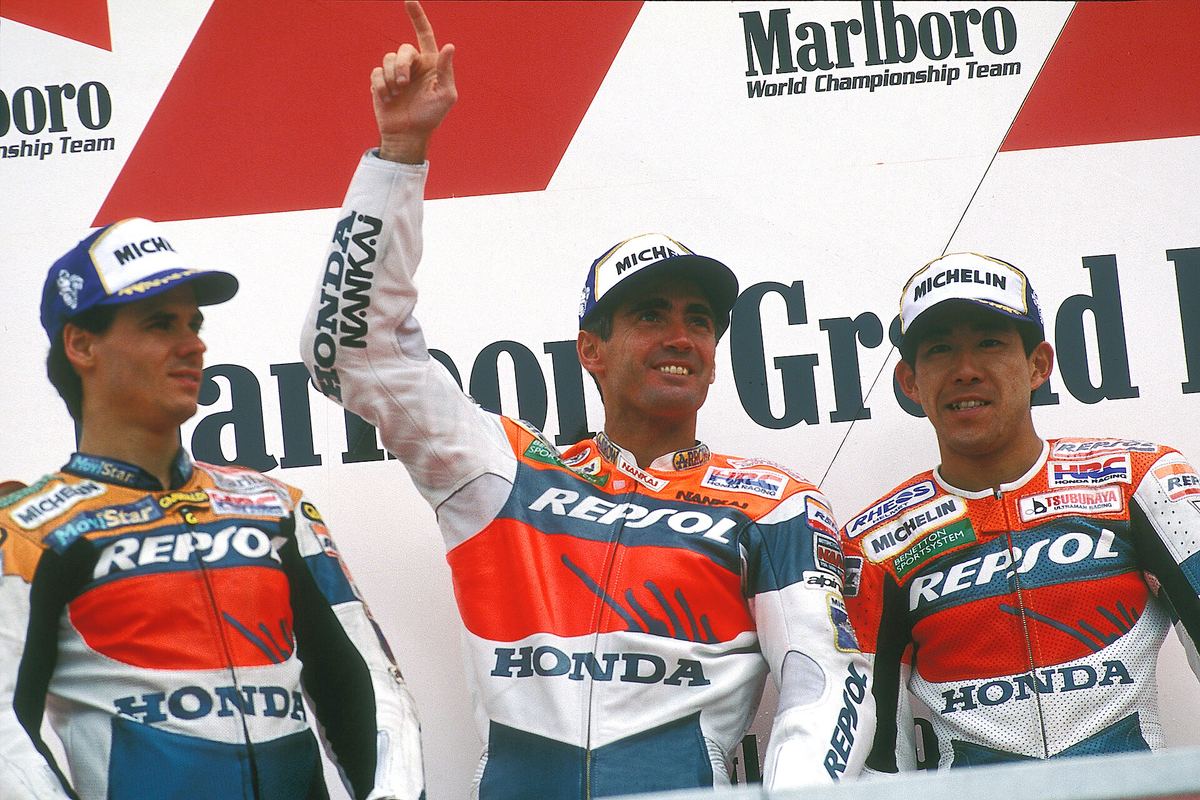
Suzuka, 20 April 1997: Doohan wins from Àlex Crivillé and Tadayuki Okada in the season he won 12 races.. Photo: J. Olivares / Box Repsol (CC BY 2.0)
Assen, 26 June 1992. Mick Doohan is running away with the 500cc world championship, 53 points clear after five wins and two second places in the first seven races. In practice for the Dutch TT his Honda slides out from under him and he breaks his right leg just above the ankle.
He chooses the fastest fix: an operation that same afternoon in the local hospital. Within hours the leg develops compartment syndrome, a build-up of pressure that cuts off its blood supply. Days later the surgeons are talking about amputation.
What follows is the greatest comeback in motorcycle racing. Six years after Assen, Mick Doohan had won five consecutive 500cc world titles, all of them riding with a leg that never fully worked again.
Who Mick Doohan was
Michael Sydney Doohan was born on 4 June 1965 in Queensland, Australia, the youngest of three brothers in a motorcycle-mad family. He started on a hand-me-down 50cc minibike at the age of eight and came to road racing through his older brothers in his late teens, after the family had moved to the Gold Coast.
He made his name in Australian superbikes and won World Superbike races as a wildcard on home soil in 1988. Honda signed him for 1989, at 23, as team-mate to his countryman Wayne Gardner in the 500cc world championship.
The Honda NSR500 of that era was a brute, and Doohan's first season was spent learning to survive it. He won his first Grand Prix in Hungary in September 1990 and finished runner-up to Wayne Rainey in 1991.
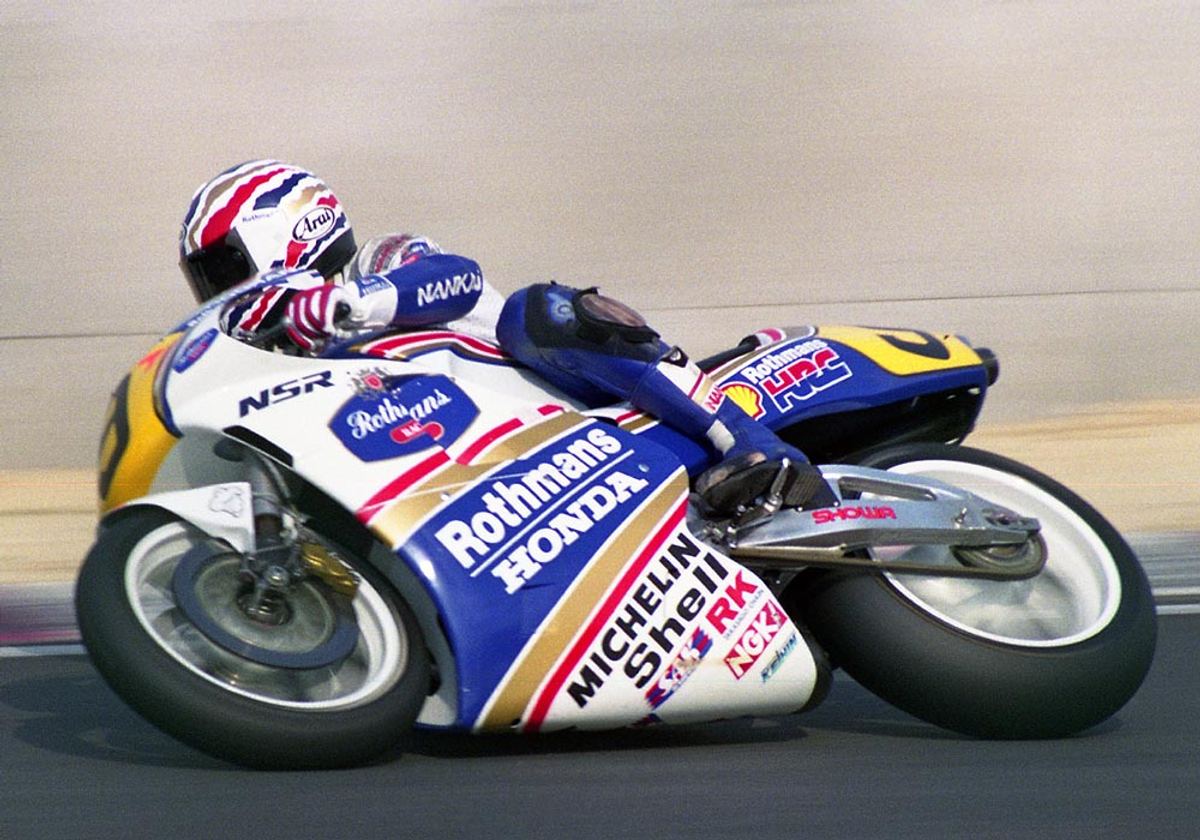
Assen, 1992: Mick Doohan's lost season
Mick Doohan's 1992 season was going so well that he could have clinched the title with four races to spare. The Assen crash was not a big one. The treatment that followed was the disaster.
The Dutch surgeon fixed the fracture with plates and screws. By the next morning Doohan could not feel his toes. Surgeons cut the leg open from knee to ankle to relieve the pressure, and the wound swelled to about 10 centimetres wide. He later told Mat Oxley of Motor Sport that the leg began to smell like rotten meat, and that the hospital warned it would have to come off if it did not improve.
The Grand Prix doctor Claudio Costa, who was not allowed to treat patients in the Dutch hospital, booked an air ambulance. Over the doctors' protests he took Doohan, and Kevin Schwantz, who had also been injured that weekend, to his clinic in Italy. When hyperbaric treatment failed to save the leg, Costa sewed Doohan's legs together so the healthy left leg could supply blood to the dying right one. They were separated after 14 days.
Eight weeks after Assen, Doohan lined up at Interlagos in Brazil. He had no feeling below the knee, and his foot kept slipping off the footrest without him noticing. He finished 12th, outside the points. At the final round in South Africa he was sixth, and Rainey won the title by four points.
The thumb brake and five straight titles
Mick Doohan's right ankle never recovered its movement, which meant he could no longer use the foot-operated rear brake. Early in 1993 a new lever appeared on the left handlebar: a rear brake worked by his thumb. According to Doohan, it was his own idea at Suzuka; other accounts credit his chief mechanic Jeremy Burgess with building it. Either way, it worked. Four races later Doohan won at Mugello, his first victory since the accident.
Late in 1993 a surgeon in California, Kevin Louie, straightened the bent leg with an external frame. By 1994 Doohan could ride the NSR properly again, and he won nine races and his first world title.
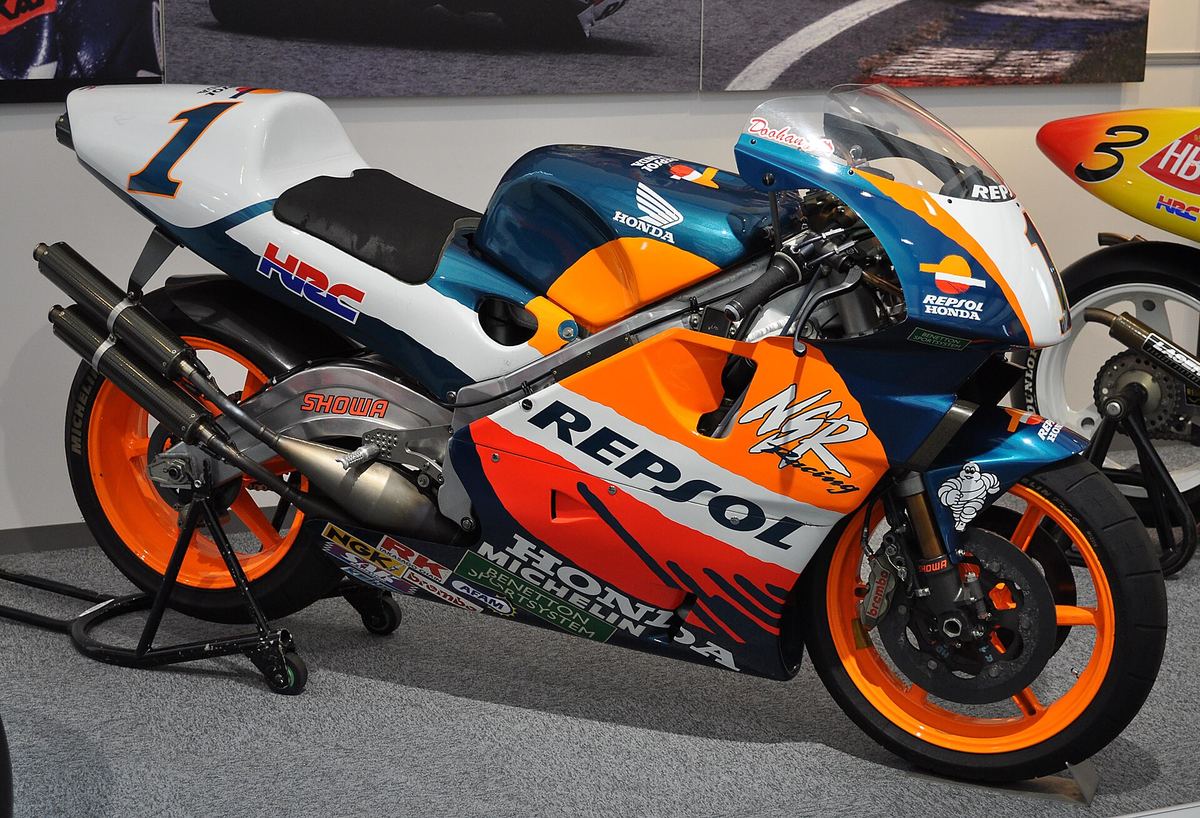
He kept the number 1 plate for five years, from 1994 to 1998. In 1997 he won 12 of the 15 races, ten of them in a row, a record for a premier-class season that stood until Marc Márquez won 13 in 2014. In 1998 he won eight more and sealed his fifth title at his home Grand Prix at Phillip Island.
In 1999 his luck ran out at Jerez. In a wet practice session he crashed heavily and broke his right leg again, along with other injuries. At 34 he announced his retirement.
What Mick Doohan left behind
Mick Doohan's five straight titles put him behind only Giacomo Agostini and Valentino Rossi among the great premier-class runs. He did it on one kind of motorcycle, Honda's NSR500, and was one of the few riders who could tame it.
His comeback also changed how the paddock thinks about injury. Doohan refused to stay off the bike for a year, refused most painkillers so he could keep his head clear, and adapted the machine to the body he had left. The thumb-operated rear brake he relied on is now a common sight on Grand Prix bikes.
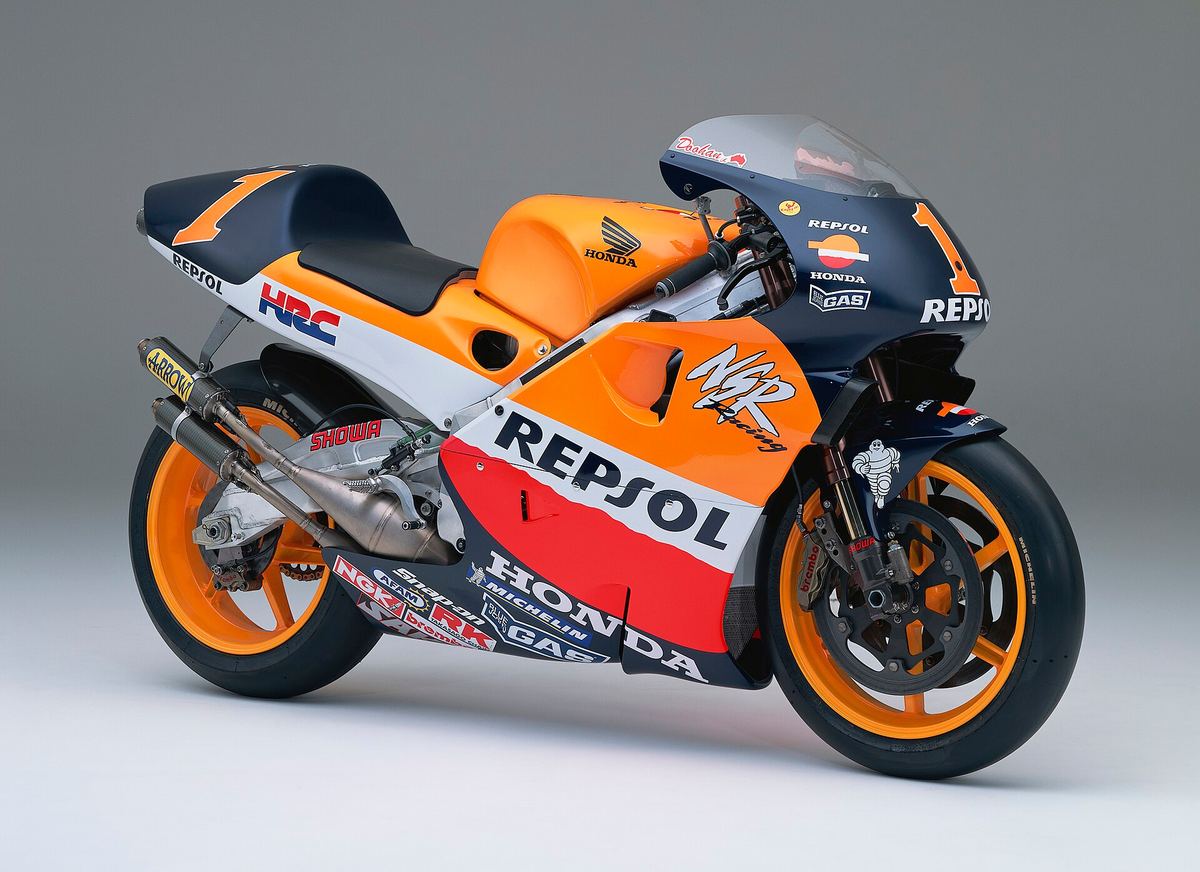
He was made a Member of the Order of Australia in 1996, and the first corner at Phillip Island carries his name.
Six years earlier a Dutch hospital had wanted to take the leg. Doohan kept it and used it to win five world titles.
Quick answers
What happened to Mick Doohan at Assen in 1992?
Mick Doohan broke his right leg in practice for the 1992 Dutch TT at Assen. A botched operation caused compartment syndrome, and doctors considered amputation. Dr Claudio Costa flew him to Italy and sewed his legs together to save the right one.
Why did Mick Doohan use a thumb brake?
After his 1992 crash, Mick Doohan had no movement in his right ankle and could not use the foot-operated rear brake. In 1993 he switched to a rear brake operated by his left thumb, and won at Mugello four races later.
How many world titles did Mick Doohan win?
Mick Doohan won five consecutive 500cc world titles, from 1994 to 1998, all on the Honda NSR500. He took 54 Grand Prix wins, 95 podiums and 58 pole positions from 137 starts between 1989 and 1999.
Why did Mick Doohan retire?
Mick Doohan crashed heavily during a wet practice session at Jerez in 1999 and broke his right leg again, among other injuries. He announced his retirement at the age of 34, as the reigning five-time 500cc world champion.