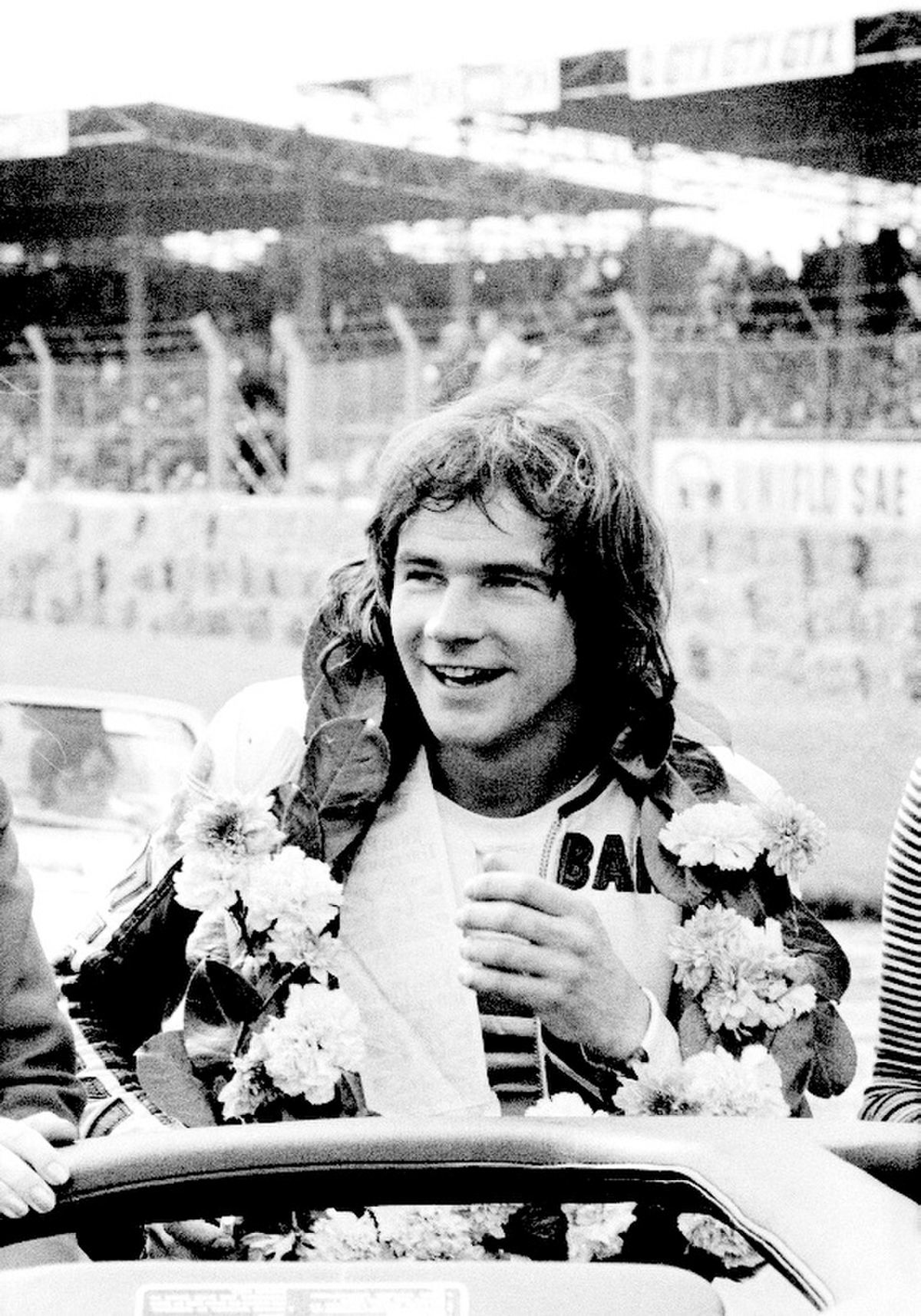
Daytona, March 1975. Barry Sheene is coming off the banking at about 175 mph (282 km/h) on Suzuki’s factory XR11, a 750cc three-cylinder two-stroke, in practice ahead of the Daytona 200. Then the bike snaps sideways and the 24-year-old Londoner is thrown down the track.
A Thames Television crew is there to make a documentary about Britain’s brightest young racer, and the cameras keep rolling. Sheene breaks his left thigh, his right arm, his collarbone and ribs, and compresses several vertebrae. Surgeons drive a pin some 18 inches long into his leg.
The footage turned a motorcycle racer into a household name. Seven weeks later Sheene was riding again. The following year he was 500cc world champion. Fifty years on from that 1976 title, no British rider has won the premier class since he retained it in 1977.
Who Barry Sheene was
Barry Sheene, “Bazza” to his fans, was born on 11 September 1950 in Holborn, central London. His father, Frank Sheene, was a former racer and resident engineer at the Royal College of Surgeons. Frank turned the college workshop into one of Britain’s busiest two-stroke tuning shops. His friendship with Francesc “Paco” Bultó, founder of Bultaco, kept the family supplied with new Spanish bikes every spring. Barry picked up Spanish along the way.
Sheene first raced in 1968, aged 17, on his father’s 125cc and 250cc Bultacos. He was British 125cc champion in 1970. That June, Frank spent his savings on a three-year-old ex-works Suzuki RT67 125 twin from Stuart Graham. It made 35 bhp, against 29 for the Bultaco single. On it, Barry finished second to Ángel Nieto at the 1970 Spanish Grand Prix at Montjuïc, his world championship debut.
In 1971 he won three 125cc Grands Prix on the RT67, at Spa, Anderstorp and Imatra, and lost the title to Nieto’s Derbi. Only a rider’s best six results counted, and that rule decided it. [⚠ VERIFY: totals often quoted as 109 points for Sheene against 87 for Nieto before scores were dropped]
He also rode the Isle of Man TT that year, for the first and last time. Sheene saw no point in racing alone against the clock on public roads, and he never went back, whatever names it earned him.
Daytona, Assen and the 1976 500cc title
Barry Sheene’s Daytona crash has never had a single agreed cause. Sheene always blamed the rear tyre. Others, as Mat Oxley recorded in Motor Sport, believe a chain tensioner broke. Even the speed changes with the teller, from 170 to 180 mph. The bike was the same XR11 on which he had won the 1973 FIM Formula 750 Prize in his first season as a Suzuki works rider.
The recovery became part of the act. The Thames crew filmed him in hospital with his leg in traction and a Gitanes, filter torn off, between his fingers. He was back on a bike at Cadwell Park seven weeks later, pin still in place.
By then the bike that mattered was the Suzuki RG500, a square-four two-stroke that had raced since 1974. Early engines were brutal. Sheene later told Oxley that the first one he tried only pulled between 9,000 and 10,500 rpm. He spent five weeks in Japan at the end of 1974 pushing Suzuki for a wider powerband.
It paid off at Assen in June 1975. Sheene won the Dutch TT from pole, beating Giacomo Agostini’s Yamaha by a fraction of a second. It was his first 500cc Grand Prix win and the RG500’s first.
In 1976 the RG500 owned the 500cc class: according to Motor Sport, RGs filled 11 of the top 12 places in the final standings. Sheene, on the British-entered works XR14, won in France, Austria, Italy, the Netherlands and Sweden. He sealed the title with rounds to spare and skipped the rest of the season.
In 1977 he won six more Grands Prix and the title again. At Spa that July he averaged 135.07 mph (217.37 km/h) on the old road circuit. No motorcycle Grand Prix has ever been won faster.
Barry Sheene vs Kenny Roberts: Silverstone, 1979
Barry Sheene met his match in Kenny Roberts. The Californian came from American dirt tracks and won the 500cc title in his rookie season, 1978. Sheene finished runner-up that year on a redesigned RG500 that most accounts call a step backwards. He was also made an MBE that year.
The rivalry peaked at the British Grand Prix at Silverstone on 12 August 1979. Sheene qualified fifth, 1.7 seconds slower than Roberts on pole. He then spent 28 laps swapping the lead with him, live on the BBC. He went ahead for the first time just after half-distance, diving inside at Woodcote, the fast right-hander before the line.
On the last lap Sheene was held up by a backmarker that Roberts had already cleared. He closed the gap anyway and tried to go past out of the final corner. Roberts kept his Yamaha on the outside line and won by 0.03 seconds.
The race is remembered as much for a hand gesture as for the finish. Sheene flashed Roberts a two-fingered sign that every British viewer recognised, and it was not a wave. [⚠ VERIFY: when in the race the gesture happened]
Roberts took the 1979 title too. Sheene won in Venezuela, Sweden and France and finished third. Over a decade the two men raced each other more than 100 times, on four continents.
Yamaha, Silverstone 1982 and the last races
Barry Sheene left Suzuki after 1979 following a contract dispute, with no factory ride to go to. His friend and team-mate Steve Parrish later said Sheene would probably have won two more titles had he stayed. Suzuki’s RG500 went on to carry Marco Lucchinelli to the 1981 crown and Franco Uncini to the 1982 one.
In 1980 Sheene raced a production Yamaha and finished 15th. In 1981 he had factory Yamaha machinery and won the Swedish Grand Prix at Anderstorp. It was his 19th and final 500cc victory and, by MotoGP’s count, the 300th premier-class race. No British rider won another premier-class race until Cal Crutchlow at Brno in 2016.
In 1982 he was in the title fight, with five podiums from the first seven rounds. For the British Grand Prix, Yamaha gave him its new 0W61 V4. In practice at Silverstone he crested a blind brow at about 160 mph (257 km/h) and hit Patrick Igoa’s fallen Yamaha TZ250. No marshal was there to wave a flag.
Sheene shattered both legs and a wrist. Surgeons rebuilt his legs with steel plates and about two dozen screws, and the X-rays became almost as famous as his race photos. He was out of hospital in 23 days. Asked on television how his legs were coming along, he replied: “They’re great — I wouldn’t be without them.”
Yamaha let him go at the end of 1982, and he returned to Suzuki for two more seasons. His last podium came at Kyalami, South Africa, in the wet opening round of 1984: third, from well down the field. He retired at the end of that year.
What Barry Sheene left behind
Barry Sheene made motorcycle racing mainstream in Britain. He sold Brut aftershave on television alongside the boxer Henry Cooper. He raced with a hole drilled in his helmet’s chin guard so he could smoke on the grid. He kept the number 7 even as world champion. He was also one of the loudest voices for safer circuits, at a time when that took some nerve.
In 1987 he moved to Australia’s Gold Coast, where the warmer climate eased the arthritis left by his injuries, and became a television commentator. He kept racing classics. He won the Lennox Cup at the Goodwood Revival three years running on a 500cc Manx Norton, and his last race on British soil was there in 2002. He died of cancer on 10 March 2003, aged 52.
Goodwood renamed the race the Barry Sheene Memorial Trophy, and it still runs every September. In 2026 a 1954 Vincent Black Shadow won it. His 1976 title-winning XR14 still belongs to the Sheene family and was restored with Suzuki’s help in 2017. Sheene was already a MotoGP Legend, and in August 2026 he entered MotoGP’s new Hall of Fame; his son Freddie collected the medal in London.
Fifty years on, Britain is still waiting for its next premier-class champion. Sheene, by all accounts, rather enjoyed that.