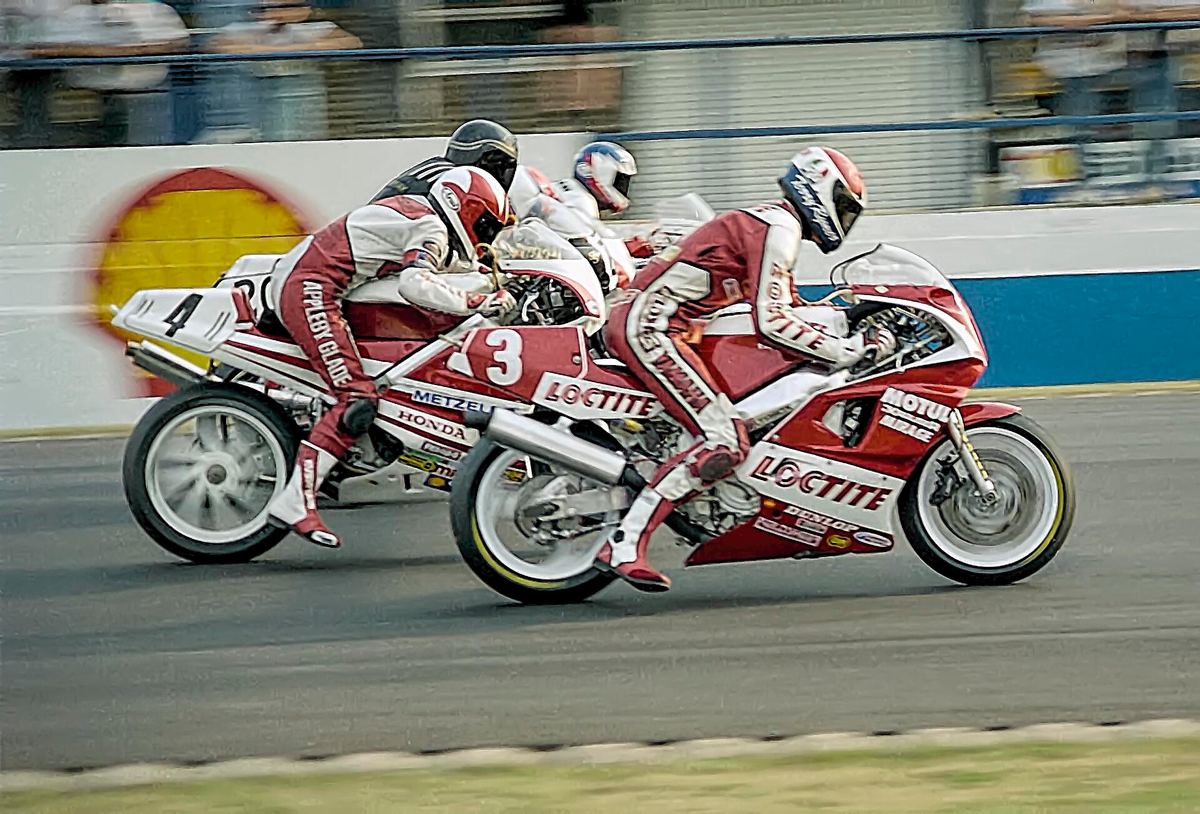
Carl Fogarty (4, Honda) chases Terry Rymer at Donington Park in July 1989, during his TT Formula One title years.. Photo: Stu Newby / Wikimedia Commons (CC BY-SA 2.0)
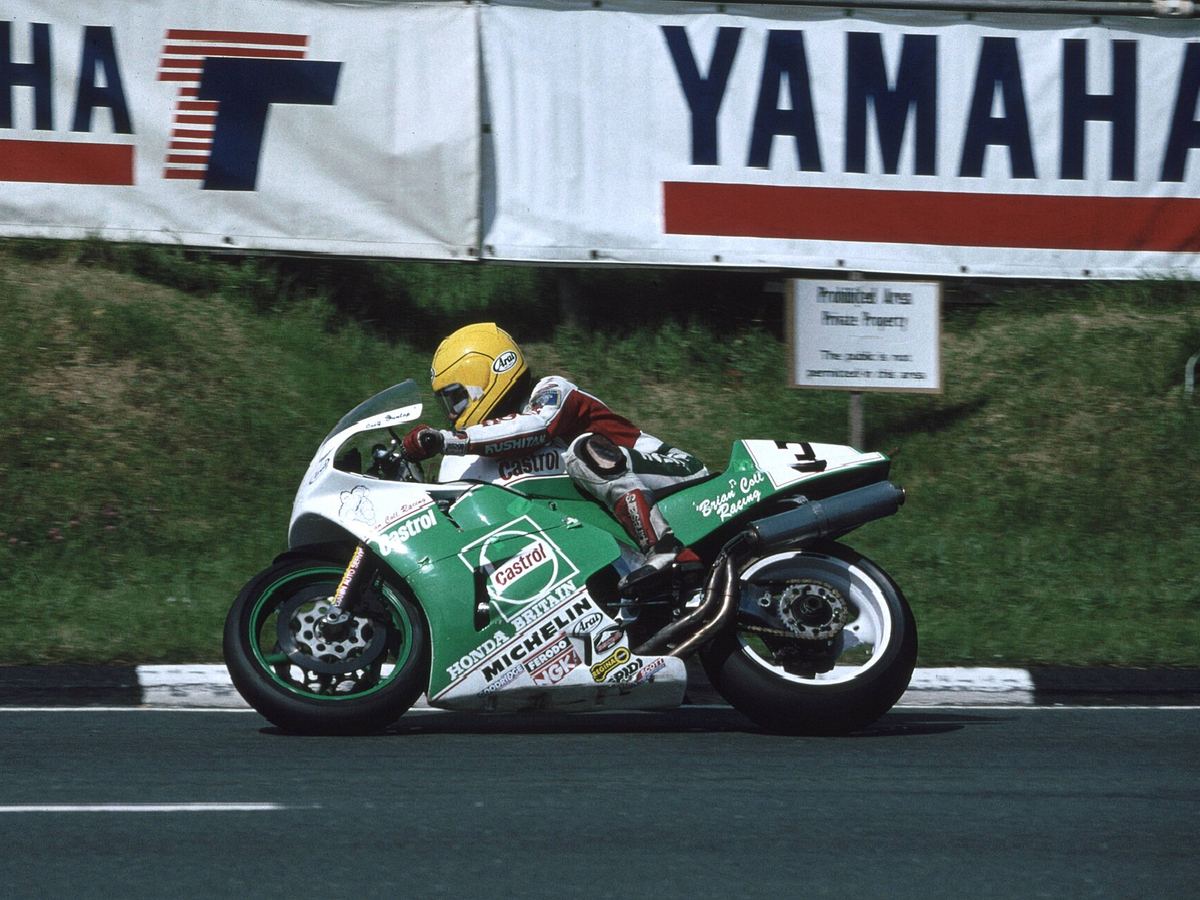
Isle of Man, Senior TT, June 1992. Carl Fogarty starts the sixth and final lap of the Mountain Course six seconds behind Steve Hislop. Fogarty is on a Yamaha superbike. Hislop is on the Norton rotary, very fast and very hard to ride. For five laps they have been trading the lead on corrected time at speeds that frightened even them.
Fogarty's Yamaha is coming apart. The instruments have stopped working. The screen is cracked and smeared on the inside with brake fluid and oil. At Ramsey on the fifth lap the exhaust broke, and the noise is deafening. He has a headache, and he decides the quickest way to make it stop is to go faster.
He loses the race by four seconds. But on that last lap he sets a new outright TT lap record, and it stands until 1999. The duel is still rated one of the greatest races in TT history.
Who Carl Fogarty was
Carl George Fogarty was born on 1 July 1965 in Blackburn, Lancashire. His father, George, raced motorcycles, and Carl spent his childhood holidays at the Isle of Man TT, watching his dad. He later said that all his childhood memories came from the TT.
The first bike he raced on a circuit, in the summer of 1983, was a Ducati that belonged to his father. He won the Lightweight Newcomers race at the Manx Grand Prix in 1985, and like most young British riders of his generation, he wanted to be a Grand Prix star like Barry Sheene.
He made his 250cc Grand Prix debut at Silverstone in 1986. Two weeks later, at Oulton Park, he was thrown off in a huge highside. His right femur broke and came through the skin. When he returned, the leg broke again because of an infection. He lost two years, and when he came back he could no longer get comfortable on a small 250.
Carl Fogarty on the roads: the TT Formula One years
Superbikes saved Carl Fogarty's career. In 1988 his sponsor, a slot-machine millionaire, bought him a Honda RC30, the road-based V4 Honda built for the new World Superbike series. The bigger bike suited his damaged leg, and he felt comfortable again. His doctors had told him to think about retiring, so he rode at about 80%, afraid of breaking the leg again.
He could not afford the full World Superbike series, which travelled as far as Japan and Australasia, so he raced in the TT Formula One world championship instead. Most of its rounds were run on dangerous public roads: the Isle of Man, Dundrod in Northern Ireland, Vila Real in Portugal. Fogarty won it in 1988, ahead of Joey Dunlop, and won it again in 1989 and 1990.
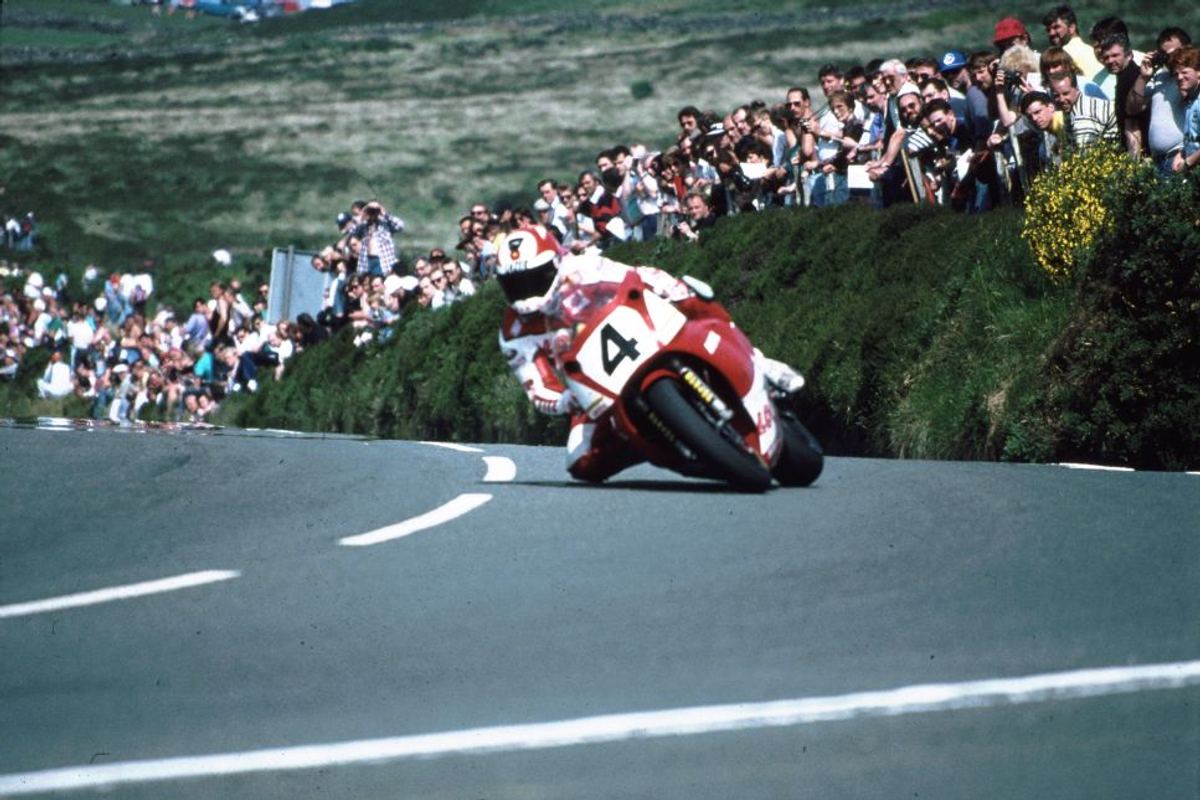
On the Isle of Man he won three TTs: one in 1989, and the Formula One and Senior races in 1990. In 1992 came the Senior duel with Hislop. Fogarty never won the race, but no TT he started is remembered more.
Ducati, the 916 and King Carl
In 1992 Carl Fogarty decided to go after the World Superbike title himself. He found backing to buy a Ducati 888 V-twin and paid for his season by taking well-paid rides between Superbike rounds: with Yamaha at the TT, and with Kawasaki in the World Endurance Championship. He won five of the six endurance rounds, including the Le Mans 24 Hours, and took a world title he had not planned on.
His speed on the Ducati was the turning point. He won his first World Superbike race at Donington Park that year, and Ducati signed him as a works rider for 1993. He lost that title narrowly to the American Scott Russell on a factory Kawasaki.
For 1994 Ducati launched the 916, the bike designed by Massimo Tamburini that became one of the most famous motorcycles ever made. At first Fogarty found it nervous and twitchy, like a 500cc Grand Prix bike. After the first few rounds the team lengthened the swingarm, and from then on he dominated the season. He won his first World Superbike title.
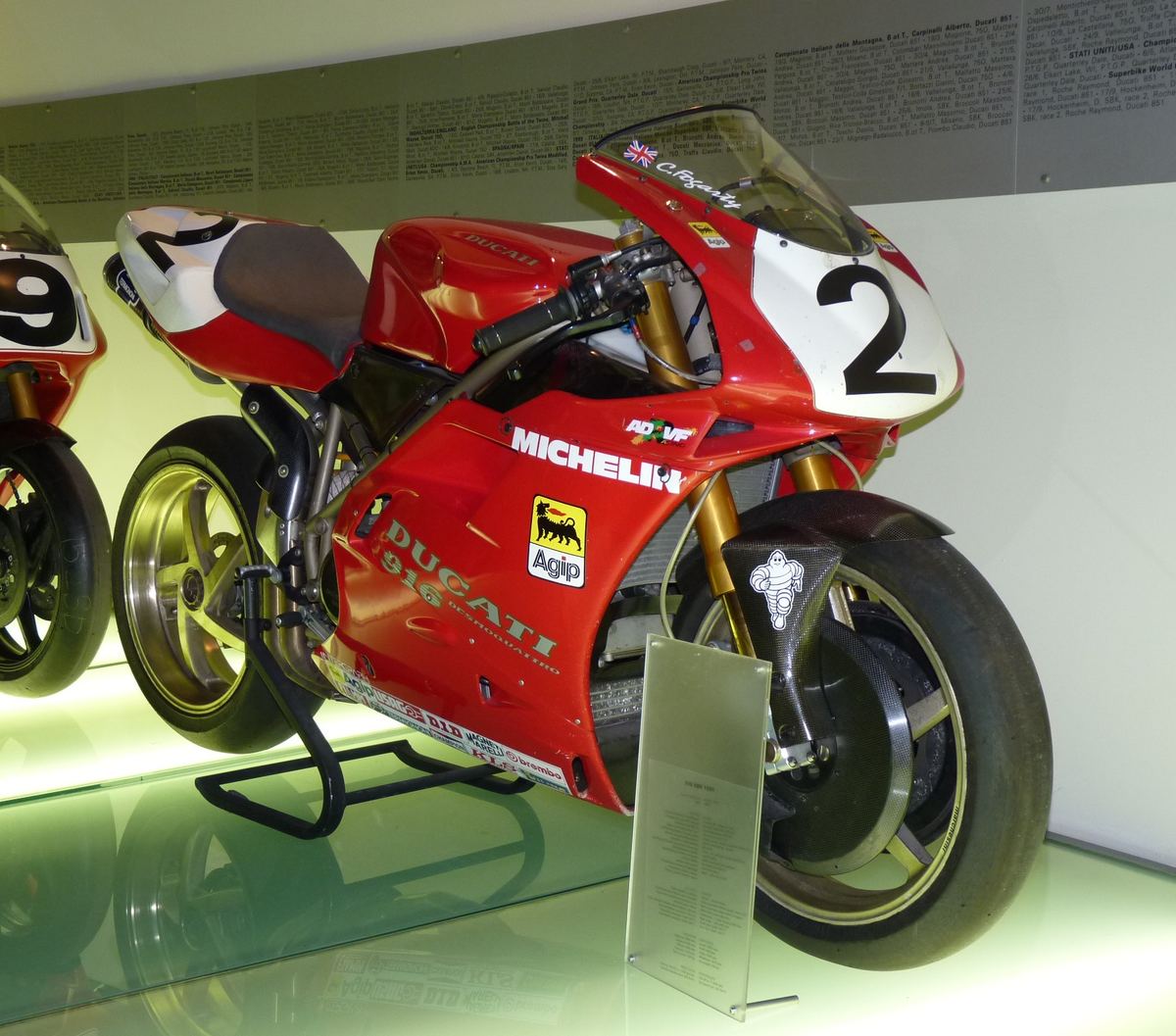
The 1995 season was even better. Fogarty won 13 races, more than half of the season, including doubles at both Brands Hatch and Donington. British fans followed him the way they followed the England football team. Britain had two World Superbike rounds a year because of him.
He was ferocious and impossible to please. He feuded with his rivals, including several of his own teammates, and used the press to rattle them. He later admitted he looked back on some of what he said and wondered why he had not just let his riding do the talking. More often than not, it worked anyway.
Honda, the return and the last two titles
At the end of 1995 Carl Fogarty walked away from Ducati. The Italian bikes were fast, but the team was disorganised and full of politics, and Honda offered to double his money. He spent 1996 on the factory Honda RC45. He won races but not the title, and he found the Japanese team too strict and too regimented for his taste. In 1997 he went back to Ducati.
His last two titles, in 1998 and 1999, were arguably his best, because the rivals and the bikes were stronger than ever. In 1998 he was struggling with back and knee injuries and made poor tyre choices, but he pulled himself together for the final rounds and won the title at the last race of the season, at Sugo in Japan.
In 1999, on the Ducati 996, he was untouchable. He scored 489 points, 128 more than the runner-up, Colin Edwards. That summer more than 120,000 people came to Brands Hatch to watch him race, the biggest crowd ever at a British motorcycle meeting.
He loved the show. Before each race at Brands he made sure he was the last rider out on the sighting lap, so that he would ride through the grid to pole position as the crowd roared, and every rival knew who owned the place.
Phillip Island 2000 and what Carl Fogarty left behind
Carl Fogarty's career ended at the second round of the 2000 season, at Phillip Island in Australia. He crashed heavily, hit his head and injured his shoulder again. He woke up in the helicopter. Specialists told him he might get back three-quarters of the movement in his shoulder, and there was nerve damage. He knew he would not come back.
He has said since that what he felt most was relief: he no longer had to prove to anyone, including himself, that he was the best.
His 59 World Superbike wins and four titles made him the most successful rider in the series' history until Jonathan Rea passed him in 2019. Fogarty also became the template for a very British route to the top. After the recession of the 1980s wiped out the expensive two-stroke Grand Prix scene in Britain, cheaper road-based superbikes became the way in for British riders, and they still are.
In 2025 he rode his 1995 title-winning Ducati 916 up the hill at the Goodwood Festival of Speed, thirty years after the season that made him a household name. He was made an MBE in 1997.
Carl Fogarty never won a 500cc Grand Prix and never won the Senior TT. He did something rarer: he made a whole country care about superbike racing.
Quick answers
How many World Superbike titles did Carl Fogarty win?
Carl Fogarty won four World Superbike titles, in 1994, 1995, 1998 and 1999, all with Ducati. He won 59 races in the series, 55 of them on Ducatis, and was the most successful World Superbike rider until Jonathan Rea passed him in 2019.
What happened in the 1992 Senior TT between Fogarty and Hislop?
In the 1992 Senior TT, Carl Fogarty on a Yamaha fought Steve Hislop on the Norton rotary for six laps. Fogarty lost by about four seconds, but set a new outright TT lap record that stood until 1999. It is still rated one of the greatest TT races.
Why did Carl Fogarty retire?
Carl Fogarty retired after a heavy crash at Phillip Island, Australia, at the second round of the 2000 World Superbike season. He suffered head and shoulder injuries and nerve damage, and doctors said he might not regain full movement in his shoulder.
What bike did Carl Fogarty win his World Superbike titles on?
Carl Fogarty won his first three World Superbike titles, in 1994, 1995 and 1998, on the Ducati 916, designed by Massimo Tamburini. He won his fourth title in 1999 on its successor, the Ducati 996.