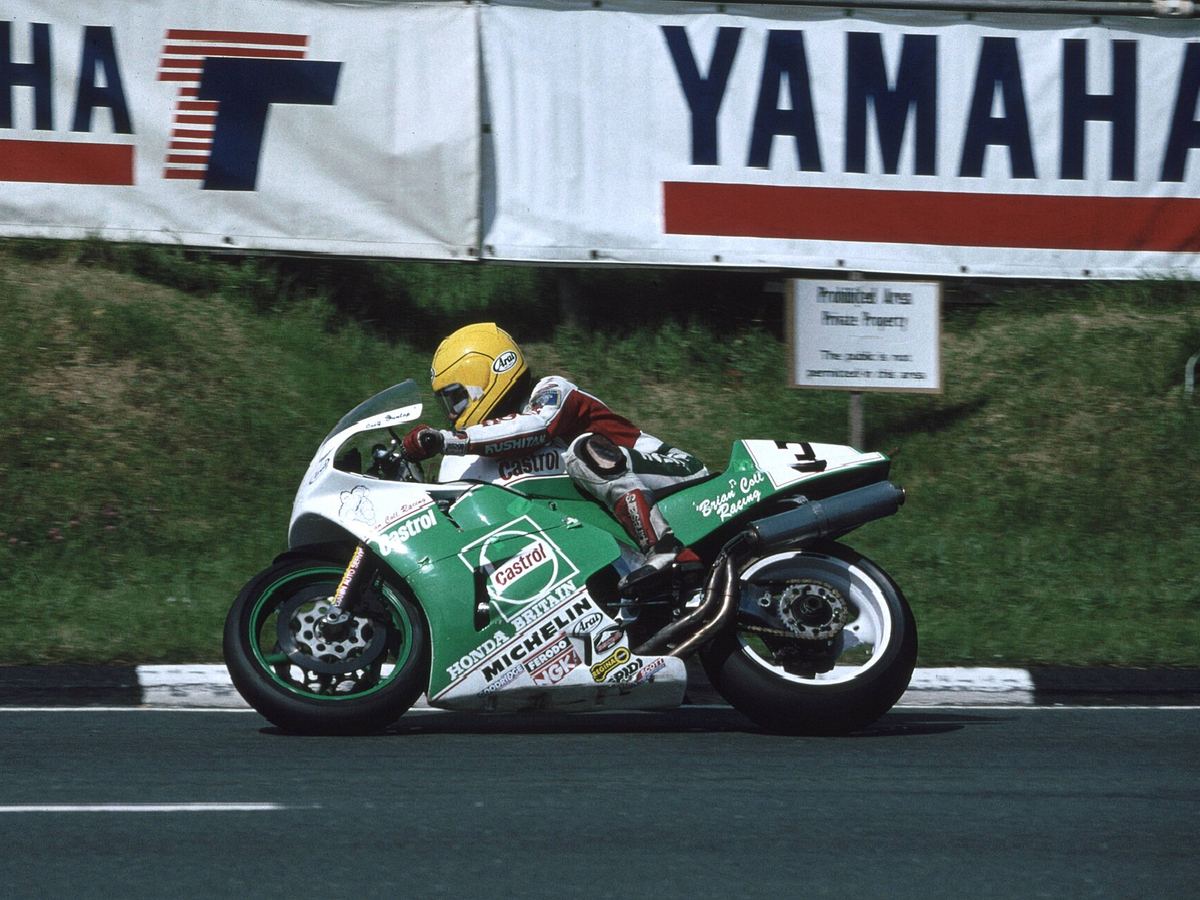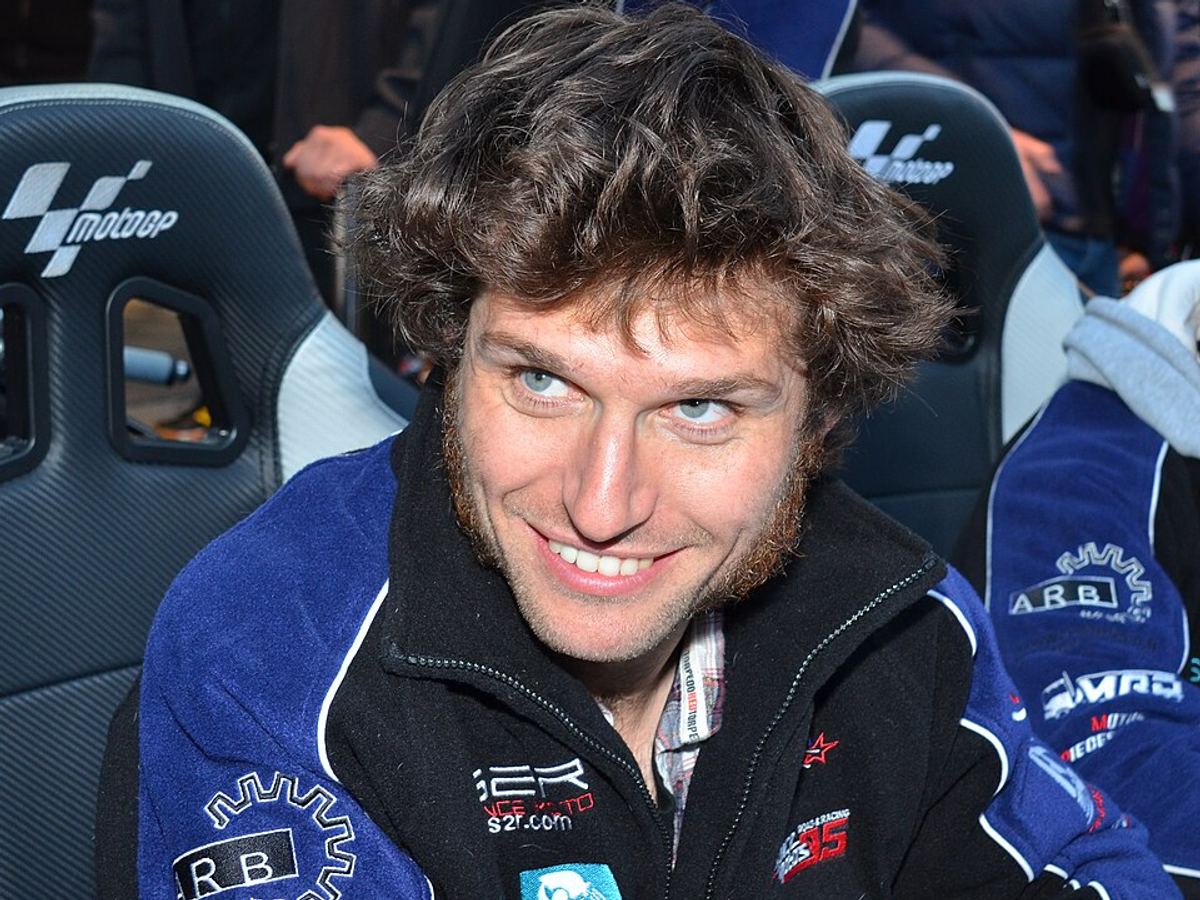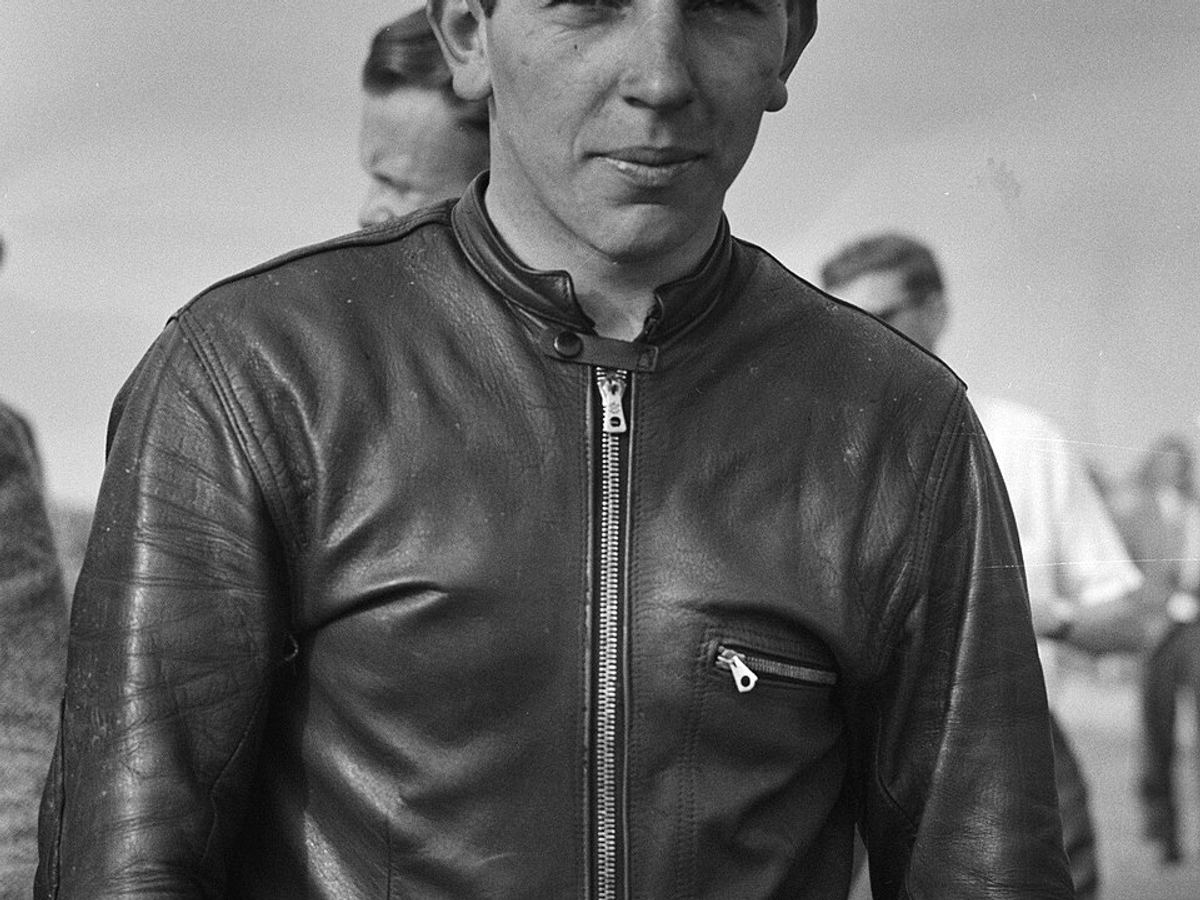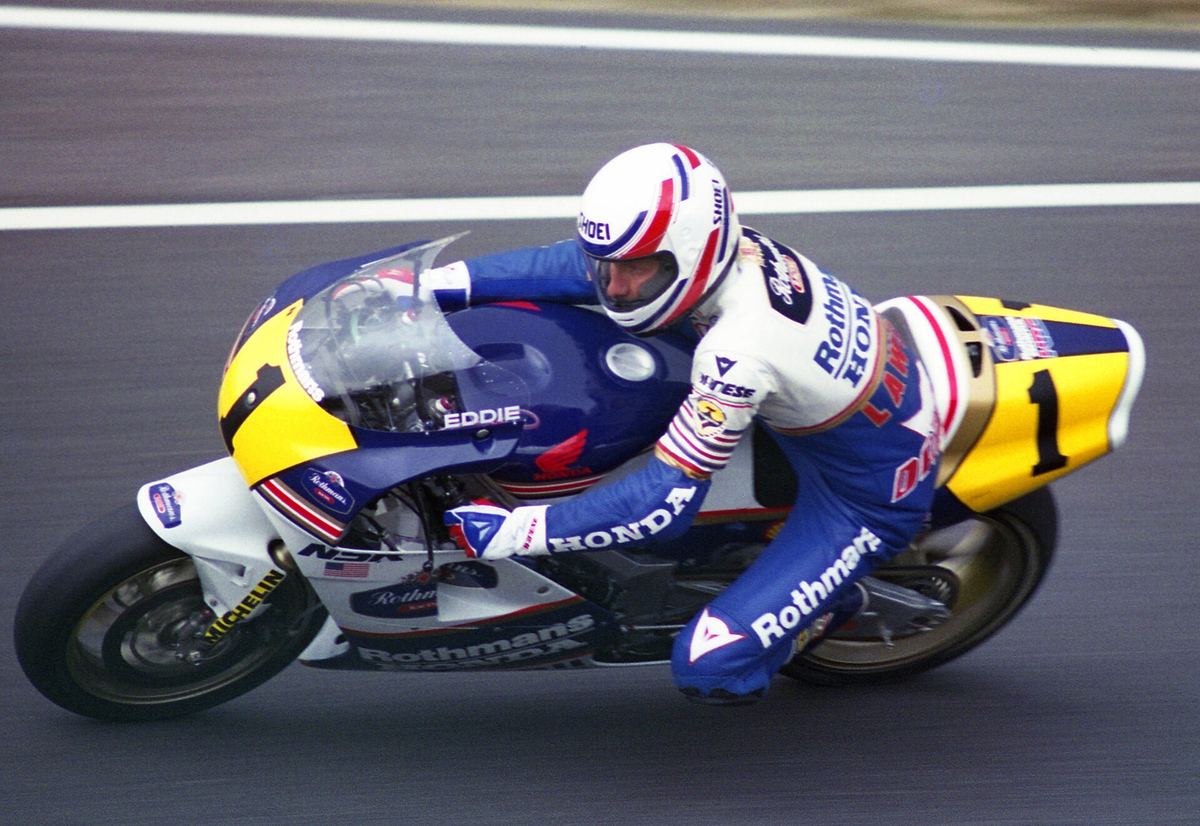
Eddie Lawson at Suzuka in March 1989, at the start of his first season on the Honda.. Photo: Rikita / Wikimedia Commons (CC BY-SA 3.0)
Hungaroring, July 1992. The 500cc Hungarian Grand Prix has been stopped after one lap because of heavy rain. On the restart grid every rider is fitting full wet tyres. Eddie Lawson, four-time world champion, 34 years old and in the last season of his career, tells his mechanic he wants to try something else.
He qualified seventh on a Cagiva, a bike that has never won a Grand Prix in twelve years of trying. If he does what everyone else does, he will finish where Cagivas always finish. So he asks for cut slicks, dry tyres with grooves hand-cut into them. His team manager, Giacomo Agostini, tells him he can't do that. Lawson, by his own account, tells Agostini where to go, and the slicks go on.
For the first part of the race it looks like a terrible mistake. The track is still soaking and Lawson drops to seventh. Then the rain stops, a dry line appears, and Lawson starts lapping up to seven seconds faster than the riders ahead.
Who Eddie Lawson was
Eddie Ray Lawson was born on 11 March 1958 in Upland, California, and grew up on the dirt tracks of Southern California. In an interview with Motorcycle.com he recalled that there were so many tracks near home that he could almost race every night of the week. One of the kids he raced against was Wayne Rainey.
Lawson moved to road racing in the late 1970s and finished second to Freddie Spencer in the 1979 AMA 250cc championship. Kawasaki then signed him. He won the AMA 250cc title in 1980 and 1981 and the AMA Superbike championship in 1981 and 1982 on a wide-handlebar Kawasaki Z1000, beating Spencer's Honda.
In 1983 Yamaha brought him to the 500cc World Championship as teammate to Kenny Roberts, in the Marlboro team run by Giacomo Agostini. Roberts was in his last season and had picked Lawson to succeed him. Lawson spent the year learning, finished fourth, and never won a race.
1984–1988: Steady Eddie and the Yamaha years
Eddie Lawson's first 500cc win came at Kyalami, South Africa, in March 1984, at the first round of the season. He won three more races that year, finished on the podium nine times in twelve rounds, and took the world title from Spencer.
He did it the way he would do most things: without fuss and without falling off. He rarely crashed and almost always scored points, and the paddock called him Steady Eddie. In public he was guarded, even grumpy. Away from the cameras, according to Motor Sport's Mat Oxley, he had a dry, dark sense of humour.
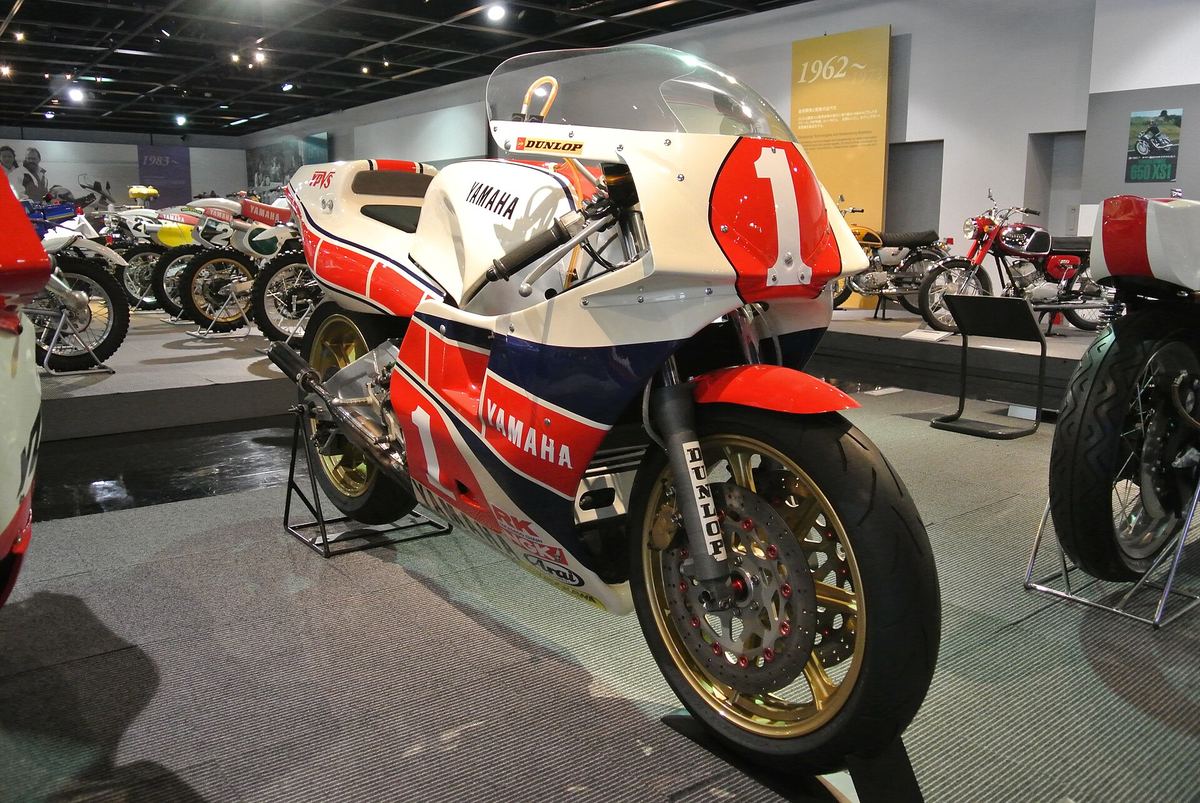
Spencer beat him in 1985, the year of the 250cc and 500cc double. In 1986 Lawson came back stronger: seven wins, seven poles and his second title. He also won the Daytona 200 that spring, giving Yamaha its first win in an AMA Superbike race. He was third in 1987, behind Wayne Gardner, then won his third title in 1988 with seven more victories.
By then Lawson had won three 500cc championships in five years. He was the best rider on the best bike in the best team. And he was about to leave.
1989: Eddie Lawson, Honda and the bike nobody wanted
At the end of 1988, Eddie Lawson and Giacomo Agostini fell out over money. Lawson later said that Agostini started hinting that the team might not be able to pay him what it had paid in 1988. Lawson, newly crowned champion for the third time, walked out.
He signed for Honda, but not for the main factory team. He joined the Rothmans Honda squad run by Erv Kanemoto, the American engineer who had won three world titles with Spencer. According to Oxley, Lawson even took a pay cut to do it. Some fans were so outraged that they called him the Antichrist.
The paddock thought he had lost his mind. Honda's NSR500 was the most feared bike in the class. Its V4 engine delivered its power in a vicious rush, and the chassis did not seem to want to turn. Wayne Gardner, Honda's 1987 champion, later called the 1988 version an evil thing. Mick Doohan, Honda's rookie, had a string of terrible crashes on the 1989 bike.
Lawson's season started badly. He broke a wrist in pre-season testing and crashed again at the second round. Then, during practice for the US Grand Prix at Laguna Seca, Kanemoto walked down to watch him through the last corners. He saw something nobody had understood: the bike was not refusing to turn; it was turning too quickly, then running wide as Lawson corrected it. Kanemoto slowed down the steering geometry overnight. In warm-up the next morning, Lawson pulled into pit lane with a verdict.
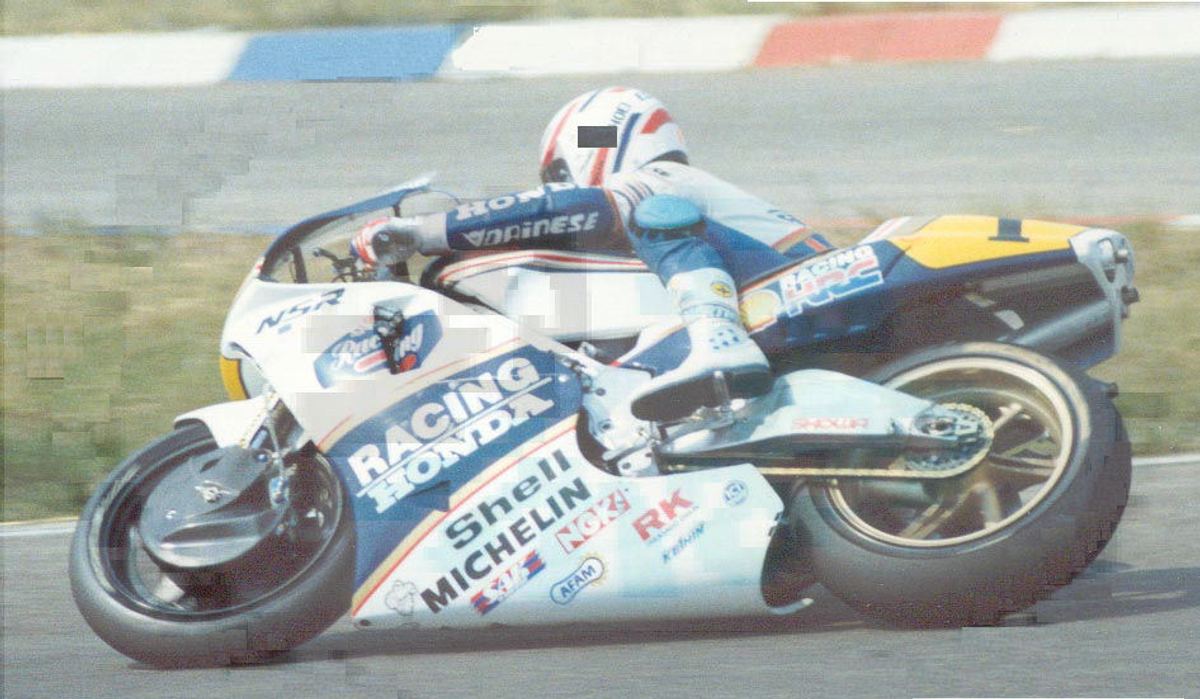
Lawson won at Jerez two races later. From then on, new parts arrived from Honda almost every race: frames, swingarms, carbon brakes, upside-down forks. Kanemoto remembers at least seven different chassis that season; Lawson has said thirteen. Kanemoto's whole team was six people.
Rainey led the championship for most of the year on his Yamaha. Lawson chipped away. He won at Le Mans from pole, then beat Rainey at Donington. At Anderstorp, the pair fought for the win until Rainey crashed, and Lawson took the points lead for the first time. He clinched the title at Goiânia, Brazil, and finished the season with 228 points to Rainey's 210.5.
Eddie Lawson was the first rider ever to win back-to-back 500cc world titles on bikes from two different manufacturers. Nobody did it again until Valentino Rossi left Honda for Yamaha in 2004.
Cagiva and the Hungaroring
Eddie Lawson and Honda could not agree terms for 1990, so he went back to Yamaha with Kenny Roberts's team. It was a difficult year: he finished seventh and won nothing. He was ready to stop. Then Cagiva, the Italian company owned by the Castiglioni brothers, made him an offer he told Cycle News he could not refuse.
The Cagiva was not a winner. Lawson said later that it had good top speed but a heavy engine with little acceleration out of corners. Over two seasons he scored podiums but no wins, until Hungary in 1992.
Once the track began to dry at the Hungaroring, Lawson's cut slicks were the perfect tyre. He passed Rainey, Kevin Schwantz and Randy Mamola, then caught the leader, Doug Chandler, whose wet tyres were destroying themselves on the drying surface. Lawson took the lead with four laps to go and kept pulling away. He won by 74.194 seconds.
It was Cagiva's first 500cc Grand Prix win, and the first in the class for an Italian bike since Agostini won on an MV Agusta at the Nürburgring in 1976. Lawson remembered afterwards that Claudio Castiglioni was beside himself with joy. Lawson, typically, called the win a gamble that happened to pay off.
He retired at the end of the season. It was his 31st Grand Prix win, and his last.
What Eddie Lawson left behind
Eddie Lawson remains the most successful American rider in Grand Prix history, with four 500cc titles and 31 wins. He is one of the very few riders to win premier-class races on bikes from three different manufacturers.
His 1989 season had an impact beyond his own career. The work Lawson and Kanemoto did that year, on chassis stiffness and on the character of the engine, put Honda on the road that led to the NSR500's domination of the 1990s. Kanemoto later told Lawson, half joking, that he had left Honda one year too early.
Lawson never chased the spotlight. He did not need to be known, he told Cycle World in 1989; he just wanted the sport to grow. He won by being precise, by telling his engineers exactly what the bike was doing, and by not falling off.
And once, on a wet Sunday in Hungary, by doing the opposite of everyone else.
Quick answers
How many 500cc world titles did Eddie Lawson win?
Eddie Lawson won four 500cc world titles: in 1984, 1986 and 1988 with Yamaha, and in 1989 with Honda. He won 31 Grands Prix and took 78 podiums between 1983 and 1992, making him the most successful American in Grand Prix history.
Why did Eddie Lawson leave Yamaha for Honda in 1989?
Eddie Lawson left Yamaha after a pay dispute with team manager Giacomo Agostini at the end of 1988. He joined Erv Kanemoto's Rothmans Honda team, reportedly on less money, and won the 1989 title on the difficult Honda NSR500.
Who was the first rider to win back-to-back titles on different bikes?
Eddie Lawson was the first rider to win back-to-back 500cc world titles on bikes from different manufacturers, with Yamaha in 1988 and Honda in 1989. Valentino Rossi was the next to do it, switching from Honda to Yamaha in 2004.
How did Eddie Lawson win the 1992 Hungarian Grand Prix?
Eddie Lawson won the 1992 Hungarian Grand Prix on a Cagiva by gambling on cut slick tyres while everyone else used wets. When the track dried, he passed the whole field and won by over 74 seconds. It was Cagiva's first 500cc Grand Prix win.